

Half the cats on the internet get called Siamese mixes. The label follows any pointed cat with blue eyes, and plenty of cats with neither. Most of those labels are guesses, because a siamese mix inherits a random slice of each parent. Some get the full Siamese look. Most get a piece of it. So what does a siamese mix look like in practice? Usually a pale body with darker points, blue or blue-ish eyes, and a leaner frame than the average house cat. The rest of this guide tests each of those clues in order.
This guide walks you through the traits that actually point toward Siamese blood: the color-point coat, blue almond eyes, a slim build, big ears, and a chatty streak. Count the features instead of chasing a pedigree. Several strong traits and you are probably living with a Siamese mix. One trait and you are probably not.
Quick conclusion up front. The color-point pattern is the single best clue, because the gene behind it is uncommon in the general cat population. A pointed cat with blue eyes and a svelte body is very likely part Siamese. But a mix can show the coat and none of the body, or the voice and none of the coat. Here is how to read each clue.
1. Color-Point Coat
Start with the coat. A Siamese mix usually shows the color-point pattern: a pale body with darker color on the face, ears, paws, and tail. The pigment responds to temperature. It develops only on the cooler parts of the body, which is why the mask and the ears go dark while the belly stays cream.
The genetics make this clue more valuable than it looks. The point-restricting allele, called cs, is recessive. A pointed kitten must inherit a copy from both parents, so two plain, unpointed cats can both carry one copy and produce a pointed kitten out of nowhere. It happens. And a pointed cat always carries two copies, which means pointed ancestry sits somewhere in the tree.
One catch. Pointed is not the same as Siamese. The Birman is pointed, the Himalayan is pointed, and so is the Ragdoll, covered in the Ragdoll mix guide. The Snowshoe, a pointed breed with white mitts, is a rarer possibility. If your cat is pointed but fluffy, with a round face, think Birman or Ragdoll instead. If it is pointed, short-haired, and sleek, Siamese is the lead suspect, and a softer, slightly darker mink version of the pattern with aqua eyes points toward the Tonkinese, the Siamese-Burmese cross.
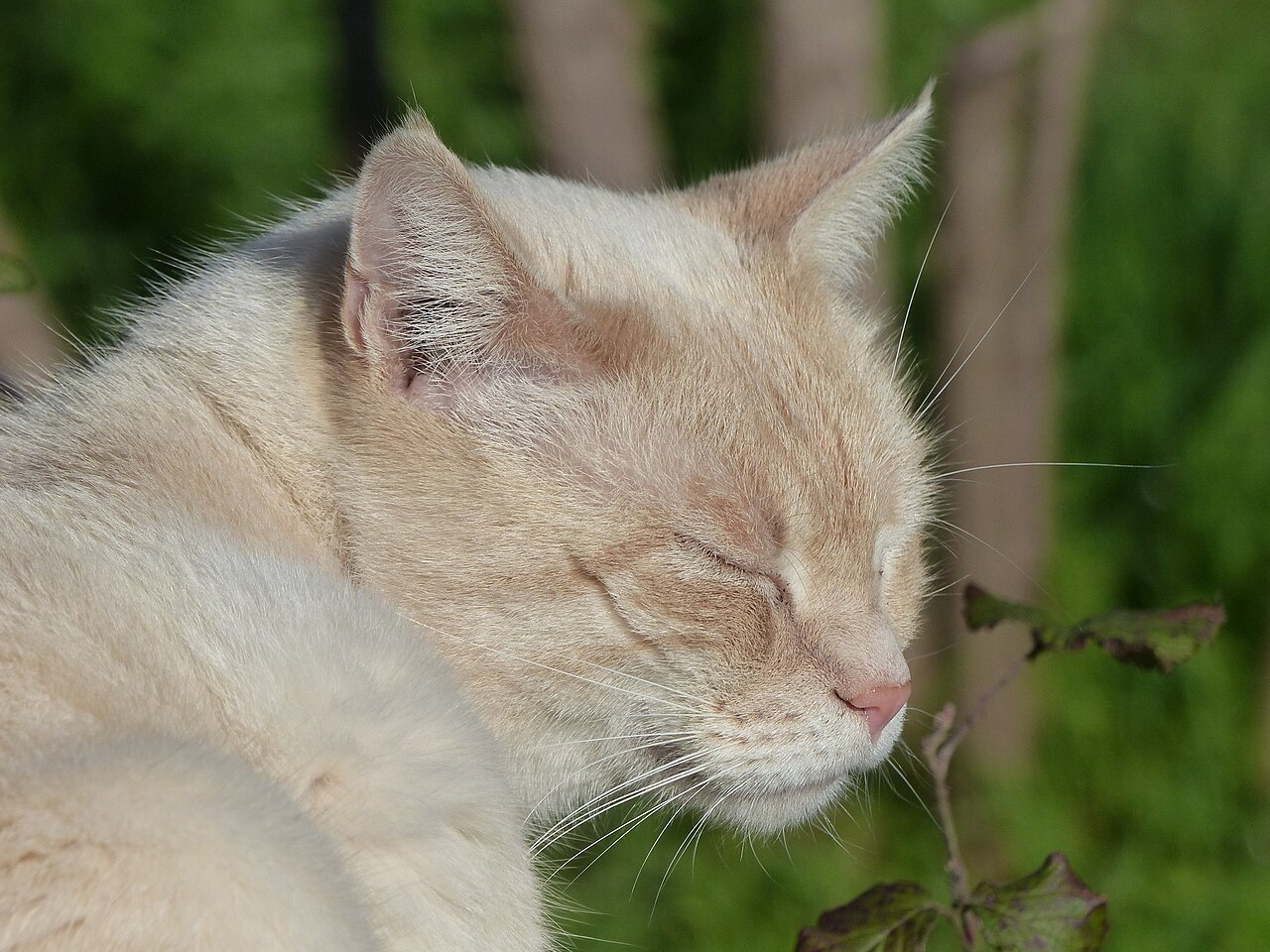
2. Blue Almond Eyes
Purebred Siamese eyes are always blue. The shade runs from pale ice blue to deep sapphire, and the shape is almond, slanting at the outer corner. In a mix, the eyes can keep the color, the shape, or neither. Many mixes end up with blue eyes and nothing else.
Blue eyes alone are a weak clue. Every kitten is born with blue eyes that shift color in the first few weeks, so a young cat tells you nothing. A white cat with blue eyes often carries a coat color gene linked to deafness. That is a white-cat package, not a Siamese clue. The Khao Manee, an ancient Thai breed, is the exception: a white cat where blue or odd eyes are the standard. The signal gets real only when the blue eyes sit in a pointed, svelte cat.
3. Slim Build and Wedge Head
The purebred Siamese is built like a question mark: long, lean, and fine-boned, with a head that narrows to a wedge. Males usually land between 8 and 12 pounds, females a little less. The whole package moves like it was drawn in one long stroke.
Mixes inherit this unevenly. A Siamese mix may have the slim frame with a rounded head, or the wedge with a stockier body. The ears are part of the tell: large, wide at the base, set to continue the triangle of the face. When head, ears, and body all agree, the mix is doing well.
4. Big Ears and the Voice
Siamese cats are famous for the voice: a loud, raspy meow that sounds like a baby arguing. The breed was shaped to talk to people, and a mix often inherits a piece of that. It may yowl at the food bowl and answer you from the other room.
Talkativeness is not a reliable test on its own. Plenty of non-Siamese cats are loud, and plenty of Siamese mixes are quiet. Treat the voice as a supporting clue. If the coat is pointed AND the cat talks, the picture gets much stronger. For the full story, the Siamese vocal guide breaks down what the meows mean.
5. Personality Clues
Owners describe Siamese cats as velcro cats with opinions. They bond hard to one person, follow that person from room to room, and insert themselves into every activity. A mix with Siamese blood often shows the same pushy affection: sleeping on your keyboard, supervising your cooking, complaining when you close a door.
Personality is the softest clue of all, because every cat is an individual. A rescued mix can be shy, aloof, and silent and still carry Siamese genes. Use the behavior to enrich the picture. Do not use it to close the case.
6. The Honest Limits of Visual ID
Visual identification ranks possibilities. It does not confirm ancestry. A pointed, blue-eyed, svelte cat is almost certainly part Siamese. A cat with a single trait is a coin flip. And a mix can look nothing like the show photos, because it inherits a random slice of each parent.
The only real verdict is a DNA test. A cheek swab kit maps the breed markers in a few weeks and costs less than a vet visit. Until then, treat any label as a best guess. The label changes nothing about the cat. It is still the same creature asleep on your pillow, whatever its ancestors were.
How to weigh the clues
| Trait | Pure Siamese | Siamese mix | Not a Siamese |
|---|---|---|---|
| Color-point coat | Always present | Common, and the strongest clue | No points, or points on a fluffy round face |
| Eyes | Vivid blue, almond shaped | Blue, almond, or neither | Any color; blue alone proves nothing |
| Body and head | Slim, long, wedge head | Some parts, not all | Stocky build, round head |
| Voice and personality | Chatty, people-bonded | Maybe, not guaranteed | Quiet or loud; behavior alone proves nothing |
The honest summary: a pointed coat, blue eyes, and a slim build together are a strong Siamese signal. One trait is a maybe. Neither label changes the cat, so enjoy it either way. For the full picture, read the Siamese breed profile. For the soundtrack, the Siamese vocal guide explains the meows. Work through the cat breed identification guide feature by feature, or run a photo through our cat breed identifier.
Related breeds
All breedsKeep reading
All articlesIdentification
How to Identify a Mixed Breed Cat: 7 Mixes
Identify your mixed breed cat: Birman, Turkish Angora, Abyssinian, Maine Coon, Siamese, and Ragdoll mixes. What each looks like and how to count clues.
9 min read
Identification
Cats That Look Like Bengals: 5 Breeds Compared
Egyptian Mau, Ocicat, or Savannah? Compare 5 breeds that mimic Bengal rosettes, build, and wild expression, with photos and trait checklists.
6 min read
Identification
Cats That Look Like Russian Blues
Chartreux, British Shorthair, or Korat? Compare the 4 blue-gray breeds confused with Russian Blues: eye color, coat sheen, body type, and temperament.
5 min read
Still not sure what your cat is?
Stop guessing from photos and text. Upload one clear photo and the AI checks 40+ visual markers in seconds. Free, no sign-up, and your photo is never stored.
Free cat breed scan