

Most Ragdoll mixes never had a Ragdoll parent that anyone can prove. The label gets attached to any big, fluffy, blue-eyed cat with a pointed face. That is how "is my cat a ragdoll mix" became one of the most common questions in cat rescue, and it deserves a straight answer.
Here is the honest framing. Ragdoll mix identification is about counting features, not confirming a pedigree. Pure Ragdolls are rare and almost always come with registration papers. The real question is not "is my cat purebred?" It is "how many strong Ragdoll traits does my cat show?" The breed was built from a short list of dramatic traits: color-point pattern, deep blue eyes, a silky semi-long coat, heavy bones, and a famously relaxed temperament.
Quick conclusion up front. A cat with several strong traits, pointed pattern, deep blue eyes, a big frame, and a floppy response in your arms, is probably part Ragdoll. A cat with one trait, usually just the fluff, is probably not. And a Ragdoll mix can look nothing like the show photos, because mixes inherit a random slice of each parent.
1. Color-Point Pattern
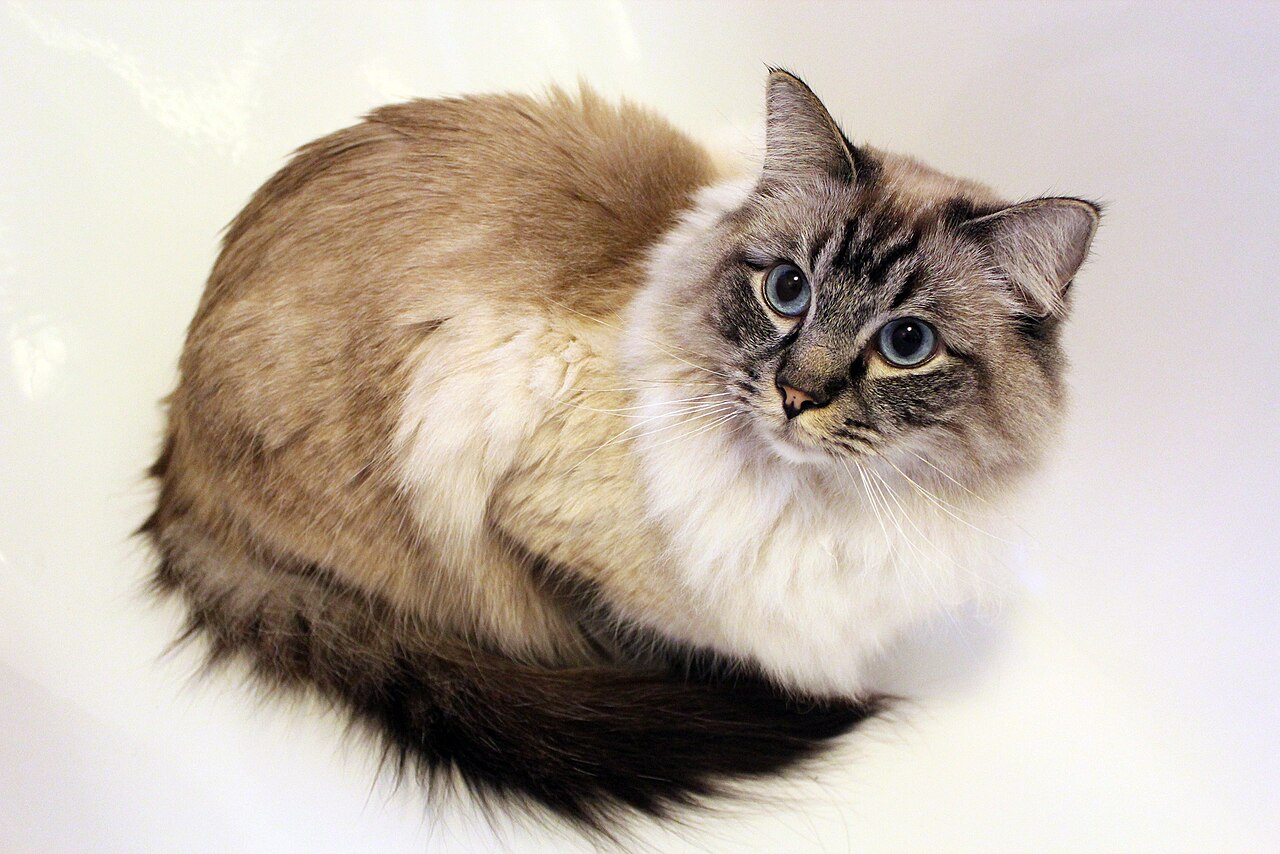
The color-point pattern is the strongest single clue. The body stays pale cream, while the ears, face, paws, and tail carry the darker color: seal, blue, chocolate, or lilac. Ragdolls come in three versions: colorpoint, mitted with white paws, and bicolor with a white V on the face.
Here is what makes the pattern valuable. Pointed coloring comes from a recessive gene, so it does not appear by accident in random-bred cats. A pointed cat almost always has a pointed breed somewhere in the family tree. The shortlist is Siamese, Birman, Himalayan, and Ragdoll. A pointed pattern gets you into the right neighborhood fast.
But the pattern alone does not separate those breeds. The Birman carries white gloves on all four feet, a detail no Ragdoll has. The Siamese is short-haired with a whip-thin body. The Ragdoll is the big, fluffy, longhaired member of the group. Use pattern as the entry, then let body and coat pick among the four.
2. Deep Blue Eyes
Every Ragdoll has blue eyes, and not a washed-out gray-blue. The standard calls for deep, vivid sapphire, the kind that reads blue from across the room. If your cat has green, gold, or copper eyes, it does not meet the Ragdoll bar.
Now the trap. Blue eyes are a weak clue on their own. Kittens of every breed start with blue eyes that change color by eight weeks, so a blue-eyed kitten tells you almost nothing. Adult blue eyes also show up in Siamese, Balinese, Javanese, and some white cats. A blue-eyed cat with no pointed pattern is probably not a Ragdoll mix.
3. The Floppy Temperament
The breed name comes from a party trick. Pick up a Ragdoll and it relaxes completely, going limp like a rag doll in your arms. Breeders selected for this response for decades. It is real, and it is the one trait here that has nothing to do with looks.
The catch is that the floppy response is highly individual. Some Ragdoll mixes flop, some stay tense, and plenty of non-Ragdoll cats melt into your arms because they like being held. A floppy cat is a nice hint. A floppy cat with pointed coloring and blue eyes is a much better hint. Use temperament to confirm the body, not replace it.
4. Size and Bone
Ragdolls are big cats. Breed standards put males at 15 to 20 pounds and females at 10 to 15, with heavy boning and a broad chest. They also grow slowly, hitting full size at three to four years. A Ragdoll mix is often a large, heavy cat, but size is not guaranteed. Mixes can land at a normal 9 pounds and still carry the face and coat.
So treat size as a supporting clue. A big, pointed, blue-eyed cat fits the picture. A small pointed cat does not rule the breed out. Weight alone proves nothing.
5. Coat and Texture
The Ragdoll coat is semi-long and famously silky, with a soft, rabbit-like texture and no dense undercoat. Many fluffy breeds, Maine Coons and Siberians included, carry a thick double coat that mats easily. The Ragdoll coat lies closer to the body, parts down the back, and resists matting. A ruff frames the neck, and the tail carries a full plume.
Fluff, as always, is the weakest evidence. Random-bred cats grow long fur all by themselves, and half the "Ragdoll mixes" in shelters are fluffy domestic cats with a generous label, or occasionally a Ragamuffin, a separate large, fluffy breed with a sweeter face. The silkiness and the single coat are worth checking, because they are harder to fake than plain length.
6. The Honest Limits of Visual ID
Say it plainly: visual identification cannot confirm a Ragdoll mix. Shelters guess, vets guess, and experienced cat people guess. Everyone works from the same feature list, and everyone can be wrong. Only a DNA test gives a real answer, and even it reports percentages, not a certificate.
What the visual method can do is rank the possibilities. Count strong traits. Pointed pattern, blue eyes, big frame, floppy response: three or more, and "Ragdoll mix" is a fair description. One trait, usually just the fluff or just the eyes, and "domestic longhair" is the more honest label. Here is the comparison at a glance.
Pure Ragdoll vs. mix vs. not one
| Trait | Pure Ragdoll | Ragdoll mix | Not a Ragdoll |
|---|---|---|---|
| Color-point | Pointed, with mitts or a white V | Often pointed, pattern can be partial | Solid, tabby, or other pattern |
| Eyes | Deep blue, required | Often blue, can be another color | Green, gold, or copper |
| Size and bone | Males 15-20 lbs, heavy bone | Often big, can be a normal 9-10 lbs | Usually under 12 lbs, light bone |
| Temperament | Goes limp when held | Sometimes floppy, often just friendly | Normal cat behavior |
So what do you do with the answer? Keep it honest. Three or more strong features, and "Ragdoll mix" is a fair claim. One feature, especially just the fluff, and you have a lovely domestic longhair. Neither label changes the cat. It is the same animal either way, with the same quirks and lap preferences.
Want to dig deeper? Read the full Ragdoll breed profile, work through the cat breed identification guide, or run a photo through our cat breed identifier to see which features the algorithm picks up. The more features you can name, the better your guess gets.
Related breeds
All breedsKeep reading
All articlesIdentification
How to Identify a Mixed Breed Cat: 7 Mixes
Identify your mixed breed cat: Birman, Turkish Angora, Abyssinian, Maine Coon, Siamese, and Ragdoll mixes. What each looks like and how to count clues.
9 min read
Identification
Cats That Look Like Bengals: 5 Breeds Compared
Egyptian Mau, Ocicat, or Savannah? Compare 5 breeds that mimic Bengal rosettes, build, and wild expression, with photos and trait checklists.
6 min read
Identification
Cats That Look Like Russian Blues
Chartreux, British Shorthair, or Korat? Compare the 4 blue-gray breeds confused with Russian Blues: eye color, coat sheen, body type, and temperament.
5 min read
Still not sure what your cat is?
Stop guessing from photos and text. Upload one clear photo and the AI checks 40+ visual markers in seconds. Free, no sign-up, and your photo is never stored.
Free cat breed scan