

Verify your cat's breed from a photo
One clear photo runs a free quality check, then unlocks the full AI report for a one-time €5.99: breed verdict, why-likely reasoning, 40+ visual markers, health notes, and follow-up questions. No subscription, and your photo is never stored.
Find the biggest mark on your cat's shoulder and look at its center. A dark ring wrapped around a lighter, tawny middle is a rosette, and that detail narrows the field faster than any other check here. A solid stripe or a plain dot leaves Bengal blood possible. The evidence just starts weaker.
Most cats called Bengal mixes have no documented Bengal parent. A purebred comes with papers or a DNA result. A mix comes with a random slice of each parent, so one cat inherits the coat and an ordinary body, and the next inherits the frame and a striped coat.
Count clues instead of chasing a pedigree. Two-tone rosettes, gold glitter, a pelt-like coat, a long frame, a small head with wide-set eyes, a cat that climbs everything and plays in the sink. Three or more strong ones and "Bengal mix" is a fair description. One, and it is usually the spots.
1. Two-Tone Rosettes
A rosette is a ring, not a spot. The center stays lighter, the rim goes dark, and the shape is irregular rather than round. On a Bengal the rosettes sit in high contrast against the ground color and scatter across the flank and shoulder.
This clue is worth trusting because the pattern is hard to produce by accident. Random-bred tabbies build their coats from stripes, and a broken stripe reads as a solid dot. A ring around a lighter center takes generations of selection.
Check in daylight without a flash. Flash flattens the contrast between ring and center, and indoor light hides it on a brown coat. On a mix the rosettes often fade to ghost markings that show only in sun, or appear on one side and dissolve into stripes over the shoulders. One clear ring beats ten solid spots.
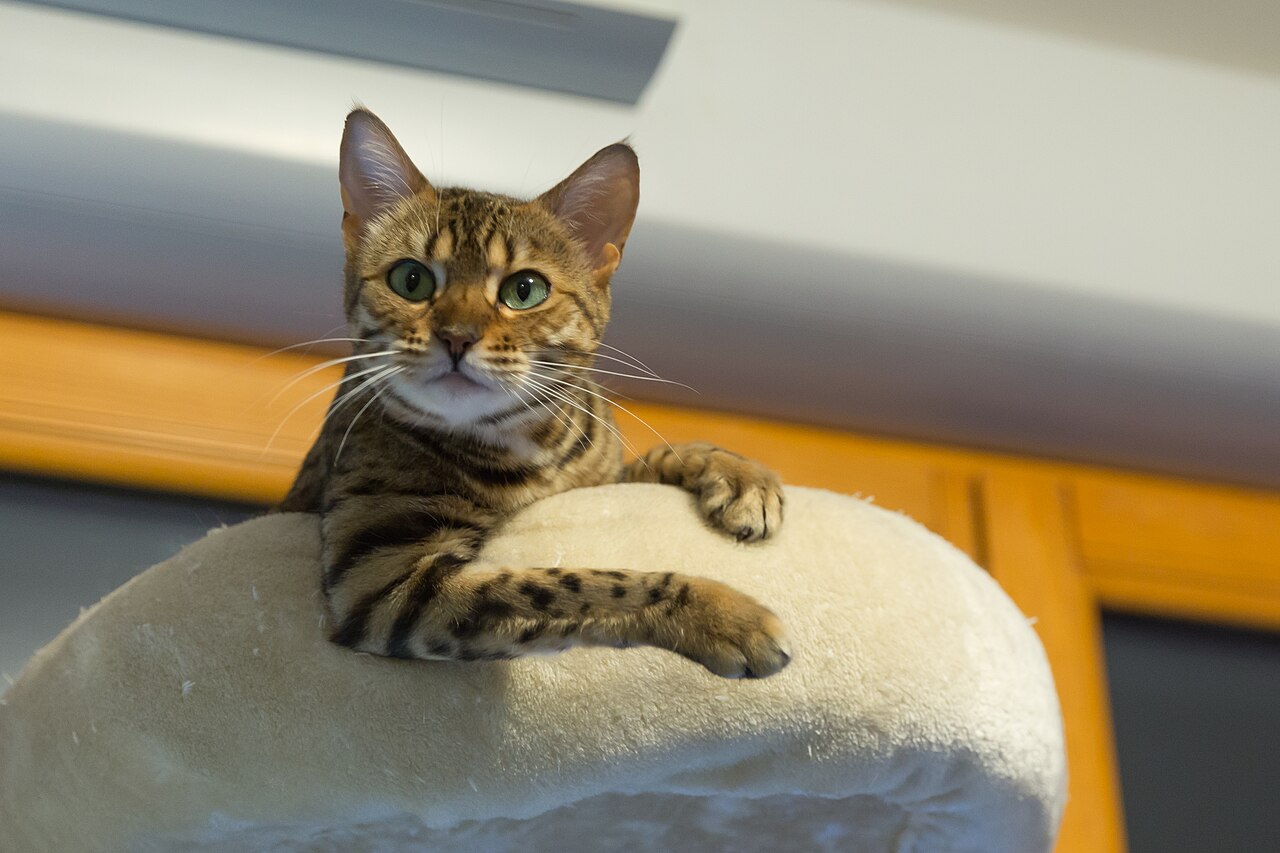
2. Glitter in the Coat
Glitter is a fine gold sparkle in the coat, the kind that reads as dust in bright light. The Bengal's ground color often shimmers with it, and most lookalikes have none.
Not every Bengal carries it, though, and a mix can lose it entirely. Presence supports the case, absence proves nothing.
Test it in the garden or by a sunny window, light behind you, camera level with the coat, flash off. Flash puts a white glare on any cat and buries the flecks you want.
3. Marbled Swirls Instead of Spots
Not every Bengal is spotted. The breed's other pattern is marbled, where the markings stretch into wide swirls instead of discrete spots, in the same high contrast against the ground color.
A brown tabby carries a bullseye on each flank, a symmetrical target of concentric rings, plus a vertical stripe over each shoulder. Marbled Bengals have neither. Their swirls are uneven and change direction along the body.
On a mix, marbling arrives in pieces: one clear swirl over the hip, mackerel stripes everywhere else. That mixture is normal, and a cat with no swirls at all can still be a Bengal mix.
4. A Long, Muscular Frame
A pet Bengal usually weighs 8 to 15 pounds on a frame longer than it is tall, with a deep chest, heavy shoulders, and loaded hindquarters. Pick one up and it feels denser than it looks.
Watch the cat move. Bengals stand tall on their legs and launch onto a counter from a sitting position without a run-up. That vertical jump is a test you can run at home with a treat.
Size is the least reliable part of the package. A mix can land at 9 pounds, keep the coat and the head, and take its body from the other parent.
5. Small Head, Wide-Set Eyes, Rounded Ears
The Bengal head is small and rounded for the size of the body, one of the wild-cat proportions the breed kept. The eyes sit wide apart. The ears are large, with a broad base and rounded tips, set wide on the skull rather than tall and pointed.
Two comparisons settle most cases. The Ocicat has a longer wedge with a visible stop at the brow and a squarer muzzle. The Egyptian Mau has a gentler profile and the scarab M on the forehead. The Bengal head reads round and soft beside either one.
Mixes keep this cluster unevenly. Wide-set eyes and a broad ear base survive; the small skull often gets lost to a larger parent.
6. A Short Coat With Pelt Texture
A Bengal coat is short and dense, close to the body but with enough substance to feel like a pelt rather than a flat layer of fur. A weekly brush with a rubber mitt keeps it glossy, and it dries fast after a splash in the sink.
Length proves nothing, since most cats have short hair. The density is the test. A domestic shorthair coat feels looser, with individual hairs you can ruffle. The Bengal coat reads as one surface, and it sheds lightly all year.
A mix can inherit the density without the pattern, or the pattern on a looser coat. Texture supports the case. It does not carry it.
7. High Energy and a Taste for Water
Bengals climb, solve puzzle feeders, and learn to open cabinets. An adult needs at least 30 minutes of interactive play a day plus vertical space, or the energy comes out on your curtains.
Water surprises new owners. Many Bengals paw at a running tap, drink from a fountain, follow people into the shower, and sit in an empty sink waiting for it to be turned on.
The voice sits in the same category: chirps and trills rather than long yowls. Behavior is the weakest evidence, because a quiet, lazy Bengal mix exists. Use it to support the body, not to replace it.
Bengal Mix vs the Lookalikes
Four cats get called Bengal mixes more than any others. One feature settles each comparison faster than a full-body assessment.
Brown tabby domestic shorthair
The common confusion, and the easiest to settle. A brown tabby's stripes meet over the spine in a bullseye, an open bar of dark fur on a lighter ground. A rosette is a closed ring. Look at the largest mark on the flank: if the dark edge does not wrap all the way around, it is a tabby bar.
Ocicat
An Ocicat has spots, and they are solid. The signature is a row of thumbprint-shaped spots down the spine, dark all the way through, with no lighter center. Add a rounder muzzle with a visible stop and an entirely domestic family tree.
Egyptian Mau
The Mau is the only naturally spotted domestic breed, and its spots are small, random, and solid. The give-away sits on the forehead: a scarab-shaped M of dark lines that Bengals do not carry. Mau eyes are gooseberry green, and the coat has no glitter.
Toyger
Toygers were bred to look like tigers, so they carry vertical broken stripes on a bright orange ground, not rosettes. The face has a circular arrangement of markings with temple lines, a pattern no other domestic breed shows.
Bengal vs Bengal mix vs the lookalikes
| Trait | Pure Bengal | Bengal mix | Lookalike |
|---|---|---|---|
| Coat pattern | Rosettes or marbled swirls | Often rosettes, can be stripes or spots | Bullseye, solid spots, or vertical stripes |
| Glitter | Common, not universal | Sometimes, easy to lose | Absent |
| Frame | 8 to 15 lbs, long and heavy-shouldered | Can be 9 lbs with the coat intact | Cobby, or fine-boned and rangy |
| Head | Small rounded head, wide-set eyes | Often the eyes and ears, not the skull | Longer wedge with a stop, or the scarab M |
| Coat texture | Short, dense, pelt-like | Usually dense, can be soft and loose | Softer, flatter, more individual hairs |
What the Clues Cannot Tell You
Visual identification ranks possibilities. It does not confirm ancestry. Shelters guess, and so do vets, working from the same feature list. A DNA swab is the only test that returns a number, and even that number is a percentage rather than a certificate.
Mixes also carry more than two breeds. A cat labeled a Bengal mix may have Bengal, tabby, and Siamese input three generations back and show one trait from each. Two rosettes and a pelt coat make a stronger case than one dramatic spot.
The wild ancestry deserves a plain answer. The Bengal descends from crosses between domestic cats and the Asian leopard cat. The early hybrid generations, F1 through F3, can carry restrictions in some states and countries. Most pet Bengals are F4 or later and are domestic cats in behavior and legal status. A shelter mix sits further out still. The wild look is a coat and a body type, not a temperament problem.
None of this changes the cat on your couch. Three strong clues and no papers is a Bengal mix in the everyday sense. One clue is a domestic shorthair with a handsome coat.
Want a second opinion on the pattern? Upload a clear profile photo to our cat breed identifier. It reads 40+ visual markers, including rosette structure, glitter, ear set, and body proportion, then ranks the likely breeds. The photo quality check costs nothing, and the full report is a one-time €5.99.
For the breed itself, read the Bengal breed profile. For kitten prices and which generations carry a premium, see Bengal cat prices. If you suspect another spotted breed, the cats similar to Bengal comparison covers five lookalikes, and how to identify a mix cat breed walks through the method.
Frequently Asked Questions
Is my cat a Bengal mix?
Count the clues. Two-tone rosettes, gold glitter, a pelt coat, a long frame, a small head with wide-set eyes, and high energy with water play. Three or more strong traits make "Bengal mix" a fair label. One, usually the spots, is not enough, because spotted tabbies are common.
How can I tell a Bengal mix from a spotted tabby?
Look at one mark. A rosette is a dark ring around a lighter center. A tabby spot is solid all the way through, and a tabby bar is an open stripe. Glitter and a longer, heavier frame support the Bengal case.
How much does a Bengal mix cost?
Adoption is the usual route, and shelter fees run about $75 to $300. A breeder sells pet-quality Bengals at $1,500 to $3,000, so a purebred price for a "Bengal mix" is a label, not a cat.
Is the identification free?
The photo quality check is free. The full report, with the breed verdict, the reasoning, and 40+ visual markers, is a one-time €5.99. No sign-up is needed.
Are Bengal mixes wild or dangerous?
No. The Asian leopard cat ancestry makes the first three hybrid generations a regulated category in some places. Most pet Bengals are F4 or later and behave like domestic cats. A mix several generations out carries even less of that ancestry.
Related breeds
All breedsKeep reading
All articlesIdentification
Cats Similar to Bengals: 5 Breeds, One Clear Tell
Egyptian Mau, Ocicat, or Savannah? Compare 5 breeds that mimic Bengal rosettes, build, and wild expression, with photos and trait checklists.
6 min read
Identification
How to Tell a Russian Blue Mix: 6 Clues, With Photos
A Russian Blue mix keeps the blue-gray coat, often the silver sheen, and green eyes in an adult. Six clues ranked, plus the gray lookalikes.
7 min read
Identification
How to Tell a Norwegian Forest Cat Mix: 7 Clues, Ranked
A Norwegian Forest Cat mix shows a two-layer coat, a heavy frame, and a straight nose on a triangular head. 7 clues, ranked by how much they prove.
8 min read
Still not sure what your cat is?
Stop guessing from photos and text. Upload one clear photo and the AI checks 40+ visual markers in seconds. The quality check is free; the full AI report is €5.99, one-time. Your photo is never stored.
Scan your cat's photo