

Verify your cat's breed from a photo
One clear photo runs a free quality check, then unlocks the full AI report for a one-time €5.99: breed verdict, why-likely reasoning, 40+ visual markers, health notes, and follow-up questions. No subscription, and your photo is never stored.
There is a gray cat on your lap and a question in your head. Is this a Russian Blue mix, or just a gray cat? You have probably compared it to a photo online and found the match close but not exact. That gap is normal. Most cats called Russian Blue mixes have no papers and no documented parent.
So drop the pedigree question and ask a smaller one. How many Russian Blue markers does this cat actually carry? The list is short: a blue-gray double coat with silver tipping, vivid green eyes in an adult, a fine-boned elongated frame, a quiet voice, and a reserved manner with strangers. Count them one at a time and the picture sharpens. The Russian Blue breed profile has the full standard.
Quick verdict before the details. A gray cat with the silver sheen, adult green eyes, and a long lean body is very likely part Russian Blue. A gray cat with flat matte fur, copper eyes, and a round face is a British Blue or a domestic shorthair. Neither answer changes the cat. It changes what you call it, and what you pay.
1. Blue-Gray Coat With Silver Tipping
Start with the fur. A Russian Blue is not a gray cat with a gray cat's coat. The undercoat is dense, each guard hair carries a silver tip, and the coat stands away from the body instead of lying flat. CFA calls it short, dense, fine, and plush.
Put a hand on the cat and push the fur the wrong way. A Russian Blue coat springs back and feels like velvet or thick silk. A domestic shorthair's coat feels flat and close to the skin, and it stays where you push it.
The silver tipping is where mixes usually lose the trait. Plenty of gray cats keep the color and drop the glow. Near a window, a tipped coat throws a pale halo along the spine and tail. A matte coat swallows the light and looks like flat paint.
Then check the layers. Part the fur along the back. A soft downy undercoat beneath longer guard hairs means a double coat, the Russian Blue arrangement. One flat layer points elsewhere, and the Korat is the usual suspect.
2. Emerald Green Eyes in an Adult
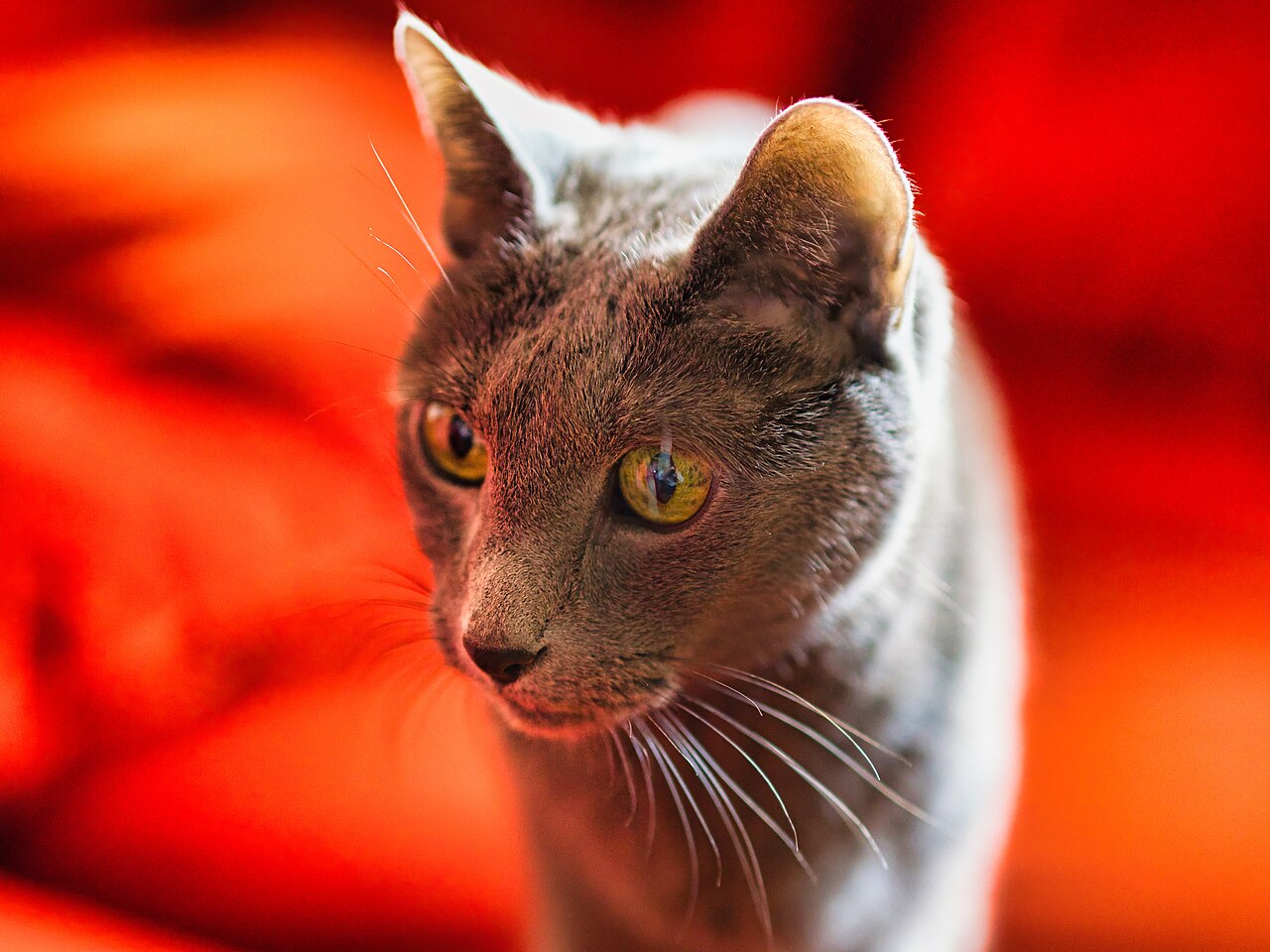
Adult Russian Blues have vivid green eyes, almond shaped and set wide. Not yellow-green, not hazel. Emerald is the word the standard uses, and the color reads across a room.
Age decides whether the color means anything. Kittens are born with yellow eyes, and the green arrives at about four months. A twelve-week-old gray kitten with yellow eyes is not evidence against the breed. An adult with those same yellow eyes is.
Copper rules the breed out. The British Blue has copper or gold eyes, the Chartreux has orange or copper, and neither produces green. Eye color separates the three blue-gray cats faster than coat texture or build. Green eyes alone prove little, since random-bred gray cats carry them too.
3. A Fine-Boned, Elongated Frame
Russian Blues are medium cats, 7 to 12 pounds, built long and lean rather than round. The neck and legs are long, the paws small and oval, and the body carries muscle without bulk. CFA calls the type foreign, which is breeder shorthand for a body stretched out of the cobby mold.
The silhouette runs longer than it is tall, with a tapering tail and a head that narrows into a wedge on a flat skull. In profile the nose goes long and straight, with a gentle break at eye level. Prominent whisker pads give the face its smile.
Mixes keep the length and lose the refinement, or the other way around. A 14-pound gray cat with a broad chest and short legs is not carrying Russian Blue bone. A 9-pound cat that looks stretched, with a long neck and a narrow muzzle, is the better candidate. Weight alone settles nothing.
4. A Quiet Voice
The Russian Blue is a quiet cat. It meows rarely and softly, and most of its signaling runs through body language, eye contact, and head bumps. Owners describe one chirp at dinner and silence the rest of the day.
The test takes an evening. A cat that yowls at closed doors, answers you from another room, or narrates every trip to the kitchen is not showing Russian Blue vocal habits. A cat that asks once and then settles fits the pattern.
Quiet is weak evidence. Quiet cats exist everywhere, and a noisy house can teach a reserved cat to talk. What the voice does well is eliminate the loud breeds. If your gray cat argues all day, look at Siamese and Oriental lines first.
5. Reserved With Strangers, Devoted at Home
The breed runs two personalities in one cat. Strangers get distance: the cat vanishes at the doorbell, then reappears to inspect from behind a chair. Family gets the other version, a shadow that follows from room to room, sleeps under the covers, and asks for cheek rubs on its schedule.
Change is the stress trigger. Renovation noise, new furniture, a boarding stay, a crowded multi-cat house: all land hard. Research places the Russian Blue among the least adaptable cats for those situations.
A mix inherits a slice of this and drops the rest. Shy with guests and glued to one person is a good sign. A cat that greets every visitor and sleeps through a party is not showing Russian Blue temperament, whatever its coat looks like. Behavior is the softest clue, since history matters as much as genetics.
6. The Honest Limits of Visual ID
No photograph confirms a Russian Blue mix. Shelters guess, vets guess, and breed-savvy owners guess. A DNA test is the only method that reports ancestry, and it reports percentages rather than a certificate.
What visual scoring does well is rank the possibilities. Three or more strong markers, meaning the silver-tipped coat, adult green eyes, a lean frame, and a quiet manner, make Russian Blue mix a fair description. One marker, usually just the gray color, makes domestic shorthair the more honest label. The mix breed identification guide walks the same method through other breeds.
Papers separate a $200 adoption from a $2,500 purchase, and nothing else does.
The Four Gray Cats That Get Mislabeled
Four cats account for most false Russian Blue labels. Coat color gets them in the door. One structural difference per cat gets them back out. The blue-gray lookalike comparison has the detail.
Chartreux. The closest lookalike and the easiest to rule out. Rounder, fuller face, shorter nose, cobby body. The eyes are orange or copper, never green. The coat is thick and woolly, like lamb's wool rather than velvet, and the cat runs 7 to 17 pounds.
Korat. This one survives the coat test and the eye test, so the head settles it. From the front the Korat head forms a heart, wide across the brow and narrowing to a rounded muzzle. The Russian Blue narrows into a wedge. The Korat coat is single, with no undercoat, and the cat is smaller at 6 to 10 pounds.
British Blue. A heavy, round cat. Broad chest, short legs, full cheeks, copper or gold eyes, and a dense plush coat that feels like sheepskin. It runs 9 to 18 pounds and sits like a loaf. Nothing about the silhouette is elongated.
Plain gray domestic shorthair. Most cats land here. Flat matte coat, any eye color, ordinary proportions, and a head that is neither wedge nor heart. No silver banding, no long lean frame, no papers. This is the answer more often than any breed label.
Pure Russian Blue vs. mix vs. not one
| Trait | Pure Russian Blue | Russian Blue mix | Not a Russian Blue |
|---|---|---|---|
| Coat | Silver-tipped double, stands off body | Blue-gray, sheen often lost | Flat matte gray, lies close |
| Eyes | Vivid green, almond, wide set | Green or yellow-green, sometimes amber | Copper, gold, or orange |
| Frame | Fine bone, 7-12 lbs, long and lean | Mixed build, often heavier | Cobby or ordinary, round face |
| Voice | Quiet, rarely meows | Often quiet, not reliable | Loud or chatty is common |
What a Mix Actually Inherits
Mixed parentage deals a random hand. A kitten takes half its genes from each parent, and coat, eye color, body type, and temperament sort independently. One mix gets silver fur, green eyes, and a loud mouth. Another gets the lean frame and a tabby coat.
Size is the most predictable part and still not reliable. Treat 7 to 12 pounds as a target, not a guarantee. A 14-pound mix with a broad chest is not a contradiction, and an 8-pound mix proves nothing.
Lifespan follows the same rule. The Russian Blue runs 12 to 17 years, and an outcrossed cat's number depends on what else is in the mix. Watch for two breed risks: urinary tract disease, and weight gain on a frame where every extra ounce shows.
Then the practical side. A shelter cat labeled Russian Blue mix costs $75 to $200. A documented kitten from a TICA cattery runs $2,500 to $4,000. Both eat the same food. If the label is what you are paying for, ask for papers before the deposit.
Frequently Asked Questions
Is my cat a Russian Blue mix?
Count the markers: silver-tipped double coat, green eyes in an adult, a fine-boned frame at 7 to 12 pounds, a quiet voice, reserved with strangers. Three or more and Russian Blue mix is fair. One, usually just gray, and domestic shorthair is honest.
Do Russian Blue mixes always have green eyes?
No. Kittens start yellow and turn green at about four months, so young cats tell you nothing. Adults that keep yellow, amber, or copper eyes are unlikely to carry much Russian Blue, since green is fixed in the breed. A mix can also inherit the coat and skip the eyes.
Can a Russian Blue mix have a round face?
Yes, and a round face is a strong hint about the other parent. Round cheeks, a short nose, and copper or gold eyes point to a British Blue or a Chartreux cross. A heart-shaped head points to Korat. The Russian Blue head is narrow with a flat skull.
How much does a Russian Blue mix cost?
Adoption runs $75 to $200 at a shelter or rescue. A documented Russian Blue kitten from a TICA cattery runs $2,500 to $4,000. No rescue can verify a mix, and breeder money for an unpapered gray cat buys a label, not a breed.
Does the photo scan cost anything?
One full breed report is a one-time €5.99, with no subscription and no credit pack. The upload step runs an image-quality check before checkout, so a blurry photo gets caught before you pay.
Still not sure after reading all that?
A photo scan checks 40+ visual markers in seconds, scores the closest breeds side by side, and explains the result in plain English. No sign-up, and the photo is never stored. One report costs €5.99, paid once.
🐱 Scan a photo nowFor the standard behind these markers, read the Russian Blue breed profile. For the scoring method on a cat with no known parentage, work through the mix breed identification guide.
Related breeds
All breedsKeep reading
All articlesIdentification
Cats That Look Like Russian Blues
Chartreux, British Shorthair, or Korat? Compare the 4 blue-gray breeds confused with Russian Blues: eye color, coat sheen, body type, and temperament.
5 min read
Identification
How to Tell a Norwegian Forest Cat Mix: 7 Clues, Ranked
A Norwegian Forest Cat mix shows a two-layer coat, a heavy frame, and a straight nose on a triangular head. 7 clues, ranked by how much they prove.
8 min read
Identification
How to Tell a Bengal Mix: 7 Clues, With Photos
A Bengal mix shows two-tone rosettes, not stripes: a dark ring around a lighter center. Check that, then glitter, frame, head, and coat texture.
7 min read
Still not sure what your cat is?
Stop guessing from photos and text. Upload one clear photo and the AI checks 40+ visual markers in seconds. The quality check is free; the full AI report is €5.99, one-time. Your photo is never stored.
Scan your cat's photo