
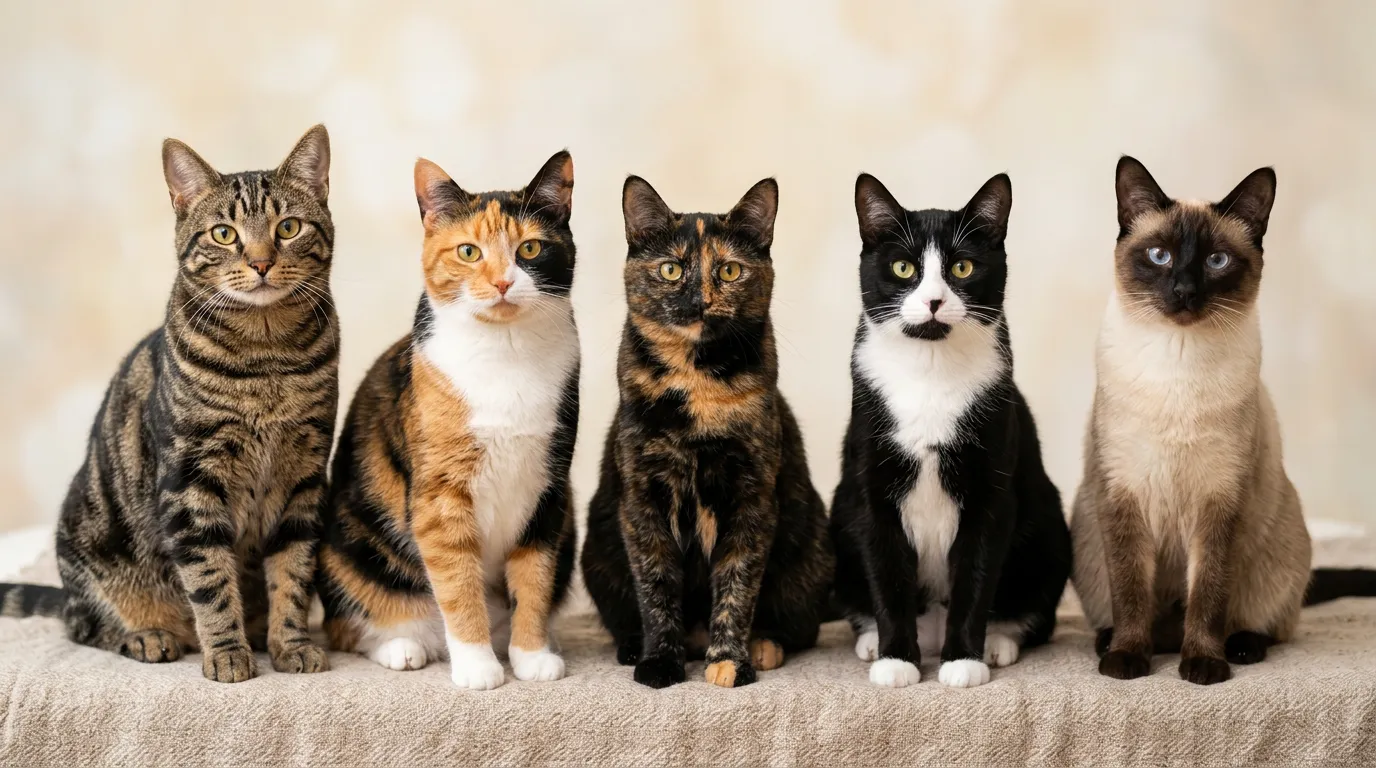
Most domestic cats are mixed breeds, and their coat pattern is the first thing you notice. A tabby Domestic Shorthair and a tabby Maine Coon share the same pattern but look completely different — because pattern is just one of 40+ visual markers that define a cat's appearance.
Tabby
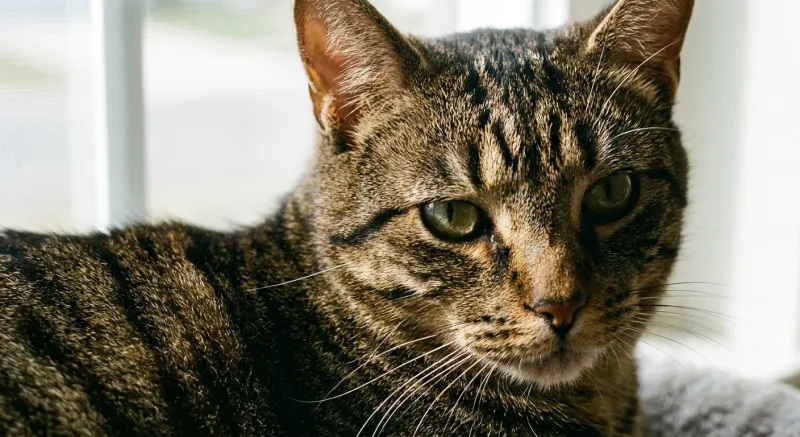
Tabby is the most common and most ancient coat pattern in domestic cats. Every tabby has the distinctive "M" marking on their forehead. There are four sub-types: mackerel (narrow stripes), classic (swirling bands), spotted (broken stripes into spots), and ticked (no visible stripes, just banded hairs).
How to Identify a Tabby Cat
- Look for the "M" on the forehead — present in all tabbies
- Mackerel tabby: narrow vertical stripes running down the sides, like a fish skeleton
- Classic tabby: thick swirling bands, a bullseye on each flank, butterfly shapes on the shoulders
- Spotted tabby: stripes broken into oval or round spots along the sides
- Ticked tabby: no visible stripes on the body, each hair is banded with alternating colors (agouti)
Breeds That Commonly Show Tabby Pattern
- Maine Coon
- British Shorthair
- American Shorthair
- Abyssinian (ticked)
- Egyptian Mau (spotted)
- Ocicat (spotted)
Genetics
Tabby is the default pattern of all domestic cats, controlled by the agouti gene (A) and pattern genes. The mackerel pattern (Mc) is dominant over classic (mc). The ticked pattern (Ta) is dominant over both. Even solid black cats carry hidden tabby genes — you can sometimes see faint stripes in bright sunlight.
Fun Fact
The "M" on a tabby's forehead has many legends: some say it stands for "Mau" (the Egyptian word for cat), others say the Prophet Muhammad placed it there. The real reason is genetics — the marking is linked to the same developmental genes that create wild-type patterns in wildcats.
Calico
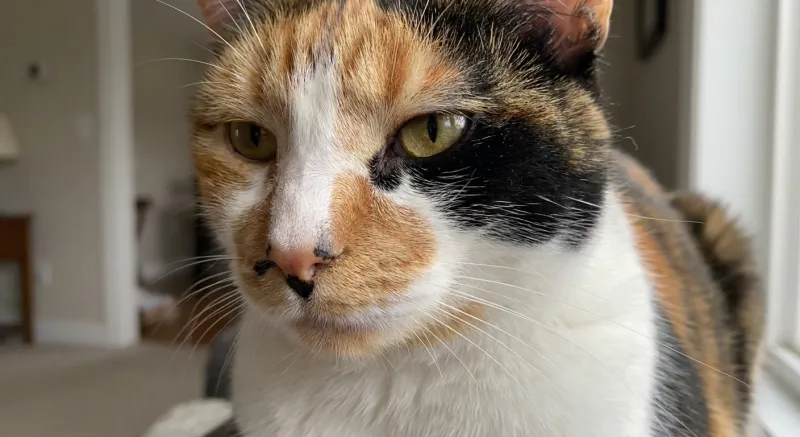
Calico cats have a white base coat with patches of orange (red) and black. The patches are distinct and well-defined, not blended. Almost all calicos are female. The pattern is random — no two calicos look exactly alike.
How to Identify a Calico Cat
- White base coat covering at least 25-50% of the body
- Distinct patches of orange and black (or their dilute versions: cream and blue/gray)
- Patches are clearly separated, not blended or swirled
- Orange patches may show faint tabby stripes (this is normal)
- Almost always female — male calicos are extremely rare (1 in 3,000)
Breeds That Commonly Show Calico Pattern
- Domestic Shorthair
- Maine Coon
- Persian
- British Shorthair
- American Shorthair
- Japanese Bobtail
Genetics
Calico requires two X chromosomes: one carrying the orange gene (O), one carrying non-orange (o). In each cell, one X is randomly inactivated (Lyonization), creating the patch pattern. This is why almost all calicos are female — males have only one X. Male calicos are XXY (Klinefelter syndrome) and are usually sterile.
Fun Fact
In the United States, Calico cats are sometimes called "money cats" because they are considered lucky. In Japan, the Maneki-neko (beckoning cat) figurine is almost always calico. Maryland named the calico cat its official state cat in 2001.
Curious what actually makes a cat calico? Read our calico cat personality & genetics guide.
Tortoiseshell
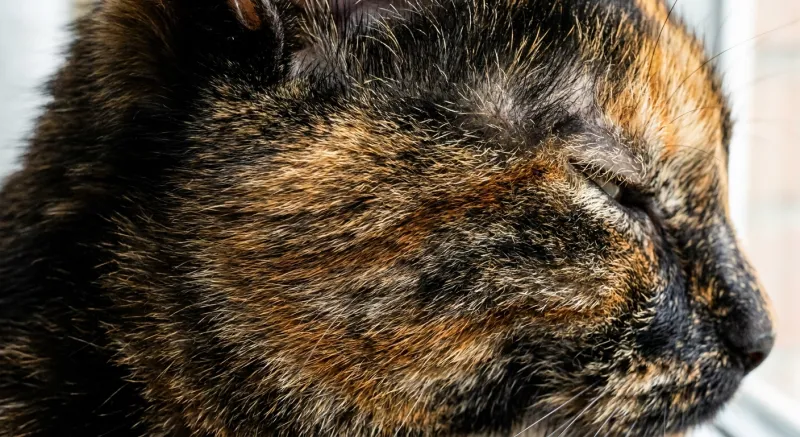
Tortoiseshell (or "tortie") cats have a coat of black and orange that is blended or swirled together, with little or no white. Unlike calico, the colors are intermixed rather than in distinct patches. Torties are almost always female.
How to Identify a Tortoiseshell Cat
- Black and orange blended together in a marbled or swirled pattern
- Little to no white — if there is significant white, it is a calico, not a tortie
- Colors are intermixed, not in distinct patches
- Dilute torties have blue-gray and cream instead of black and orange
- Almost always female
Breeds That Commonly Show Tortoiseshell Pattern
- Domestic Shorthair
- Maine Coon
- Persian
- British Shorthair
- Cornish Rex
- American Shorthair
Genetics
Same X-inactivation mechanism as calico, but without the white spotting gene. The orange and black cells are more evenly distributed, creating the blended "tortie" look instead of distinct patches. "Tortitude" — the feisty personality stereotype — comes from consistent owner reports and a 2016 UC Davis survey, not from proven genetics.
Fun Fact
Tortoiseshell cats are known for "tortitude" — a strong-willed, independent personality. A 2016 study from UC Davis surveyed 1,432 cat owners and found that tortie and calico owners reported more aggression toward humans than owners of other coat colors. The study measured owner perception, not controlled behavior, but the reports are consistent.
Want to know what living with a tortie is really like? Read our tortoiseshell cat personality guide.
Bicolor (Black & White)
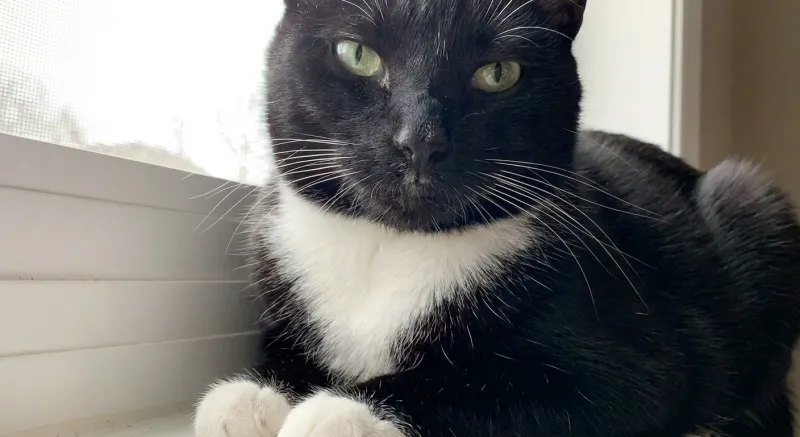
Bicolor cats have a combination of white and one other color (usually black). The tuxedo pattern — black with a white chest and paws — is the most famous bicolor. Other bicolor patterns include "cap and saddle" (white cap on head, white saddle on back) and "van" (mostly white with color only on the head and tail).
How to Identify a Bicolor (Black & White) Cat
- White combined with one solid color (usually black, but can be orange, gray, etc.)
- Tuxedo: black body with white chest, belly, and paws — like wearing a formal suit
- Cap and saddle: white "cap" on the head and white "saddle" on the back
- Van pattern: mostly white with color only on the head and tail
- The white spotting gene (S) controls how much white appears
Breeds That Commonly Show Bicolor (Black & White) Pattern
- Domestic Shorthair
- Maine Coon
- British Shorthair
- Scottish Fold
- Persian
- Turkish Van (van pattern)
Genetics
The white spotting gene (S) is incompletely dominant. One copy gives moderate white (tuxedo), two copies give extensive white (van pattern). The gene suppresses pigment cell migration during embryonic development — areas that pigment cells do not reach stay white.
Fun Fact
Tuxedo cats have been to the top of Mount Everest (a cat named Roderick), served in World War II, and run for political office — a tuxedo cat named Tuxedo Stan ran for mayor of Halifax, Canada in 2012.
Curious about the tuxedo cat personality? Read our tuxedo cat personality guide.
Pointed (Colorpoint)
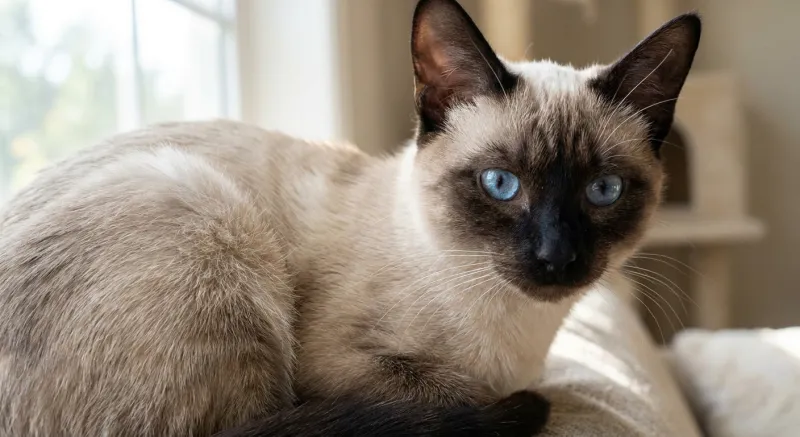
Pointed cats have a pale body with darker coloring on the extremities: ears, face (mask), paws, and tail. This is the signature pattern of Siamese cats and their relatives. The contrast between body and points can be dramatic or subtle depending on the breed.
How to Identify a Pointed (Colorpoint) Cat
- Pale or cream body with darker "points" on ears, face, paws, and tail
- Face has a distinctive dark "mask" or "V" shape
- Points can be seal (dark brown), blue (gray), chocolate, lilac, flame (orange), or cream
- Kittens are born white — points develop as they grow and their body temperature regulates
- Eyes are almost always blue
Breeds That Commonly Show Pointed (Colorpoint) Pattern
Genetics
The pointed pattern is caused by a temperature-sensitive mutation of the tyrosinase gene (cs). The enzyme only works at lower temperatures, so the cooler extremities produce pigment while the warm body stays pale. This is why kittens are born white (uniform womb temperature) and darken as they grow.
Fun Fact
Siamese cats darken with age. A Siamese living in a cold climate will be noticeably darker overall than one in a tropical climate. The pattern is literally a map of body temperature — you can predict which parts of the cat are warmer or cooler.
Solid (Self)
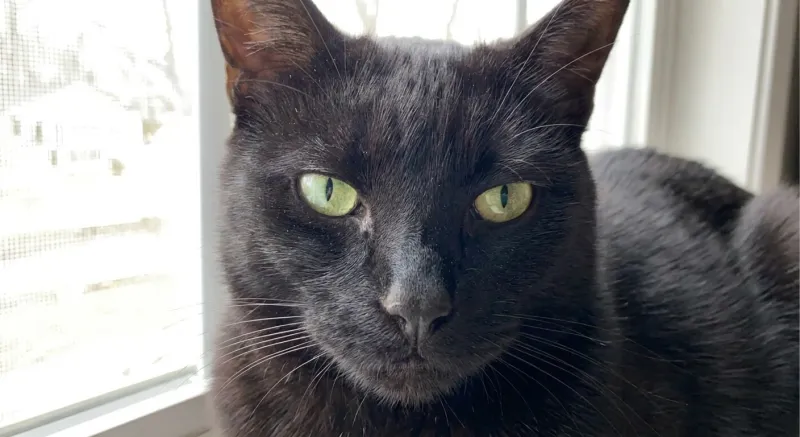
Solid-colored cats have a uniform coat with no visible pattern or markings. Common solid colors include black, white, gray (blue), cream, and cinnamon. Solid cats look simple, but achieving a truly uniform color without any ghost markings is genetically complex.
How to Identify a Solid (Self) Cat
- Uniform color from root to tip, no stripes, spots, or patches
- Black: deep, dense black without any brown or rust tones
- White: pure white, often with blue, gold, or odd eyes
- Gray/Blue: uniform blue-gray, no tabby ghost markings
- Cream: pale warm beige, dilute version of orange
Breeds That Commonly Show Solid (Self) Pattern
- Bombay (black)
- Russian Blue (gray/blue)
- British Shorthair (blue, cream)
- Chartreux (blue)
- Turkish Angora (white)
- Persian (all solid colors)
Genetics
Solid color requires the non-agouti gene (a/a) to suppress tabby patterning. The dominant white gene (W) overrides all other colors. The dilution gene (d/d) lightens black to blue/gray and orange to cream. Achieving a truly uniform solid color without ghost markings requires multiple recessive genes working together.
Fun Fact
Black cats can "rust" in sunlight. UV exposure breaks down melanin, turning the coat brownish or revealing hidden tabby stripes. Indoor cats stay blacker. If your black cat has faint stripes in the sun, it carries hidden tabby genes.
Identifying a solid black cat? Our black cat personality & breed guide narrows the field by temperament and body shape.
Cat Coat Patterns at a Glance
| Pattern | Key Feature | Gender | Top Breeds |
|---|---|---|---|
| Tabby | Look for the "M" on the forehead | Either | Maine Coon, British Shorthair, American Shorthair |
| Calico | White base coat covering at least 25-50% of the body | ~99.97% female | Domestic Shorthair, Maine Coon, Persian |
| Tortoiseshell | Black and orange blended together in a marbled or swirled pattern | ~99.97% female | Domestic Shorthair, Maine Coon, Persian |
| Bicolor (Black & White) | White combined with one solid color (usually black, but can be orange, gray, etc.) | Either | Domestic Shorthair, Maine Coon, British Shorthair |
| Pointed (Colorpoint) | Pale or cream body with darker "points" on ears, face, paws, and tail | Either | Siamese, Ragdoll, Birman |
| Solid (Self) | Uniform color from root to tip, no stripes, spots, or patches | Either | Bombay (black), Russian Blue (gray/blue), British Shorthair (blue, cream) |
Cat Fur Patterns vs Cat Coat Patterns
These terms are often used interchangeably, but there is a technical difference. "Coat pattern" refers to the color arrangement — tabby stripes, calico patches, solid color. "Fur pattern" or "fur type" refers to the hair itself — short, long, curly, wavy, or hairless. A cat can have any coat pattern on any fur type. A long-haired tabby Maine Coon and a short-haired tabby Domestic Shorthair have the same coat pattern but different fur types.
When people search for "cat fur patterns," they usually mean the same thing as "cat coat patterns" — the visual arrangement of colors and markings on the cat's body. This guide covers both.
Cat Markings: The Details Within the Pattern
Cat markings are the specific visual features within a coat pattern. A tabby cat's markings include the forehead "M," the stripes on the legs, and the rings on the tail. A calico cat's markings are the distinct patches of orange and black on a white base. A pointed cat's markings are the dark mask on the face and the darker ears, paws, and tail.
Markings are what make each cat unique. Two tabby Domestic Shorthairs can look completely different because their markings vary — one might have narrow mackerel stripes, the other thick classic swirls. This is why "cat markings" is a popular search term: people want to understand the specific features that make their cat distinctive.
What Breed Is Your Cat?
Coat pattern is the starting point, not the finish line. A tabby could be a Maine Coon, a British Shorthair, an American Shorthair, or a mixed breed. A pointed cat could be a Siamese, a Ragdoll, a Birman, or a Himalayan. To narrow it down, you need to look at face shape, ear type, body proportions, and eye color — the 40+ visual markers our AI checks in a single photo.
Upload a photo — free cat breed scan →
Want to go deeper on coat genetics? Read our complete guide to cat coat patterns for a more detailed breakdown of the science behind each pattern.
Frequently Asked Questions
What are the main cat coat patterns?
The six major coat patterns are: tabby (stripes or spots), calico (white with orange and black patches), tortoiseshell (blended black and orange), bicolor (white with one other color), pointed (pale body with dark extremities), and solid (uniform color with no pattern). Most domestic cats are one of these patterns or a combination.
What is the difference between cat coat patterns and cat fur types?
Coat pattern refers to the color arrangement — tabby stripes, calico patches, solid color, etc. Fur type refers to the hair itself — short, long, curly, wavy, or hairless. A cat can have any pattern on any fur type. For example, a Maine Coon can be a tabby (pattern) with long fur (type).
What is the difference between calico and tortoiseshell?
Calico cats have a white base coat with distinct patches of orange and black. Tortoiseshell cats have black and orange blended together with little or no white. Both patterns are caused by the same X-inactivation mechanism and are almost always female.
What is a tabby cat?
A tabby cat has a coat with stripes, swirls, spots, or ticking caused by the agouti gene. Every tabby has an "M" marking on its forehead. There are four sub-types: mackerel (narrow stripes), classic (swirling bands), spotted (broken stripes), and ticked (banded hairs, no visible stripes). Tabby is the most common and most ancient coat pattern in domestic cats.
What is a tuxedo cat?
A tuxedo cat is a bicolor cat — black with a white chest, belly, and paws, resembling a formal tuxedo. The pattern is caused by the white spotting gene. Tuxedo is not a breed — it is a color pattern that appears in many breeds and mixed-breed cats.
Can I identify my cat breed from its coat pattern?
Coat pattern narrows the field but does not identify a breed. A pointed pattern suggests Siamese, Ragdoll, or Birman. A ticked tabby suggests Abyssinian. But most cats are mixed breeds, and pattern alone is not enough. Upload a photo to Furriq and our AI checks pattern plus 40 other visual markers for a more complete picture.
What is a colorpoint cat?
A colorpoint cat has a pale body with darker coloring on the extremities — ears, face, paws, and tail. This pattern is caused by a temperature-sensitive gene and is the signature of Siamese cats. Colorpoint cats are almost always blue-eyed.
Do all orange cats have tabby stripes?
Yes. The orange gene does not produce a truly solid coat — every orange cat has some form of tabby pattern, even if the stripes are very faint. You can usually see the "M" on the forehead and subtle striping on the legs and tail.
What is the rarest cat coat pattern?
Solid chocolate and solid lilac are among the rarest coat colors in domestic cats. The chocolate gene (b) is recessive and requires both parents to carry it. Among patterns, male calico (about 1 in 3,000) and chimeric cats (two genetically distinct cell lines) are extremely rare.
What are cat markings vs cat coat patterns?
Cat markings are the specific visual features within a coat pattern — stripes, spots, swirls, patches, points. Cat coat patterns are the overall category — tabby, calico, tortoiseshell, bicolor, pointed, solid. Markings are the details; patterns are the big picture. Both terms are used interchangeably in casual conversation.
Personality by Coat Color
Coat color does not determine personality, but owner surveys and veterinary studies show consistent patterns. Each color has its own stereotype — and some of it is backed by data. Click a color to read the full breakdown.
Tuxedo Personality
Bold, social, and talkative. The "clowns of the cat world."
Orange (Ginger) Personality
Friendly, food-motivated, and famously goofy.
Calico Personality
Sassy, independent, and fiercely loyal to one person.
Tortoiseshell Personality
Feisty and strong-willed. The original "tortitude."
Tabby Personality
Four sub-patterns. The honest answer: personality tracks the breed, not the stripes.
Black Personality
Calm, loyal, and surprisingly playful. The opposite of the myth.