

Verify your cat's breed from a photo
One clear photo runs a free quality check, then unlocks the full AI report for a one-time €5.99: breed verdict, why-likely reasoning, 40+ visual markers, health notes, and follow-up questions. No subscription, and your photo is never stored.
Your cat is big, shaggy, and has a mane, and you want a name for what you have. Skip the breed encyclopedia. Run four checks: part the coat along the spine, watch it stand, look at the head from the side, extend the tail. Two minutes, and most of the question is settled.
The short answer: a two-layer coat that runs short on the shoulders and long on the belly and hind legs, a heavy frame over 9 lbs with the rump higher than the shoulders, and a straight line from forehead to nose tip makes a strong candidate. Long fur and nothing else makes a domestic longhair.
None of these clues proves ancestry. A mix inherits a random slice of each parent, so the coat can arrive on an ordinary skeleton, or the frame on a short coat.
1. The Double Coat, With Ruff and Britches
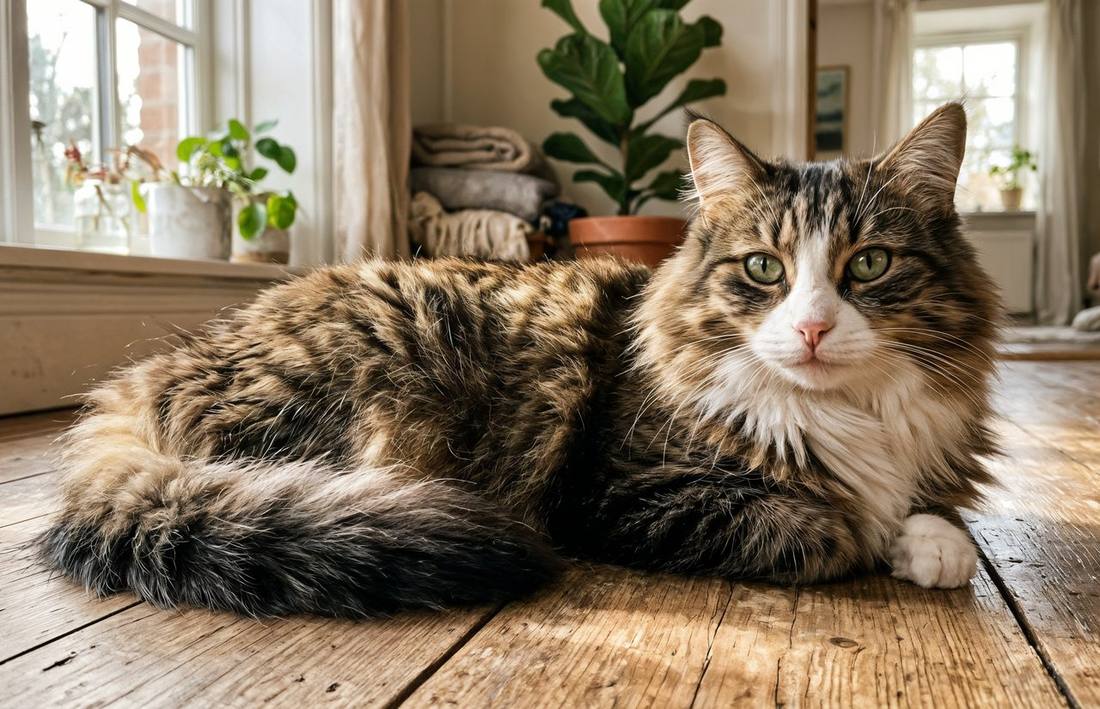
Start here, because this is the hardest clue to fake. The Norwegian Forest Cat carries two layers: a dense woolly undercoat that traps warm air, and long glossy guard hairs on top that shed rain and snow.
Part the fur along the spine with two fingers. On a Wegie mix you meet resistance from the wool close to the skin, then longer, coarser hairs on top. A coat that feels soft and uniform all the way down is the wrong texture, however long it is.
Length is uneven by design. Short across the shoulders, longer on the belly, in the ruff around the neck, and down the back of the hind legs. Those hind-leg trousers are called britches. The ruff starts under the chin and spreads over the chest, heaviest in males and in winter coat.
2. Frame and Bone
Weight is the number people quote, so start there. The standard puts Norwegian Forest Cats at 9 to 16 lbs, or 4 to 7 kg. Big, but not the biggest longhair in the room: Maine Coons run heavier and longer.
Bone matters more than the scale. Hands down the front legs and across the chest. A Wegie mix feels solid, with a broad rib cage and thick legs.
Then watch it stand. Hind legs longer than the front push the rump higher than the shoulders, and the back slopes downhill toward the head. Many carry a loose flap of skin along the belly, the primordial pouch.
A mix can land at 10 lbs and still carry the head and coat. And a fat cat is not a big-boned cat, so feel for rib and shin, not padding.
3. The Triangular Head and Straight Profile
Look at the cat from the side, at its eye level. The Norwegian profile runs close to a straight line from forehead to nose tip, with no dip where the nose begins. That dip is called a stop, and most breeds have one.
Persians and British Shorthairs have a deep stop. Maine Coons curve into a square muzzle. The Wegie line stays straight, and the chin is firm enough to form the third point of a triangle with the ears.
From the front, that triangle is the whole head: ears wide at the base continuing the cheek line, cheeks tapering to a defined chin. Ears are medium to large with rounded tips and lynx-like tufts. Tufts alone prove little, since Maine Coons have them too. Tufts on a straight-nosed head prove more.
4. Almond Eyes, Green to Gold
The eyes are large and almond shaped, set at a slight slant that gives the face its alert look. Color runs green, gold, or copper. Blue appears mainly in white cats, and eye color is independent of coat color here.
The slant is the useful detail. A round eye sits flat in the face. This eye tilts toward the outer corner, and the almond shape holds even when the cat is half asleep.
Do not judge a kitten. Every kitten opens its eyes blue, and adult color arrives around eight weeks. A blue-eyed adult points at a Ragdoll or Siamese line, not a Wegie, unless the cat is white.
5. The Plumed Tail
Pull the tail gently along the cat's side, toward the shoulder blade. On a Norwegian Forest Cat the tip reaches at least to the shoulder. The fur is long and plumed, thickest near the tip, and carried in a loose curl or straight out, never rigid.
Length relative to the body is the check. A short, tapering tail points away from the breed. One that reaches the shoulder and looks like a bottle brush points toward it.
6. Climbing Instinct
This is a farm cat from Norway, built for vertical work. Norwegian Forest Cats come down trees head first, a maneuver most cats avoid, and they claim the highest perch in the house as routine.
Behavior is soft evidence, and this clue ranks low for a reason. Plenty of ordinary cats climb bookcases. Use the habit to support a body that already fits.
7. Seasonal Shedding
The double coat blows twice a year. In spring the undercoat comes out in tufts you can pull with two fingers, and the cat looks thinner for a month. By midwinter the ruff is heaviest and the britches are thick again.
Every double-coated breed does this, so timing alone proves nothing. What it confirms is that the coat has two layers, which loops back to clue one.
Wegie or Maine Coon? Three Differences You Can See
This is the confusion that sends most people searching, and it runs both ways. Both breeds are large, both have ear tufts, both carry a ruff. Three differences settle it.
1. The muzzle. A Maine Coon muzzle is square: a long, boxy front with high cheekbones and a stop behind the nose. The Norwegian nose tapers into a straight line. Run a finger down the bridge. A box pushing forward is Maine Coon. A straight ramp is Wegie.
2. The body outline. Maine Coons are longer than they are tall, rectangular from shoulder to hip, and can stretch 40 inches nose to tail. The Norwegian body is shorter relative to its height, with the raised rump and downhill back from clue two.
3. The coat. Maine Coon fur is silky and close to even in length across the body, with a lighter undercoat. Norwegian fur is coarser on top, denser underneath, and changes length by body part. Stroke from shoulders to tail. Steady texture and length means a Maine Coon coat.
Mixes blur all three. When they do, weigh the muzzle and the coat, because those survive crossbreeding more reliably than size. Full breakdown: how to tell a Maine Coon mix.
The Other Look-Alikes: Siberian and Longhaired DSH
The Siberian is the closest match in purpose: another forest cat from a cold country, same job, same heavy coat. The face separates them. Siberians have a rounder head with a visible stop and a denser triple coat closer to the body. They run 8 to 15 lbs.
The third option is not a breed at all. Long hair is recessive, so two shorthaired parents can produce a longhaired kitten with no forest cat in the line. Most cats labeled Wegie mixes in shelters are domestic longhairs with the right coat length and the wrong structure.
What These Clues Cannot Tell You
Visual identification ranks possibilities. It does not confirm ancestry, and no honest guide can. Vets work from the same feature list. People with 30 years in the fancy still get it wrong.
Mixes keep some traits and drop others, and the drop is random. A Wegie mix can have the coat on an ordinary head, the head on a short coat, or the frame with neither. One strong trait is a maybe. Four is a fair claim on a shelter form.
A DNA test is the only verdict, and even it reports percentages, not a certificate. A purebred Norwegian Forest Cat comes with registration papers. Without them, the breed name describes a look, not a lineage.
Pure Norwegian Forest Cat vs. mix vs. not one
| Trait | Pure Norwegian Forest Cat | Mix | Not a Wegie |
|---|---|---|---|
| Coat | Two layers, uneven length | Two layers, often uneven | One even layer of fluff |
| Frame | 9-16 lbs, heavy bone, high rump | Often big, can be a normal 10 lbs | Light bone, level back |
| Head | Triangular, straight profile, no stop | One feature, not both | Round or square with a stop |
| Tail | Reaches the shoulder, plumed | Usually long | Short or tapering |
If your cat scores four or more, read the Norwegian Forest Cat breed profile for the full standard, then the look-alike comparison. Not sure the cat is a mix at all? Work through how to identify a mix cat breed first.
For a second opinion, upload a clear side-profile photo to the Furriq cat breed scanner. It scores face shape, ear set, coat pattern, and body proportions, and it handles mixes. The photo quality check is free. The full report is €5.99, paid once, no subscription.
FAQ
How can I tell if my cat is part Norwegian Forest Cat?
Check four things. Part the coat: two layers, short on the shoulders, long on the belly and hind legs. Watch the cat stand: hind legs longer, rump higher. Look at the side profile: a straight line from forehead to nose. Extend the tail: the tip should reach the shoulder. Three or four make a strong candidate.
What is the difference between a Norwegian Forest Cat mix and a Maine Coon mix?
The muzzle is the fastest check. Maine Coons have a square, boxy muzzle with a stop behind the nose; Norwegian noses taper into a straight line. Maine Coon bodies are longer than they are tall, while Norwegians are shorter with a higher rump. The Maine Coon coat is silkier and more even.
Do Norwegian Forest Cat mixes shed a lot?
Yes, if they inherit the double coat. Expect two heavy sheds a year, one in spring when the undercoat comes out in tufts, one in autumn when the winter coat fills in. Brush two or three times a week, daily during a blow. The ruff, britches, and armpits mat first.
How big does a Norwegian Forest Cat mix get?
The parent breed runs 9 to 16 lbs, or 4 to 7 kg, with males at the top. A mix can land anywhere: some hit 16 lbs, some stop at 10 lbs and still carry the head and coat. Weight alone says nothing about ancestry.
Is the Norwegian Forest Cat mix check free?
The photo quality check costs nothing and needs no account. The full breed report is €5.99 as a one-time payment, with no subscription. Neither is a DNA test. A photo reads visible traits, and traits are clues, not proof.
Related breeds
All breedsKeep reading
All articlesIdentification
How to Tell a Russian Blue Mix: 6 Clues, With Photos
A Russian Blue mix keeps the blue-gray coat, often the silver sheen, and green eyes in an adult. Six clues ranked, plus the gray lookalikes.
7 min read
Identification
How to Tell a Bengal Mix: 7 Clues, With Photos
A Bengal mix shows two-tone rosettes, not stripes: a dark ring around a lighter center. Check that, then glitter, frame, head, and coat texture.
7 min read
Identification
What Breed Is My White Cat? 5 Likely Breeds
White cats are hard to ID because the white gene hides every coat clue. Read the real markers instead: eye color, ear health, coat texture, body shape.
9 min read
Still not sure what your cat is?
Stop guessing from photos and text. Upload one clear photo and the AI checks 40+ visual markers in seconds. The quality check is free; the full AI report is €5.99, one-time. Your photo is never stored.
Scan your cat's photo