

When someone says "my cat is gray and white," they are describing a coat pattern. When a vet says "domestic shorthair," they mean pattern plus nothing else , no breed-specific features. The gap between those two statements is where breed identification lives. Coat pattern is the starting point. It narrows the field from "all cats" to "cats that can look like this."
Here are the six major coat patterns, how to tell them apart, and which breeds commonly produce each one.
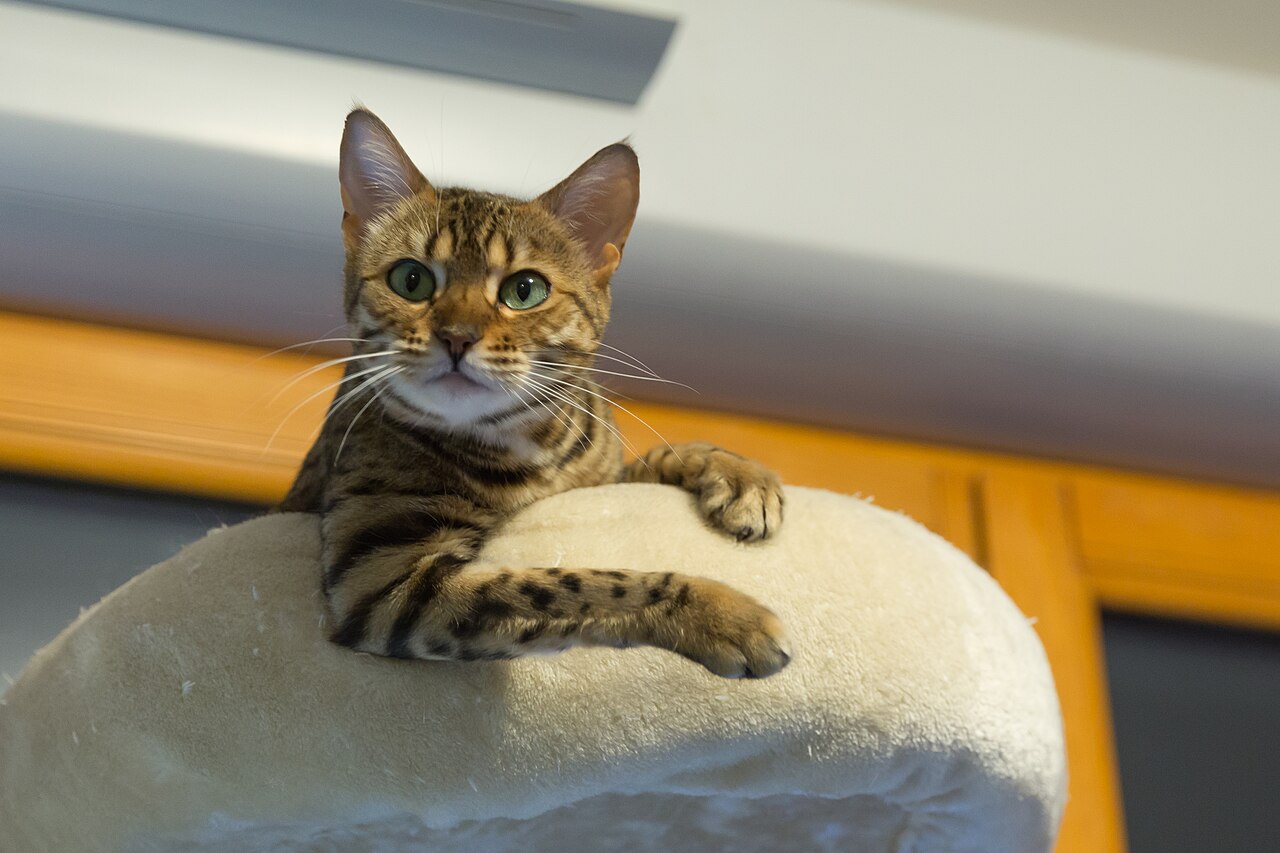
Tabby
Tabby is not a breed. It is a pattern , the most common one in domestic cats. All tabbies share one feature: the M-shaped marking on the forehead. After that, tabbies split into four subtypes.
Classic (blotched) tabby. Thick swirling bands on the flanks, a bullseye pattern on each side, butterfly shapes on the shoulders. This is common in Maine Coons and British Shorthairs. In random-bred cats it shows up frequently too, so do not over-weight it. Classic tabby plus a large rectangular body is a signal. Classic tabby on a medium cat is just a tabby.
Mackerel tabby. Narrow vertical stripes running down the sides, like a fish skeleton. This is the default tabby pattern. It appears in virtually every breed and every mixed-breed population. Mackerel tabby tells you nothing about breed. It is the baseline.
Ticked tabby. Each hair has bands of alternating color (agouti), no stripes on the body, just a faint M on the forehead. The overall effect is a heathered, salt-and-pepper look. This is the defining pattern of Abyssinians and Somalis. If your cat has a ticked coat with no body stripes, Abyssinian or Somali ancestry is the top hypothesis.
Spotted tabby. Spots instead of stripes, formed when the mackerel or classic pattern breaks into dots. Breed examples: Bengal (large rosettes, not simple spots), Egyptian Mau (random small spots on a silver or bronze background), Ocicat (thumbprint-shaped spots). Spotted tabby plus a lean, athletic body points toward the wildcat-hybrid or spotted breeds. Spotted tabby on an otherwise average cat is just a pattern variant.
Mackerel Tabby: The Default Stripes
Mackerel tabby is the pattern most people picture when they hear the word tabby. Narrow vertical stripes run down the sides from a darker spine line, like a fish skeleton, which is where the name comes from. The legs carry thin bracelets, the tail has rings, and the forehead keeps the classic M. Genetically it is the ancestral pattern, the one closest to the African wildcat every domestic cat descends from. That is why it shows up everywhere: in random-bred cats on every continent and in pedigreed breeds alike. A mackerel tabby American Shorthair is the textbook pedigreed example, with crisp stripes on a dense, hard coat. If your striped cat has no other unusual features, mackerel tabby on a domestic shorthair is the most likely answer by a wide margin.
Classic Tabby: The Swirled Blotched Pattern
Classic tabby, also called blotched tabby, trades stripes for broad swirls. Each flank carries a bullseye or oyster pattern, the shoulders show butterfly shapes, and three dark lines run down the spine. The bands are thick and marbled rather than narrow and parallel. Two breeds produce this pattern at show quality often enough to matter for identification. The Maine Coon in brown classic tabby is the iconic image of the breed, swirls on a shaggy, rectangular body. The British Shorthair in silver classic tabby is nearly as famous, with bold black marbling on a pale ground. Classic tabby on a huge cat with ear tufts points one way, on a cobby round cat the other. On an average-sized cat it points nowhere in particular, because the pattern is recessive but widespread in the general population.
Ticked Tabby: Stripes Only in the Hairs
Ticked tabby looks like no pattern at all until you look at a single hair. Each hair carries alternating bands of light and dark pigment, called agouti ticking, and the body shows no stripes or spots at all. The result is a heathered, salt-and-pepper coat that seems to shimmer when the cat moves. Faint tabby markings often survive on the forehead, legs, and tail tip, but the body stays clear. This pattern is the signature of the Abyssinian, where the standard warm ruddy coat is ticking and nothing else. The Somali is the longhaired version of the same look, ticking on a fox-like frame with a plumed tail. A ticked cat with a lean, athletic body and large ears is a strong Abyssinian or Somali hypothesis. It is one of the few tabby subtypes that genuinely narrows the breed field.
Spotted Tabby: Stripes Broken Into Dots
Spotted tabby is what happens when the mackerel or classic pattern breaks apart into spots. The stripes fragment into dots of varying size, sometimes still hinting at lines along the spine. Three breeds turn this pattern into a calling card. The Bengal carries large rosettes, two-toned spots with a lighter center, inherited from its Asian leopard cat ancestor. The Egyptian Mau is the only naturally spotted domestic breed, with random small spots on a silver, bronze, or smoke background and a famously worried expression. The Ocicat shows thumbprint-shaped spots arranged in a classic tabby layout, a wild look with no wild blood at all. Spotted tabby plus a sleek, muscular, athletic body points toward one of these three. Random small spots on an ordinary cat are usually just a broken mackerel pattern.
Calico
Calico is patches of white, orange, and black. The white is the key , calico has significant white areas, often covering the belly, chest, and paws. The orange and black patches sit on a white base.
Calico is not breed-specific. Persians, British Shorthairs, Maine Coons, and random-bred cats all produce calico. But calico does tell you one thing with near certainty: the cat is female. The genetics require two X chromosomes , one carrying orange, one carrying non-orange , plus the white spotting gene. A male calico is possible but requires an XXY chromosome abnormality. It is rare enough that if you have a calico, you can confidently say "she."
Breed-wise, calico in a longhaired cat points toward Persian or Maine Coon. Calico in a shorthair with a round face points toward British Shorthair or Exotic Shorthair. Calico on an otherwise unremarkable cat is a domestic shorthair , and the most common outcome.
Tortoiseshell
Tortoiseshell is calico without the white. Patches of orange and black intermingled, often with a brindled or mottled appearance. The colors are blended rather than separated into distinct blocks. Like calico, tortoiseshell cats are almost always female for the same genetic reason.
The "tortie" personality is a thing people talk about , supposedly feisty and independent. This is folklore, not genetics. Coat color genes do not control behavior. But the perception persists because torties are common enough that everyone knows one.
Tortoiseshell appears in Persians, British Shorthairs, Maine Coons, and random-bred cats. The pattern itself does not point to a breed. You need body type and face shape to narrow it down.
White + colorTuxedo common
Bicolor means any cat with white plus one other color. The most famous bicolor pattern is the tuxedo: black body with white chest, white paws, and sometimes a white chin. But bicolor includes any ratio of white to color, from a small white locket on the chest to a mostly white cat with colored patches on the head and tail (called "van" pattern).
Bicolor appears in virtually every breed. British Shorthairs in bicolor are common. Ragdolls in the bicolor pattern have an inverted white V on the face, white legs, and a white belly. Turkish Vans are defined by the van pattern: mostly white with color restricted to the head and tail.
The distribution of white matters more than the fact of bicolor. A white inverted V on the face in a large, blue-eyed, color-point cat points toward Ragdoll. A van pattern in a sturdy, water-loving cat points toward Turkish Van. Random white spotting on an average cat means nothing.
Pale bodyDark points
Pointed cats have a pale body with darker color on the ears, face, paws, and tail. This is the Himalayan gene , a temperature-sensitive form of partial albinism. The cooler parts of the body (extremities) develop pigment. The warmer core stays pale.
Pointed cats are almost always from a narrow set of breeds: Siamese (seal point, blue point, chocolate point, lilac point), Ragdoll (pointed or mitted), Birman (pointed with white gloves), Himalayan (pointed Persian), Balinese (longhaired Siamese).
A pointed pattern in a cat with blue eyes and a lean body is Siamese. Pointed with blue eyes, a large body, and a fluffy coat is Ragdoll. Pointed with a flat face is Himalayan. The pointed pattern narrows the breed field to about six names. It is one of the strongest visual signals in cat identification.
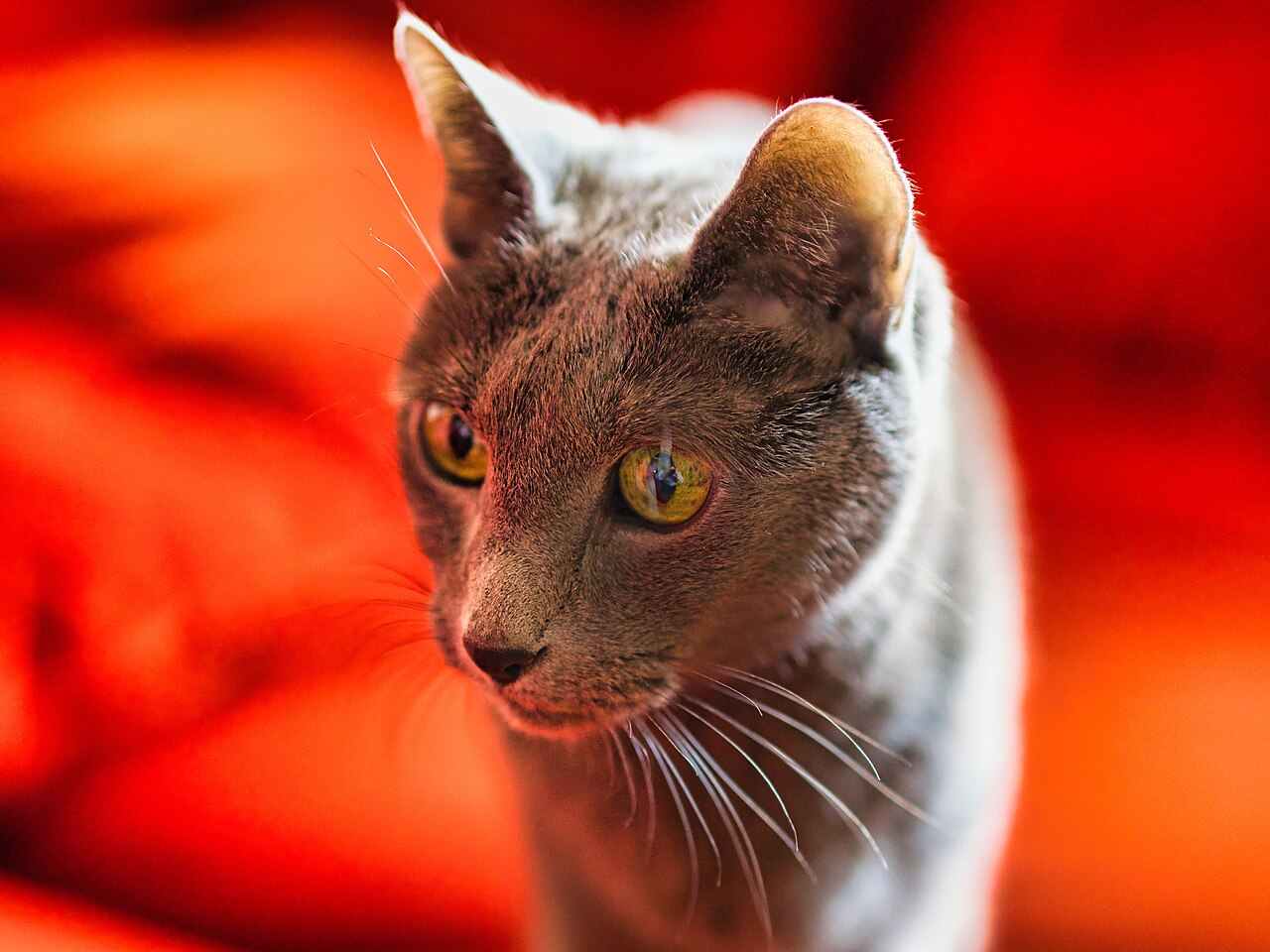
Solid
Solid means one uniform color with no markings. No stripes, no spots, no white patches. Solid black, solid white, solid blue (gray), solid red (orange), solid cream.
Solid is common in British Shorthairs, Persians, Bombay (solid black only), Russian Blue (solid blue only), Chartreux (solid blue-gray only), the Turkish Angora (the classic solid-white longhair), and the Havana Brown (solid chocolate). A solid coat in a cat with no other breed features is a domestic shorthair. A solid coat in a round-faced, cobby-bodied cat is likely British Shorthair. A solid black coat with copper eyes on a muscular, panther-like cat is likely Bombay.
Solid coats make breed identification harder because pattern , the most visible feature , is absent. You must rely on body type, face shape, and eye color. That is fine. It just means you need more data points from the other categories.
Coat pattern overview
| Pattern | Key Feature | Gender Link | Common Breeds |
|---|---|---|---|
| Classic Tabby | Swirling bands, bullseye flanks | None | Maine Coon, British Shorthair |
| Mackerel Tabby | Narrow vertical stripes | None | All breeds |
| Ticked Tabby | No stripes, banded hairs | None | Abyssinian, Somali |
| Spotted Tabby | Spots instead of stripes | None | Bengal, Egyptian Mau |
| Calico | White + orange + black patches | Female | Persian, British Shorthair |
| Tortoiseshell | Orange + black blended | Female | Persian, British Shorthair |
| Bicolor | White + one other color | None | Most breeds |
| Pointed | Pale body, dark extremities | None | Siamese, Ragdoll, Birman |
| Solid | One uniform color | None | British Shorthair, Russian Blue |
Tabby sub-types compared
| Sub-type | Pattern | Body Stripes | Forehead M | Common In |
|---|---|---|---|---|
| Classic | Swirling bands, bullseye | Yes, thick | Yes | Maine Coon, British Shorthair |
| Mackerel | Narrow vertical stripes | Yes, thin | Yes | All breeds |
| Ticked | Banded hairs, no stripes | No | Yes (faint) | Abyssinian, Somali |
| Spotted | Spots instead of stripes | Broken into dots | Yes | Bengal, Egyptian Mau |
Which pattern should you look at first?
Start with the pattern that jumps out. If your cat is pointed, that alone narrows the breed field to a handful. If your cat is a ticked tabby, Abyssinian is the top hypothesis. If your cat is solid black, you need a different approach , check our black cat breed guide for a breakdown by body type instead of color.
For a step-by-step method that combines coat pattern with face shape, body type, ears, and tail, read the full cat breed identification guide. Or upload a photo to our cat breed identifier and let the model compare 40+ visual markers against breed profiles.
Frequently Asked Questions
What are the main cat coat patterns?
Six patterns cover almost every cat: tabby (stripes in classic, mackerel, ticked, and spotted forms), solid, bicolor, calico, tortoiseshell, and pointed. Each is controlled by separate genes, which is why a tabby can also be bicolor, and why a calico is always part tortoiseshell. Pattern is the most visible identification clue a coat gives you.
Is tabby a breed or a coat pattern?
Tabby is a pattern, not a breed. The gene for tabby markings exists in nearly every domestic cat, including ones that look solid: black cats and blue cats still carry it, and ghost stripes often appear in strong light. Breed associations treat tabby as a color class, so a tabby Maine Coon and a tabby British Shorthair are entirely different breeds sharing one pattern.
Which cat breeds have a spotted coat pattern?
Spotted tabbies include Bengal, Egyptian Mau, Ocicat, Savannah, and American Bobtail. The spots come from the same tabby gene family as stripes, so the pattern alone does not name the breed. Pair spots with body type: a sleek spotted cat with a long stride points to Bengal or Egyptian Mau, a stockier spotted cat to Ocicat or Savannah.
What does a pointed coat pattern mean?
Pointed means the extremities (ears, face mask, paws, tail) are darker than the body. It comes from a temperature-sensitive gene: cooler skin grows darker fur, so the body stays pale and the cooler points darken. Siamese, Balinese, Himalayan, and Ragdoll all carry the pattern. A pointed cat with blue eyes is a strong breed clue on its own.
Can a cat's coat pattern change as it grows?
Yes, in two ways. Kittens of pointed breeds are born nearly white and darken with age as the temperature-sensitive gene kicks in. Ticked and tabby patterns can also become more or less visible with age, weight, and season. A dramatic color change in an adult cat is worth a vet visit, but gradual darkening in a pointed cat is normal.
Is a calico or tortoiseshell cat always female?
Almost always. Calico and tortoiseshell need two X chromosomes to express both orange and non-orange patches, so females carry the pattern. The rare male calico has an extra X chromosome (XXY) and is almost always sterile. Seeing calico patches tells you the cat is female first, and nothing about breed: many breeds and most domestic cats can produce the pattern.
What is the difference between calico and tortoiseshell cats?
Calico means white plus patches of orange and black (or their dilute versions), while tortoiseshell has the two colored patches with little or no white. The calico gene is separate from the tortoiseshell one, which is why a calico is always partly tortoiseshell but a tortoiseshell can have no white at all. Both patterns need two X chromosomes, so both are almost always female.
What is a ticked tabby cat?
A ticked tabby has no stripes on the body. Each hair is banded with alternating light and dark segments, which gives the coat a shimmering, salt-and-pepper look from a distance. Abyssinian and Somali cats carry this pattern as their breed signature, but a ticked coat can also appear in random-bred cats.
Are cat coat colors and patterns linked to specific breeds?
Some patterns are breed signatures: pointed coats with blue eyes are the Siamese family trait, ticked coats define the Abyssinian, and rosetted spots mark the Bengal. But most colors and patterns, from tabby to calico to solid black, appear across many breeds and in most domestic cats. A pattern narrows the candidate list; it rarely names the breed by itself.
Which cat coat pattern is the rarest?
Roasted and pointed combinations are among the rarer ones, but pattern rarity depends on the population. In the general cat world, a male calico is the rarest of all: it needs an extra X chromosome (XXY) and is almost always sterile. Among breed standards, the ticked coat in a non-Abyssinian line and the sepia pattern in Tonkinese are less common finds.
Keep reading
All articlesIdentification
Tortoiseshell Cat: Colors, Personality, and Breeds
Tortoiseshell cats are black and orange patchwork, almost always female. Here is what the pattern means, what tortoiseshell cat personality is really like, and which breeds carry it.
8 min read
Identification
Is My Cat a Calico? How to Identify Calico Patterns
Is your cat calico? Look for white, orange, and black patches, the tri-color signature. Learn how to tell calico from tortoiseshell and which breeds produce calicos.
5 min read
Cat Coat Colors
Tortoiseshell vs Calico Cat: What's the Difference?
Tortoiseshell and calico cats share the same orange-and-black coloring, but they are not the same. Learn the genetic, visual, and personality differences — and how to tell which coat pattern your cat has.
8 min read
Still not sure what your cat is?
Stop guessing from photos and text. Upload one clear photo and the AI checks 40+ visual markers in seconds. Free, no sign-up, and your photo is never stored.
🐱 Free cat breed scan