
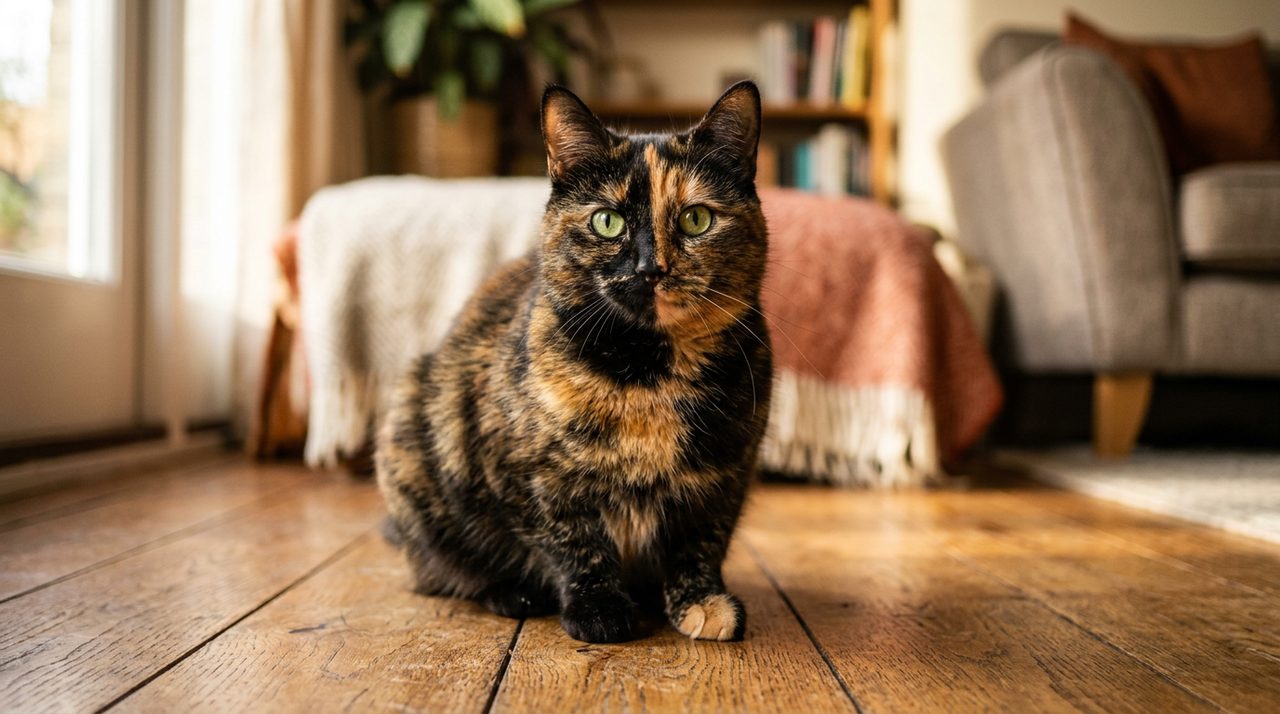

Quick answer: A tortoiseshell cat has black and orange patches with no white. A calico cat has black, orange, and white patches. Both patterns come from the same X-linked gene — the only difference is whether a separate white-spotting gene adds white to the mix. That is the short version. The longer version involves X chromosomes, lyonization, and why nearly every tortoiseshell and calico cat you will ever meet is female.
If you are staring at your cat right now wondering is my cat a calico or tortoiseshell, look for white. Any white at all — a white paw, a white chest patch, a white belly — means calico. No white, just black and orange swirling together, means tortoiseshell. The distinction is that simple at the surface, and surprisingly deep underneath.
What Makes a Tortoiseshell Cat
A tortoiseshell cat carries two versions of the orange gene on her two X chromosomes. One X carries the O (orange) allele; the other carries o (non-orange, which produces black). Early in embryonic development, each cell randomly inactivates one X chromosome — a process called lyonization or X-inactivation. Some cells express the orange allele and produce pheomelanin (orange pigment). Others express the non-orange allele and produce eumelanin (black pigment). The result is a mosaic of black and orange patches across the coat.
The patches in a tortoiseshell cat are typically interwoven or brindled — small flecks of orange and black mixed together, rather than large distinct blocks. This is the classic "tortie" look — what some owners call a tortie calico pattern when the brindling is especially fine. The pattern can range from nearly all black with a few orange flecks to a roughly even mix. There is no single "correct" tortoiseshell pattern; every tortie is unique.
Tortoiseshell is not a breed. It is a coat color pattern that can appear in almost any breed or mixed-breed cat. A Domestic Shorthair, a Maine Coon, a British Shorthair — any of them can be tortoiseshell if the genetics line up. The pattern tells you something about the cat's X chromosomes, not her breed.
What Makes a Calico Cat
A calico cat has the same X-linked orange/black genetics as a tortoiseshell, but with one addition: the white-spotting gene (S). This dominant gene suppresses pigment in certain areas of the skin during development, producing patches of white. The orange and black still appear where pigment cells migrated before the white-spotting gene took effect, but large areas of the coat remain unpigmented — white.
The result is a tri-color cat: patches of black, patches of orange, and areas of white. The black and orange patches in a calico tend to be larger and more distinct than in a tortoiseshell, because the white areas act as natural boundaries between the colored regions. Where a tortie has brindled swirls of black and orange, a calico has discrete blocks of color separated by white.
Like tortoiseshell, calico is a coat pattern, not a breed. You can find calico cats in Persians, Japanese Bobtails, Scottish Folds, and countless mixed-breed cats. The Japanese Bobtail is perhaps the breed most strongly associated with calico coloring — the famous maneki-neko (beckoning cat) figurine is almost always a calico. In online communities, you will sometimes see the term calico tortoiseshell used to describe cats that sit somewhere between the two patterns — brindled coloring with small white patches that do not quite form the distinct blocks of a classic calico.
Tortoiseshell vs Calico: Side-by-Side Comparison
| Trait | Tortoiseshell | Calico |
|---|---|---|
| Colors | Black and orange (no white) | Black, orange, and white |
| Patch style | Brindled, interwoven, small flecks | Distinct blocks separated by white |
| White present? | No | Yes — any amount |
| Genetics | X-linked O/o + lyonization | X-linked O/o + lyonization + white-spotting gene (S) |
| Sex | Almost always female | Almost always female |
| Breed? | No — coat pattern only | No — coat pattern only |
| Male possibility | ~1 in 3,000 (XXY / chimeric) | ~1 in 3,000 (XXY / chimeric) |
Are Tortoiseshell and Calico the Same Thing?
They share the same underlying genetics but are not the same pattern. Think of it this way: tortoiseshell is the base pattern (X-inactivation producing black and orange), and calico is tortoiseshell plus white (the white-spotting gene layered on top). Every calico cat is genetically a tortoiseshell — but not every tortoiseshell is a calico.
The confusion is understandable because the terms are sometimes used interchangeably in casual conversation. Some people call any black-and-orange cat a "calico" regardless of white. In genetics and cat fancy terminology, though, the distinction is clear: no white = tortoiseshell, any white = calico.
There is also a middle ground that makes things more confusing: the tortico (sometimes called a "caliby"). This is a cat with tortoiseshell brindling and white patches — essentially a tortie pattern overlaid with the white-spotting gene. Some registries classify these cats as calicos; others treat them as a separate pattern. For most practical purposes, if your cat has any white, she is a calico or tortico — not a pure tortoiseshell.
Why Are Almost All Tortoiseshell and Calico Cats Female?
This is the question that trips up most cat owners, and the answer is pure genetics.
The orange gene is X-linked — it sits on the X chromosome. Female cats have two X chromosomes (XX), so they can carry both the orange allele (O) on one X and the non-orange allele (o) on the other. When both alleles are present, lyonization kicks in: each cell randomly shuts down one X, and the cat develops a mosaic of orange and black patches. That mosaic is the tortoiseshell pattern.
Male cats have only one X chromosome (XY). They can be orange (O) or non-orange (o), but they cannot be both — they only have one X to work with. A male cat is either orange or black (or a dilute version), never a patchwork of both.
So how do male tortoiseshell and calico cats exist? There are two rare mechanisms:
- XXY (Klinefelter syndrome): The cat has an extra X chromosome, giving it two X's and the ability to carry both O and o. These cats are almost always sterile.
- Chimerism: Two embryos fuse early in development, creating a single cat with two different cell lines — one carrying O, the other carrying o. These cats can be fertile.
Male tortoiseshell and calico cats occur in roughly 1 in 3,000 births. They are rare, and they are one of the few coat-color patterns that can reliably indicate a genetic anomaly.
Tortoiseshell vs Calico Personality
You will hear the word "tortitude" thrown around a lot in cat communities. The claim is that tortoiseshell cats have a distinct personality: bold, sassy, independent, quick to vocalize, and occasionally spicy. Calico cats get a similar reputation — strong-willed, opinionated, and fiercely loyal to one person.
Is there science behind this? A 2015 study from UC Davis surveyed 1,274 cat owners and found that tortoiseshell and calico owners did report more frequent aggression — hissing, biting, swatting — compared to owners of solid-colored cats. But the effect size was small, and the study relied on owner-reported behavior, which is notoriously biased. Owners who expect their tortie to be sassy may notice and remember sassy behavior more.
The honest answer: coat color does not reliably predict personality. A tortoiseshell cat can be a lap cat or a loner. A calico can be shy or outgoing. Individual temperament, socialization, breed background, and early life experiences matter far more than which X chromosome is expressing which pigment gene. If someone tells you "all torties are feisty," they are repeating a folk observation, not a scientific fact.
Can a Cat Be Both Tortoiseshell and Calico?
Yes — and it happens more often than you might think. Here are the common combinations:
- Tortico: A cat with tortoiseshell brindling (interwoven black and orange) plus white patches. This is the most common hybrid — essentially a tortie pattern with the white-spotting gene active. Some people call them "caliby" if tabby striping is also present.
- Torbie: A tortoiseshell cat with tabby striping in the dark patches. Instead of solid black, the "black" areas show brown or gray tabby stripes. The orange areas may also show tabby markings. Torbies are sometimes called "patched tabbies."
- Calico tabby (caliby): A calico cat where the black patches show tabby striping. The orange patches almost always show some tabby pattern because the tabby gene is dominant over solid in orange cats.
These combinations are not separate genetic categories — they are the result of layering different genes (tortie + white-spotting, tortie + tabby, calico + tabby) on top of each other. A single cat can carry all of these simultaneously.
How to Tell If Your Cat Is Tortoiseshell or Calico
Here is a simple decision tree:
- Does your cat have any white fur? If yes → calico (or tortico if the colored areas are brindled rather than blocked).
- No white, but both orange and black? → tortoiseshell.
- Is the dark color actually brown/gray tabby stripes, not solid black? → torbie (tortoiseshell + tabby).
- Only one color (all orange, all black, all gray)? → not tortie or calico at all. Your cat is a solid or tabby.
The trickiest cases are dilute tortoiseshell and calico cats, where the black fades to blue-gray and the orange fades to cream. These "dilute" versions are caused by a recessive gene that lightens both pigments. A dilute tortie has blue-gray and cream patches instead of black and orange. A dilute calico has blue-gray, cream, and white. The same rules apply — no white means tortie, any white means calico — but the colors are softer and easier to confuse with a solid gray or a tabby.
A few practical tips for identification in real-world conditions:
- Check the belly. White patches often show up on the chest and belly first. Flip your cat over and look — a white belly stripe or white "socks" means calico, even if the rest of the coat looks tortie.
- Look at the paws. Calico cats frequently have white paw tips. Tortoiseshell cats do not. If even one paw has white, you are looking at a calico or tortico.
- Photograph in natural light. Indoor lighting can wash out subtle white patches or make cream-colored areas look white. A photo near a window in daylight gives the most accurate color representation.
- Check kitten photos. Coat patterns are set at birth, but kittens have shorter fur that makes patches easier to see. If you have kitten photos, those are often the clearest reference for identifying the pattern.
Still not sure? Upload a photo to our cat breed identifier — it can detect coat patterns including tortoiseshell and calico, and it might also tell you what breed your cat is while it is at it.
Frequently Asked Questions
Is a tortoiseshell cat the same as a calico?
No. Both have orange and black coloring from the same X-linked gene, but a calico also has white patches from the white-spotting gene. A tortoiseshell has no white. The genetics are almost identical — the only difference is whether the white-spotting gene (S) is active.
What is the difference between a calico and a tortoiseshell cat?
The difference is white. A calico has three colors: black, orange, and white. A tortoiseshell has two: black and orange, with no white. Both patterns are almost exclusively female because the orange gene is X-linked, and you need two X chromosomes to carry both the orange and non-orange alleles.
Are calico and tortoiseshell cats always female?
Almost always. The orange gene sits on the X chromosome. Females (XX) can carry both orange and non-orange alleles, producing the patchwork pattern. Males (XY) have only one X, so they are typically solid orange or solid black. Male tortoiseshell and calico cats exist but are extremely rare (~1 in 3,000) and usually have an extra X chromosome (XXY) or are chimeras.
Can a male cat be tortoiseshell or calico?
Yes, but it is rare — about 1 in 3,000. Male tortie and calico cats usually have Klinefelter syndrome (XXY chromosomes) or are chimeras (two fused embryos). XXY males are almost always sterile. Chimeric males can be fertile. Either way, a male tortoiseshell or calico is a genetic exception, not the rule.
Do tortoiseshell cats have a different personality than calico cats?
The "tortitude" stereotype says torties are sassy and bold, but scientific evidence is weak. A 2015 UC Davis study found slightly more owner-reported aggression in tortie and calico cats, but the effect was small and likely influenced by owner expectations. Coat color does not reliably predict personality — individual temperament, socialization, and breed background matter far more.
What is a tortico cat?
A tortico is a cat that combines tortoiseshell brindling (interwoven black and orange) with white patches. It is essentially a tortoiseshell pattern with the white-spotting gene active. Some people call them "caliby" if tabby markings are also present. Torticos are not a separate breed — they are a coat pattern combination.
What is the difference between a tortie and a torbie?
A tortie (tortoiseshell) has solid black and orange patches. A torbie has tabby-striped patches instead of solid black — the dark areas show brown or gray tabby stripes, and the orange areas may also show tabby markings. Torbies are sometimes called "patched tabbies." Both are almost always female.
Is my cat a calico or tortoiseshell?
Look for white. Any white fur at all — even a single white paw or chest patch — means your cat is a calico (or tortico if the colored areas are brindled). No white, just black and orange, means tortoiseshell. If the dark areas show tabby stripes instead of solid black, your cat is a torbie.
Can a tortoiseshell cat become calico?
No. A cat's coat pattern is determined at conception by its genes. A tortoiseshell cat will always be tortoiseshell — it does not have the white-spotting gene. However, a kitten's coat can change slightly as it matures (colors may darken or lighten), and seasonal shedding can make patches more or less visible. The underlying pattern does not change.
Are tortoiseshell and calico cats rare?
Not individually — tortoiseshell and calico patterns are common in female cats. What is rare is a male tortoiseshell or calico (~1 in 3,000). The patterns themselves are a natural consequence of X-inactivation in any female cat that carries both orange and non-orange alleles, which is genetically common.
Not Sure What Coat Pattern Your Cat Has?
Upload a photo to Furriq's breed identifier. It detects coat patterns including tortoiseshell, calico, tabby, and solid — and tells you the most likely breed in seconds. No sign-up, no storage.
Want to learn more about coat genetics? Read our complete guide to cat coat patterns for a deeper dive on tabby, bicolor, pointed, and solid coats. Or browse our breed directory to see which breeds commonly come in tortoiseshell and calico.
Keep reading
All articlesIdentification
Cat Coat Patterns Explained: Tabby, Calico & More
Coat pattern is the most visible clue to a cat's breed mix. Tabby, calico, tortoiseshell, bicolor, pointed, and solid patterns, with breed links for each.
5 min read
Identification
Tortoiseshell Cat: Colors, Personality, and Breeds
Tortoiseshell cats are black and orange patchwork, almost always female. What the pattern means, what tortie personality is like, and which breeds carry it.
8 min read
Cat Health
Cat Breed DNA Test: Accuracy, Cost & What It Shows
What a cat breed DNA test can and cannot show, how accurate the results are, what kits cost, and when a free photo check tells you enough.
8 min read
Still not sure what your cat is?
Stop guessing from photos and text. Upload one clear photo and the AI checks 40+ visual markers in seconds. Free, no sign-up, and your photo is never stored.
Free cat breed scan