
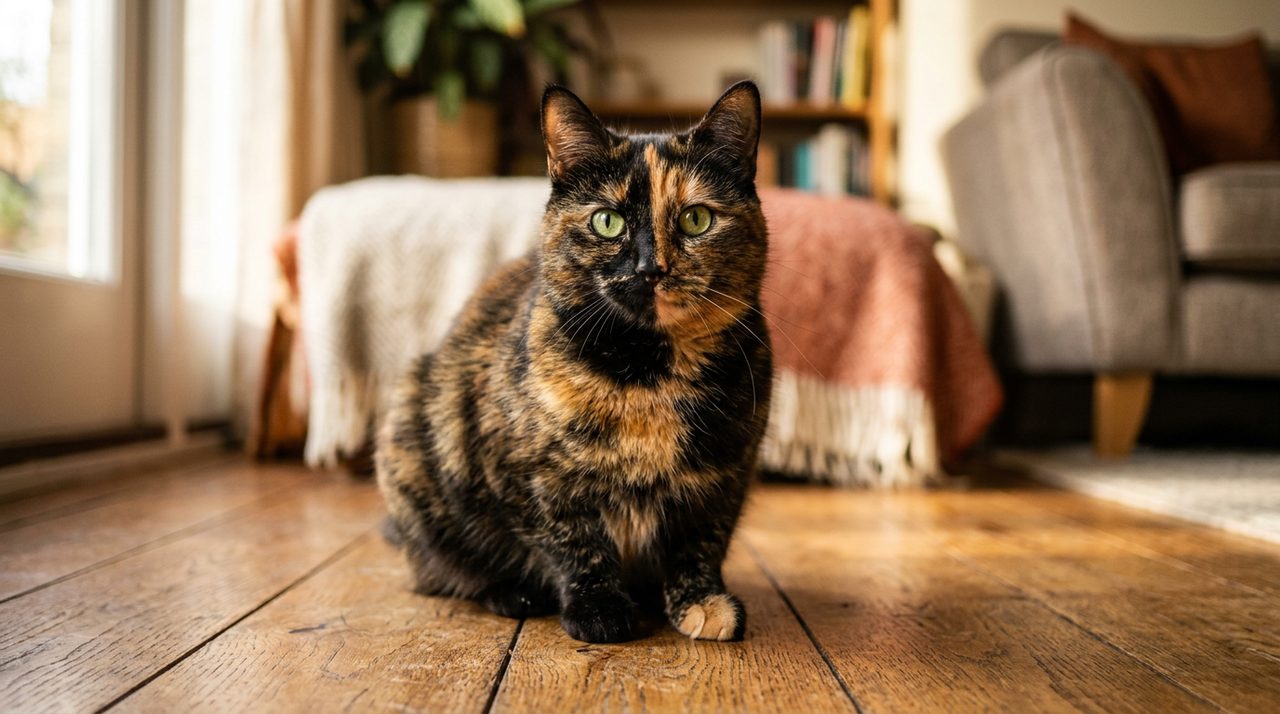

Tortoiseshell cats look like someone dropped a black cat into a vat of orange paint and swirled it. The black and orange patches blend together instead of sitting in clean blocks, and white is missing almost entirely. That one detail, the absence of white, is what separates a tortoiseshell from a calico. The pattern is not a breed. It is a coat color that any cat can carry, and it comes with one near-certainty: the cat is female.
What Is a Tortoiseshell Cat?
A tortoiseshell coat is patches of black (or gray, chocolate, or cinnamon in the diluted versions) intermingled with orange or cream. The colors are blended and brindled rather than separated into distinct blocks. Tortoiseshell cats do not have significant white areas. When white appears in quantity, the cat is a calico instead. A tortie with tabby stripes in the orange patches is called a torbie, and one with white and gray patches is a blue-cream tortoiseshell.
Why Are Tortoiseshell Cats Almost Always Female?
The genetics are elegant and unforgiving. Coat color for orange and black lives on the X chromosome. A female cat has two X chromosomes, so she can carry both orange and non-orange, producing the two-tone tortoiseshell look. A male cat has one X chromosome and one Y, so he can be orange or not orange, but never both. The rare male tortoiseshell exists, but it requires an XXY chromosome arrangement, a genetic anomaly. If you have a tortoiseshell cat, you can say "she" with near-total confidence. Male torties are so rare that breeders treat them as a curiosity.
The Tortitude Myth
Ask a group of cat owners about tortoiseshell personality and half of them will swear torties are feistier, more assertive, and more opinionated than other cats. The term tortitude has become a meme. The honest answer: the evidence for tortitude is owner surveys, not controlled studies. The perception persists because torties are common enough that everyone knows one, and the pattern is visually striking enough that people remember the personality of the loud ones. Treat tortitude as a reputation, not a rule. Judge the cat in front of you, not the color of its coat.
Tortoiseshell Cat Personality: What to Actually Expect
Strip away the tortitude myth and look at what tortoiseshell cat owners actually report. The short version: torties are cats. Their personality is shaped by genetics, socialization, and individual temperament, not by coat color. But because tortoiseshell is such a common pattern, there is a large sample size of owner reports, and some patterns do emerge.
Independence. Many tortie owners describe their cats as independent. This is not unique to torties, it is a trait shared by most domestic shorthairs. Torties are often random-bred cats, and random-bred cats tend to be more self-sufficient than purebreds that have been selected for docility. If your tortoiseshell is not a lap cat, that is normal cat behavior, not tortitude.
Affection on their terms. Torties are frequently described as affectionate but selective. They choose when and where to sit on your lap, and they leave when they want. This is standard cat behavior. The selectiveness is not coat-color-linked. It is how most cats operate.
Energy level. Torties span the full energy spectrum. Some are couch potatoes. Some are zoomies machines. The coat pattern does not predict energy level. If you want a specific temperament, look at the breed (if known), the individual cat's history, and how it was socialized as a kitten.
Vocalization. Some torties are talkative. Some are silent. There is no evidence that tortoiseshell cats vocalize more or less than other cats. If your tortie talks a lot, it is because that cat talks a lot, not because it is a tortie.
The bottom line: tortoiseshell cat personality is individual personality. The coat tells you the cat is female and carries both orange and non-orange genes. It tells you little about whether the cat will be cuddly, aloof, playful, or lazy. If you are adopting a tortie, meet the specific cat and judge it on its own behavior. For what owners consistently report and how it compares with the calico attitude, see our tortoiseshell cat personality page.
Which Breeds Carry the Tortoiseshell Pattern?
Because tortoiseshell is a color and not a breed, it shows up across the pedigree world and in random-bred cats everywhere. The breeds where tortie colors appear most often include the American Shorthair, British Shorthair, Persian, Maine Coon, and Siberian. In longhaired cats, tortie patterns show up in Norwegian Forest Cats and random-bred longhairs. The pattern itself tells you almost nothing about ancestry. You need body type, face shape, and ear structure to narrow the field, and even then a tortoiseshell domestic shorthair is the most likely answer.
Can You Identify a Breed From a Tortoiseshell Coat?
No, not reliably. The coat says female and says nothing else. A large tortoiseshell cat with ear tufts and a rectangular body points toward Maine Coon ancestry. A cobby, round-faced tortie with a plush coat points toward British Shorthair. A tortie with a flat face and a long cottony coat points toward Persian. Without those structural clues, a tortoiseshell shorthair is a domestic shorthair, full stop. Structure beats color every time in breed identification.
Try Identifying Your Cat
Have a tortoiseshell cat and want a second opinion? Upload a clear side-profile photo to our AI cat breed identifier. The model looks at face shape, body type, ears, and tail, exactly the features that matter when the coat gives you so little.
FAQ
Are tortoiseshell cats always female?
Almost always. The two-tone pattern requires two X chromosomes. Male tortoiseshells exist but are rare, the result of an XXY chromosome arrangement or chimerism.
What is the difference between a tortoiseshell and a calico cat?
White. Tortoiseshell cats have black and orange blended together with little or no white. Calico cats have large patches of white plus black and orange. See our calico cat pattern guide for the full breakdown.
Are tortoiseshell cats good pets?
As pets, they are no better and no worse than any other cat. Individual personality varies far more than coat color. Torties tend to be affectionate, playful, and independent, like most cats, but that is cat behavior, not tortie magic.
Do tortoiseshell cats have a specific personality type?
No controlled study says coat color genes control behavior. Owner surveys report a weak aggression signal for torties and calicos, but the signal is small and shaped by expectation. Tortoiseshell cats span the full personality spectrum: some are cuddly, some are aloof, some are playful, some are lazy. If you want to know a tortie's personality, meet the specific cat.
Are tortoiseshell cats more aggressive than other cats?
There is no scientific evidence that tortoiseshell cats are more aggressive. A 2016 UC Davis survey of 1,432 cats found that tortie and calico owners reported more aggression toward humans than owners of other colors, but the effect was small and the study relied on owner perception, not behavioral testing. Tortitude is a meme, not a diagnosis.
Are tortoiseshell cats cuddly?
Some are, some are not. Cuddliness is an individual trait, not a coat-color trait. Tortoiseshell cats that were socialized as kittens, handled gently, and raised in calm homes tend to be more affectionate. But a tortie that was feral or undersocialized will be wary of contact, just like any other cat.
Do tortoiseshell cats get along with other cats?
Same answer as any cat: it depends on the individual. Torties are not inherently more or less social than other cats. Proper introductions, separate resources (food, water, litter boxes), and patience matter far more than coat color when adding a tortie to a multi-cat household.
Why does my tortoiseshell cat bite me?
For the same reasons any cat bites: overstimulation, play aggression, fear, or pain. Torties do not bite more than other cats. If the biting is sudden or frequent, rule out pain or anxiety first. If it happens during petting, the cat is overstimulated and you should stop before the bite.
Keep reading
All articlesIdentification
Cat Coat Patterns Explained: Tabby, Calico & More
Coat pattern is the most visible clue to a cat's breed mix. Tabby, calico, tortoiseshell, bicolor, pointed, and solid patterns, with breed links for each.
5 min read
Identification
How to Identify a Mixed Breed Cat: 7 Mixes
Identify your mixed breed cat: Birman, Turkish Angora, Abyssinian, Maine Coon, Siamese, and Ragdoll mixes. What each looks like and how to count clues.
9 min read
Identification
Cats That Look Like Bengals: 5 Breeds Compared
Egyptian Mau, Ocicat, or Savannah? Compare 5 breeds that mimic Bengal rosettes, build, and wild expression, with photos and trait checklists.
6 min read
Still not sure what your cat is?
Stop guessing from photos and text. Upload one clear photo and the AI checks 40+ visual markers in seconds. Free, no sign-up, and your photo is never stored.
Free cat breed scan