

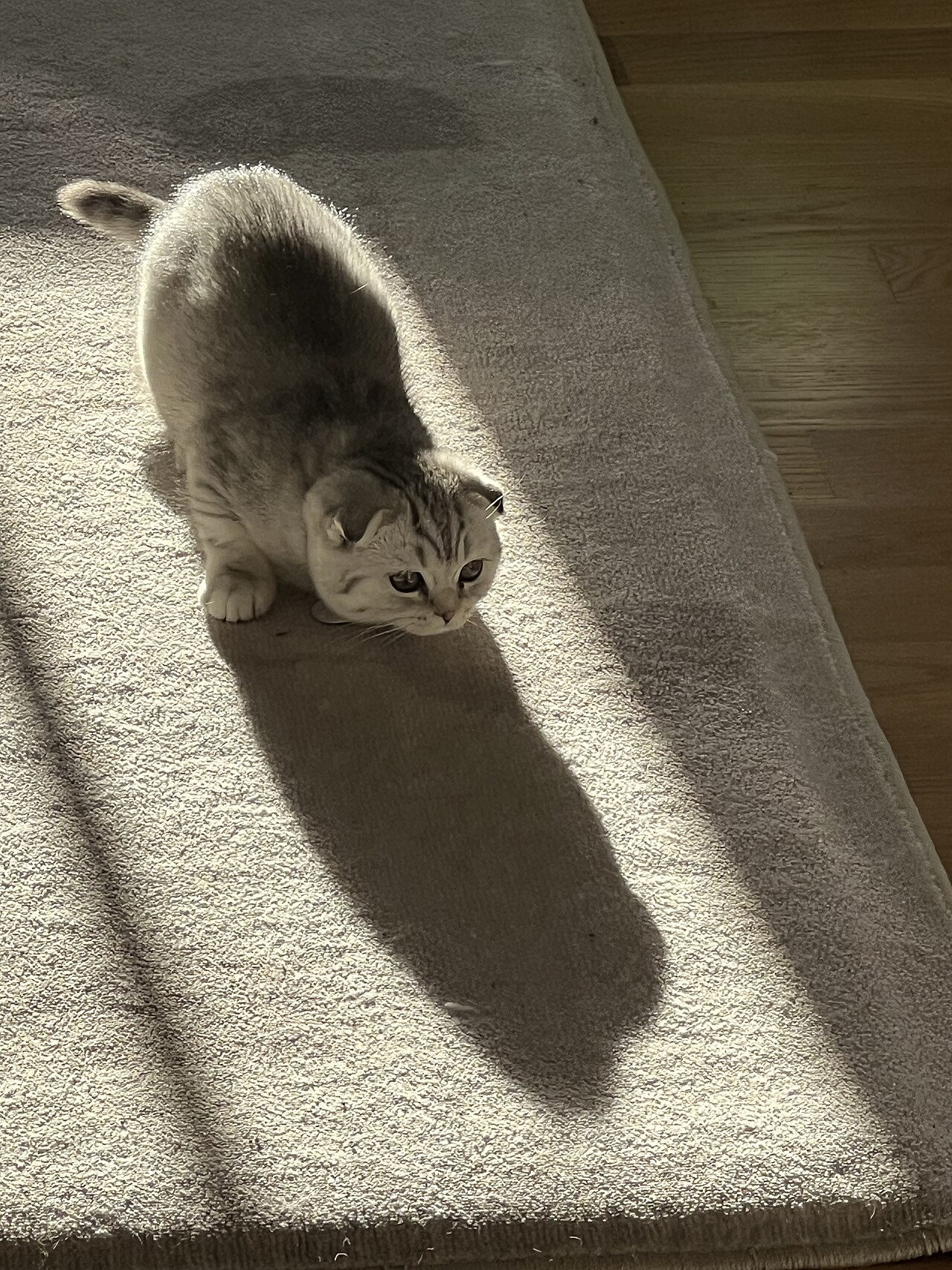
The Scottish Fold is famous for one thing: ears that fold forward and down like a small hood. That look is not a breed quirk. It comes from a single dominant gene that changes how cartilage forms, and the same gene causes the breed's biggest health problem. The ear shape and the disease are two sides of one mutation.
Here is the honest summary before the details. Every Scottish Fold carries the fold gene, and every fold carries some risk of a joint condition called osteochondrodysplasia. Some folds never show serious symptoms. Others develop stiff, painful joints early in life. There is no cure, but a lot can be done to slow the disease and keep a cat comfortable. Knowing the signs early is the best move you can make.
1. Osteochondrodysplasia (OCD)
Osteochondrodysplasia is a developmental disease of cartilage and bone. In Scottish Folds it is caused by the same dominant gene, called Fd, that folds the ears. Cartilage cushions joints and shapes ears, so a gene that bends ear cartilage also affects the joints, the spine, and the tail.
Cats inherit two copies of every gene. A fold with two copies, written FdFd, develops severe and widespread skeletal disease: thickened short limbs, a stiff painful tail, and crippling arthritis. This is why responsible breeders never mate two folds together. About a quarter of the kittens from such a pairing would be homozygous, a welfare problem. A fold with one copy, written Fdfd, is the typical pet Scottish Fold. The risk is milder but still real. Some Fdfd cats develop osteochondrodysplasia, and some do not. All of them carry the risk.
2. Signs to Watch
Osteochondrodysplasia usually shows up between a few months and a few years of age. The earliest sign is often the tail. A healthy cat tail bends freely. A fold with the disease has a stiff, short, or painful tail, and the cat may hold it stiffly.
Watch the legs and the way the cat moves. Reluctance to jump, a stiff or stilted walk, swollen paws or ankles, and lameness after exercise are all red flags. Some cats sit like a human with hind legs out, or stop using the stairs they used to fly down. Any new stiffness or pain deserves a vet visit. Cats hide pain well, so a change in behavior is often the first honest clue.
3. How Vets Diagnose It
A vet starts with a physical exam, feeling the joints and the tail and watching the cat move. The diagnosis is confirmed with X-rays of the limbs, tail, and spine. The images show the classic changes: extra bone growth around joints, thickened bones, and narrowed joint spaces.
Parentage matters too. A fold from two fold parents carries a much higher risk, while a fold from a fold and a straight parent carries the standard heterozygous risk. Some breeders X-ray kittens early to screen for changes. If you adopt a fold, ask the breeder about the parents and screening. If you rescued a cat with folded ears, have the vet look closely at the first checkup.
4. Treatment & Management
There is no cure for osteochondrodysplasia. It cannot be reversed, but it can be managed, and good management makes a real difference in quality of life. Pain relief is the foundation: anti-inflammatory drugs and other prescription pain medicine, always under vet guidance.
Joint supplements and omega-3 fatty acids help some cats. Keeping the cat lean is one of your most powerful tools, because extra weight loads the joints. At home, make life easier: soft beds in warm spots, ramps up to the sofa, low-sided litter boxes, and bowls that avoid a deep crouch. Many affected folds live happy, comfortable lives for years.
5. Breeding Ethics
The ethics question is simple and uncomfortable. The fold look exists because of a mutation that can cause pain. Homozygous kittens, from two fold parents, can be severely deformed, a serious welfare problem. So responsible breeders never mate fold to fold. Every pedigree fold should come from crossing a fold with a Scottish Straight.
A Scottish Straight comes from the same litters with normal, upright ears. It carries no fold gene and none of the joint risk. A few registries do not accept the fold for showing, and some countries restrict breeding entirely. If you want the breed's look without the gamble, a Scottish Straight is worth a look. The Munchkin has a similar story: a different gene, but the same lesson that cute shapes can cost cats their joints. The Minuet, a Munchkin crossed with a Persian, inherits the same short legs and the same joint considerations.
Fold vs. Normal Cat
One table shows the gap between a healthy cat and an affected fold. If your cat shows several of these, book a vet visit.
Scottish Fold compared to a normal cat
| Symptom or behavior | Normal cat | Affected fold |
|---|---|---|
| Tail | Bends freely, waves often | Stiff, thick, painful to touch |
| Jumping | Leaps onto counters without thinking | Hesitates, jumps low or not at all |
| Gait | Smooth and fluid | Stiff, stilted, or limping |
| Paws and ankles | Neat and normal sized | Swollen or thickened |
| After play | Recovers quickly | Sore, stiff, or reluctant to move |
| Being handled | Fine, enjoys touch | Flinches, avoids certain areas |
6. What It Means for Your Cat
Here is the balanced truth. Not every Scottish Fold develops serious disease. Many live with mild stiffness or none at all, especially those from careful breeding lines. But every fold carries the gene, so every fold carries the risk. Adopt with eyes open, keep the cat lean, watch its movement, and work with a vet who knows the breed.
If your cat has folded ears, start with the full Scottish Fold breed profile, then compare the face and ears against the British Shorthair, the fold's closest lookalike. If your cat has upright ears and you are not sure what it is, run a photo through our cat breed identifier or work through the cat breed identification guide feature by feature. The right answer starts with looking closely.
⚕️ Furriq Health Screen is a visual observation tool, not a veterinary diagnosis. This analysis does not replace professional veterinary advice. Always consult a licensed veterinarian for any health concerns about your cat.
Related breeds
All breedsKeep reading
All articlesHealth
Sphynx Cat Health Problems: 6 Issues
Sphynx cats face real health risks: HCM, myasthenia, skin oil buildup, dental disease, sunburn, and temperature issues. Here is what to watch.
6 min read
Health
Bengal Cat Health Problems: 5 Issues
Bengals face PRA, FIP, flat-chested kitten syndrome, separation anxiety, and skin sensitivity. Here is what to watch in this high-energy breed.
5 min read
Health
Maine Coon Cat Health Problems: 4 Issues
Maine Coons carry HCM, hip dysplasia, spinal muscular atrophy, and obesity risk. Here is what to watch in the gentle giant.
5 min read
Still not sure what your cat is?
Stop guessing from photos and text. Upload one clear photo and the AI checks 40+ visual markers in seconds. Free, no sign-up, and your photo is never stored.
Free cat breed scan