

Most cats are mixes. Shelters hand out cats with a family history of "somebody's barn cat had kittens," and that is where "Maine Coon mix" enters the story. It is one of the most common labels in the shelter world, slapped on any big, fluffy cat with ear tufts. That tells you how much weight the label should carry.
Here is the honest framing: Maine Coon mix identification is not about confirming a pedigree. It is about counting features. Purebred Maine Coons are rare and almost always come with paperwork. The real question is not "is my cat purebred?" It is "how many strong Maine Coon traits does my cat show?"
Quick conclusion up front. A cat with several strong traits, big bones, ear tufts, a square muzzle, a plush tail, is probably part Maine Coon. A cat with one trait, usually the fluff, is probably not. And a Maine Coon mix can be small. Size is a clue, not a requirement. Keep that in mind as you work through the list.
1. Size and Bone
Start with the feature everyone knows: size. The Maine Coon is the largest domestic cat breed. Males run 13 to 18 pounds, and plenty clear 20. The body is long and rectangular, the chest broad, the paws big enough to look like snowshoes.
Now the part that surprises people. A Maine Coon mix may not be big at all. Mixes inherit a random slice of traits from each parent, and size is not guaranteed. Plenty of confirmed mixes weigh 9 pounds, the same as an ordinary domestic cat. So a small cat does not rule the breed out, and a big cat alone does not prove it. Big bone is a strong signal. Size alone is a weak one. For the full picture, see the Maine Coon breed profile.
2. Ear Tufts and Tail
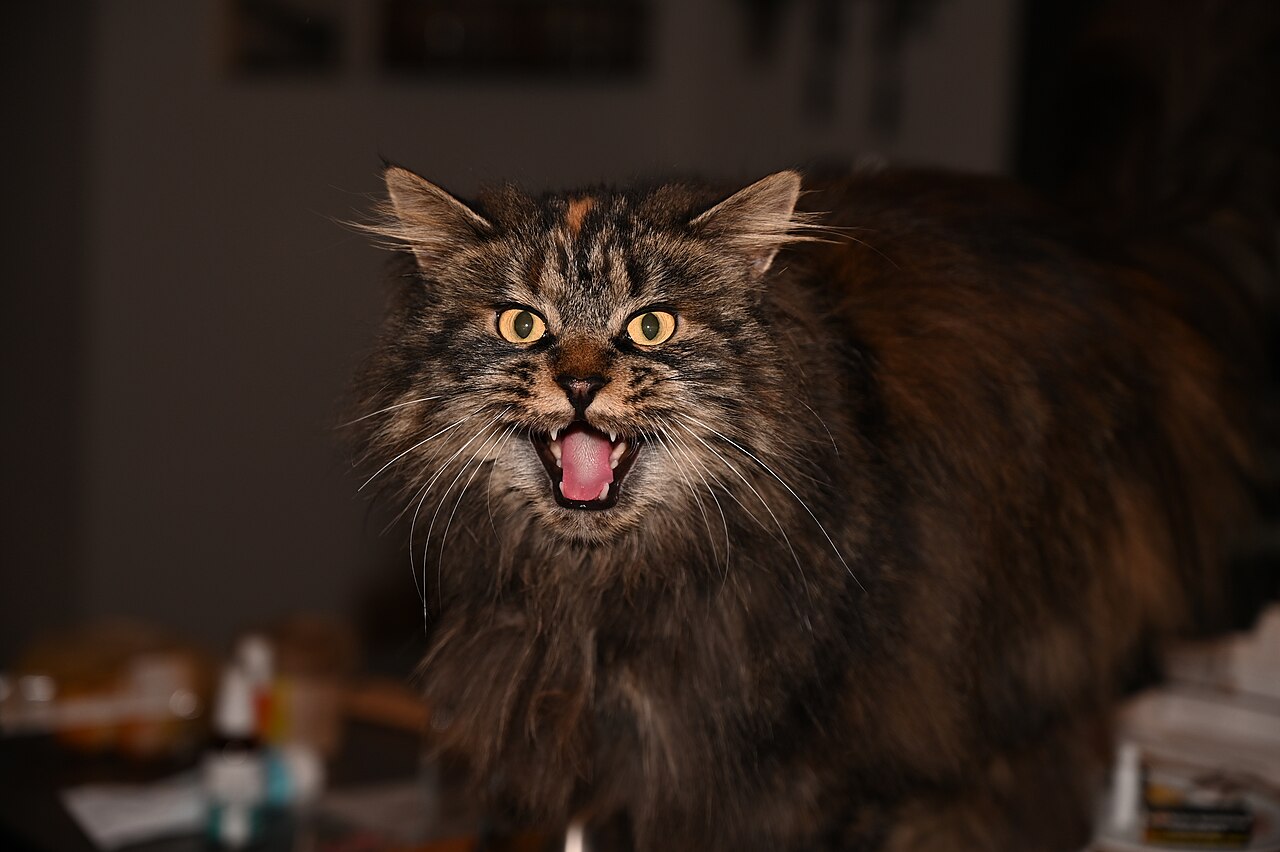
Ear tufts are fur that sprouts from the tips of the ears, like a lynx. Not the fuzz inside the ear, every cat has that. Actual tufts poking off the points. This is one of the strongest Maine Coon signals, shared with the Norwegian Forest Cat and the Siberian.
The tail is the second half of the pair. A Maine Coon tail is long, thick, and plume-like, nearly as long as the body, the kind you could wrap around the cat like a scarf. Here is the useful pattern: mixes often keep the tail even when they do not keep the size. A medium cat with a plume tail and ear tufts is a more convincing Maine Coon mix than a big cat with ordinary ears.
3. Coat and Ruff
The Maine Coon coat is thick, shaggy, and water-resistant, a true double coat with a soft underlayer under the guard hairs. The fur is shorter on the shoulders, longer on the belly and the britches, and it forms a ruff, a mane around the neck and chest that gives the cat a lion look.
Color does not narrow things down. Maine Coons come in almost every color, and black is common. If you have a black cat, look for a reddish or brownish tinge in direct sunlight, called "rusting." It is normal sun bleaching, not a health problem.
Now the warning. Fluff is the trait random-bred cats produce on their own. Half the "Maine Coon mixes" in shelters are just fluffy domestic longhairs with a generous label. Coat alone is the weakest evidence here. Coat plus ear tufts plus a plume tail is a different story.
4. Square Muzzle
Look at the face straight on. The Maine Coon has a broad head, slightly longer than it is wide, with high cheekbones and a muzzle that is distinctly squared off. The chin is strong. Compare that to a pointed Siamese face or a flat Persian face, and the difference is obvious.
The square muzzle matters because it is hard to fake. Fluff is easy, bone structure is not. A square muzzle and ear tufts together is a two-point combo that points at the Maine Coon more than anything else on this list.
5. Personality Clues
Maine Coons are famously friendly, dog-like cats. They greet visitors, follow you room to room, tolerate kids, get along with other pets, and chirp and trill instead of yowling. If your big fluffy cat does all of that, it fits the picture.
Here is the catch. Personality is the weakest evidence in mix identification. Domestic longhairs can be just as friendly and just as chirpy. The Maine Coon temperament is real, and you can read the full breakdown in our Maine Coon personality guide, but behavior only confirms what the body already suggested.
6. The Honest Limits of Visual ID
Say it plainly: visual identification cannot confirm a Maine Coon mix. Shelters guess, vets guess, and experienced cat people guess. Everyone works from the same feature list, and everyone can be wrong. Only a DNA test gives a real answer, and even it reports percentages, not a certificate.
What the visual method can do is rank the possibilities. Count strong traits. Three or more, and "Maine Coon mix" is a fair description. One trait, usually the coat, and "domestic longhair" is the more honest label. Here is the comparison at a glance.
Pure Maine Coon vs. mix vs. not one
| Trait | Pure Maine Coon | Maine Coon mix | Not a Maine Coon |
|---|---|---|---|
| Size and bone | Males 13-18 lbs plus, heavy bone | Often big, but can be a normal 9-10 lbs | Usually under 12 lbs, light bone |
| Ears and tail | Lynx tufts, plume tail | Tufts, plush tail, or both | Plain ears, average tail |
| Face and coat | Square muzzle, ruff, double coat | Some features, rarely all | Round or pointed face, single coat |
So what do you do with the answer? Keep it honest. Three or more strong features, and "Maine Coon mix" is a fair claim. One feature, especially just the fluff, and you have a lovely domestic longhair. Neither label changes the cat. It is the same animal either way, with the same chirps and lap preferences.
Want to dig deeper? Read the full Maine Coon breed profile, work through the cat breed identification guide, or run a photo through our cat breed identifier to see which features the algorithm picks up. The more features you can name, the better your guess gets.
FAQ
Can a Maine Coon mix be small?
Yes. Mixes inherit a random slice of traits from each parent, and size is not guaranteed. Plenty of confirmed mixes weigh 9 pounds, the same as an ordinary domestic cat. A small cat does not rule the breed out, and a big cat alone does not prove it.
What is the difference between a Maine Coon mix and a Norwegian Forest Cat mix?
Look at the face and the personality. Maine Coons carry a square muzzle, ear tufts, and a plume tail, and they act like friendly, dog-like cats. Norwegian Forest Cats have a more triangular head with a straight profile, and they are the more independent climbers of the two. Both are big-boned longhairs with ear tufts, so they get confused constantly. Face shape and temperament separate them better than coat.
How much does a Maine Coon mix cost?
Adoption and shelter prices vary widely, typically from a few dozen to a few hundred dollars. Purebred Maine Coons from breeders cost far more and usually come with registration papers. A mix from a rescue is the budget path, and the cat does not care what you paid.
Are Maine Coon mixes good with dogs and kids?
Usually, yes. Maine Coons are famous for being friendly with children and dogs, with a dog-like personality to match. A mix inherits that temperament often but not always, so individual personality matters most. Meet the actual cat before assuming anything.
Related breeds
All breedsKeep reading
All articlesIdentification
Cats That Look Like Maine Coons: 4 Breeds Compared
Is it a Maine Coon or a look-alike? 4 breeds match the size, tufts, and shaggy coat. See the tells that give each one away.
5 min read
Identification
How to Identify a Mixed Breed Cat: 7 Mixes
Identify your mixed breed cat: Birman, Turkish Angora, Abyssinian, Maine Coon, Siamese, and Ragdoll mixes. What each looks like and how to count clues.
9 min read
Identification
Cats That Look Like Bengals: 5 Breeds Compared
Egyptian Mau, Ocicat, or Savannah? Compare 5 breeds that mimic Bengal rosettes, build, and wild expression, with photos and trait checklists.
6 min read
Still not sure what your cat is?
Stop guessing from photos and text. Upload one clear photo and the AI checks 40+ visual markers in seconds. Free, no sign-up, and your photo is never stored.
Free cat breed scan