
Maine Coons look like the wild cats of the north. Big, shaggy, ear tufts, a tail you could wrap around your neck. People fall for the look first, then find the cat behind it is even better: a calm, friendly, dog-like temperament in the largest domestic cat breed there is. The size gets the attention. The personality makes owners stay.
Here is the short version. Maine Coons are big, slow to mature, and quieter than most cats. They are gentle with people of every age, get along with other animals, and bond with their family without being needy. They are smart, trainable, and happiest with room to roam and a human to follow.
That package, size plus an easy-going temperament, earned the breed the nickname "gentle giant." It is also why households with kids and pets pick a Maine Coon so often. Here is what the Maine Coon temperament and characteristics actually look like, feature by feature. For the physical side, see the Maine Coon breed profile.
Size and Build: The Giant Factor
Let us start with the obvious. The Maine Coon is the largest domestic cat breed, and the difference is not subtle. Males typically weigh 13 to 18 pounds, and plenty push past 20. Females are smaller but still big, usually 8 to 12 pounds. Picture a long rectangular body, broad chest, heavy bones, and a tail nearly as long as the body.
Size shapes everything else. You will need bigger litter boxes, sturdier furniture, and a cat tree built for weight. You will also need patience: these cats keep growing until three to five years old. A Maine Coon kitten looks ordinary. The same cat at four is twice the cat.
Temperament: The Gentle Giant Personality
For a cat that size, the Maine Coon personality is remarkably mellow. These cats are not hyper, not aggressive, not easily startled. They watch a new situation calmly instead of diving under the sofa. It is one of the most reliable Maine Coon characteristics: a big cat with a soft, patient nature.
They are affectionate but not clingy. A Maine Coon follows you from room to room, sits near you while you work, sleeps on your bed. It rarely demands to be held. Most prefer to be close on their own terms, draped over the couch beside you rather than in your lap.
Intelligence and Trainability
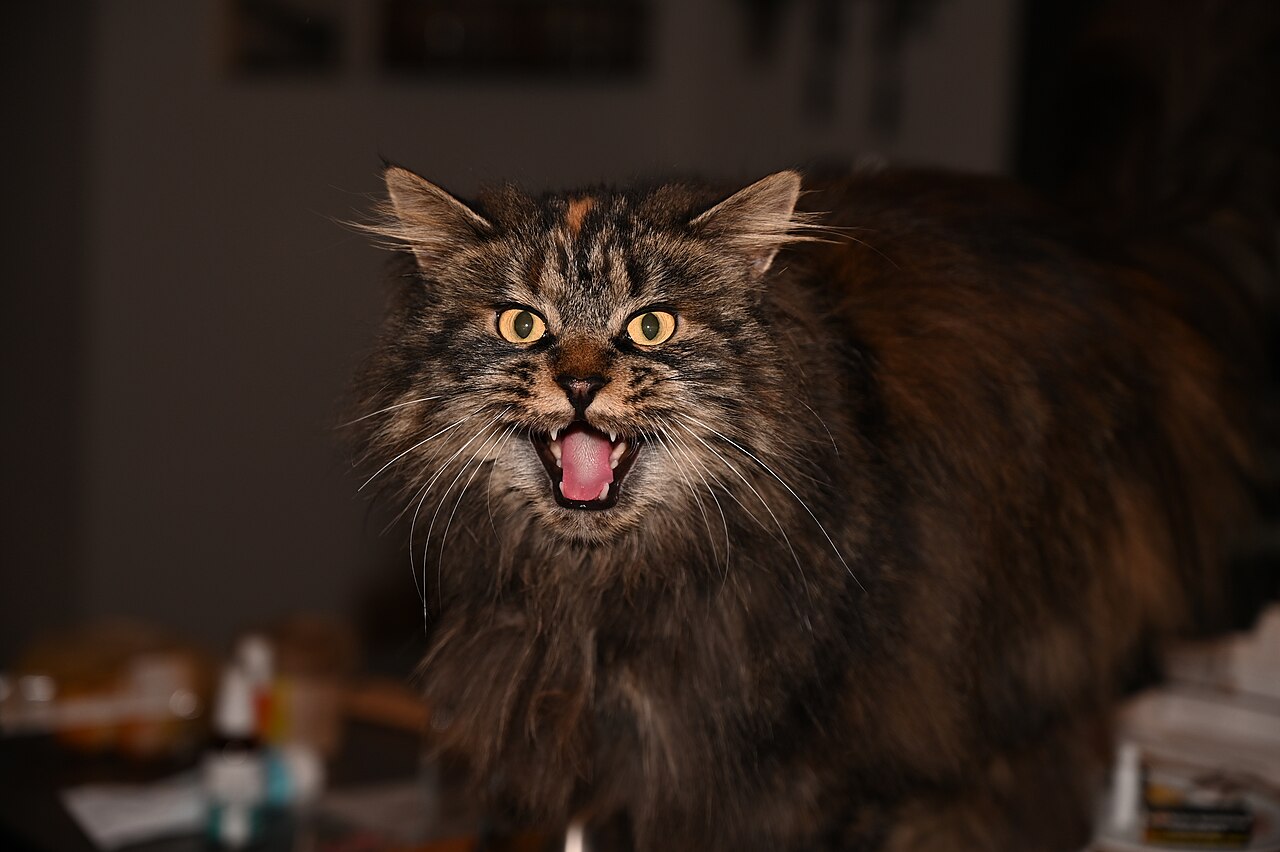
Maine Coons are smart, and it shows. They learn to open doors, reach the top shelf, and find where you hide the treats. That intelligence makes them one of the easiest cats to train. Many owners teach theirs to fetch, sit, high-five, and walk on a harness. The breed also loves water, dipping paws into bowls or joining you at the sink, a quirk you will not see in most cats.
The flip side: a smart cat with nothing to do gets bored. Maine Coons do best with toys, puzzle feeders, and a little daily play. Give one a job, even fetching a toy, and you will have a content cat. Leave one alone all day and you may come home to a rearranged living room.
Social Behavior: How They Bond
If you want a cat that greets you at the door, the Maine Coon is a strong candidate. The breed is famously social, closer to a dog in behavior than most cats. They are friendly with everyone, not just their owner. Guests, delivery people, the vet: a well-adjusted Maine Coon treats strangers as potential friends.
That sociability is why the breed suits first-time owners. The Maine Coon temperament takes the guesswork out of cat ownership. You do not have to earn trust slowly or decode mysterious signals. The cat walks up, says hello in its own quiet way, and decides you are family within a day.
With Kids and Other Pets
Maine Coons are one of the better breeds for households with children. They are patient, sturdy, and rarely scratch or bite in frustration. A child who is too rough with most cats gets a warning meow from a Maine Coon, then a retreat. Size helps: a 15-pound cat does not feel threatened by a toddler.
Other pets are rarely a problem either. Maine Coons generally accept dogs, other cats, and even small animals, as long as introductions are gradual. The breed is not territorial or aggressive by nature, which makes it a solid choice for multi-pet homes.
Vocalization: Chirps, Trills, and Quiet
Here is a surprise for people who expect a giant cat with a giant voice: Maine Coons are quiet. They do not yowl or meow constantly like Siamese cats. Instead they make a distinctive chirp or trill, a soft musical sound more bird than cat. Owners describe it as talking in questions: the cat chirps, waits, and chirps again.
They use this voice deliberately. A Maine Coon chirps to greet you, to ask for food, to say the water bowl is empty. The sound is gentle enough that you will not be woken at 3 a.m. by a screaming cat. You will hear a soft trill from the hallway, which is somehow worse, because you will get up and feed it.
Care Implications: What the Personality Means for You
The Maine Coon personality is easy to live with. The maintenance is not. The coat is a thick, water-resistant double coat that needs brushing two to three times a week, more during shedding season. Skipping it means mats, and mats mean the vet and a shaved cat.
Space matters too. A cat this size wants room to stretch, climb, and patrol. Apartments can work with cat trees and playtime, but a house suits the breed better. Factor in food: big cat, big appetite, and obesity is a real risk if you free-feed. Add a taller scratching post, a sturdier litter box, and furniture that survives a 20-pound landing.
Maine Coon vs Norwegian Forest Cat: temperament at a glance
| Trait | Maine Coon | Norwegian Forest Cat |
|---|---|---|
| Size | Largest, males 13-18 lbs plus | Large, males 9-16 lbs |
| Temperament | Mellow, people-focused | Independent, reserved |
| Vocalization | Quiet, chirps and trills | Quiet, soft meows |
| With strangers | Friendly, curious | Wary, warms up slowly |
| Maturity | 3-5 years | 4-5 years |
| Grooming | Double coat, brush weekly | Double coat, brush weekly |
None of this is a reason to skip the breed. It is a reason to go in informed. The Maine Coon gives you a loyal, gentle, intelligent companion for 12 to 15 years, and asks for grooming, space, and attention in return. For most owners, that trade is a good one.
If you are wondering whether your own big, fluffy cat is a Maine Coon or just a large domestic longhair, personality is part of the puzzle but not proof. Size, ear tufts, the square muzzle, and that chirp together make a much stronger case. Compare your cat against the Maine Coon breed profile, work through the visual identification guide, or upload a photo to our cat breed identifier. If the result says Maine Coon, you live with a gentle giant. If it says domestic longhair, you still live with a gentle giant. The label changes nothing about the cat.
Related breeds
All breedsKeep reading
All articlesBreed Guides
Siamese Cat Personality & Behavior: What to Expect
Siamese cats are loud, clingy, and brilliant. The Siamese personality means constant meowing, intense attachment, and daily play. Is that your cat?
7 min read
Breed Guides
Sphynx Personality & Temperament: What to Expect
The Sphynx temperament is more dog than cat: clingy, playful, smart, and prone to separation anxiety. What to expect before you adopt one.
7 min read
Breed Guides
Birman Cat: Personality, Care & History
Deep blue eyes, white gloves, a pointed coat. Birman personality: calm, quiet, devoted. Care routine, health notes, and the Sacred Cat of Burma legend.
8 min read
Still not sure what your cat is?
Stop guessing from photos and text. Upload one clear photo and the AI checks 40+ visual markers in seconds. Free, no sign-up, and your photo is never stored.
Free cat breed scan