
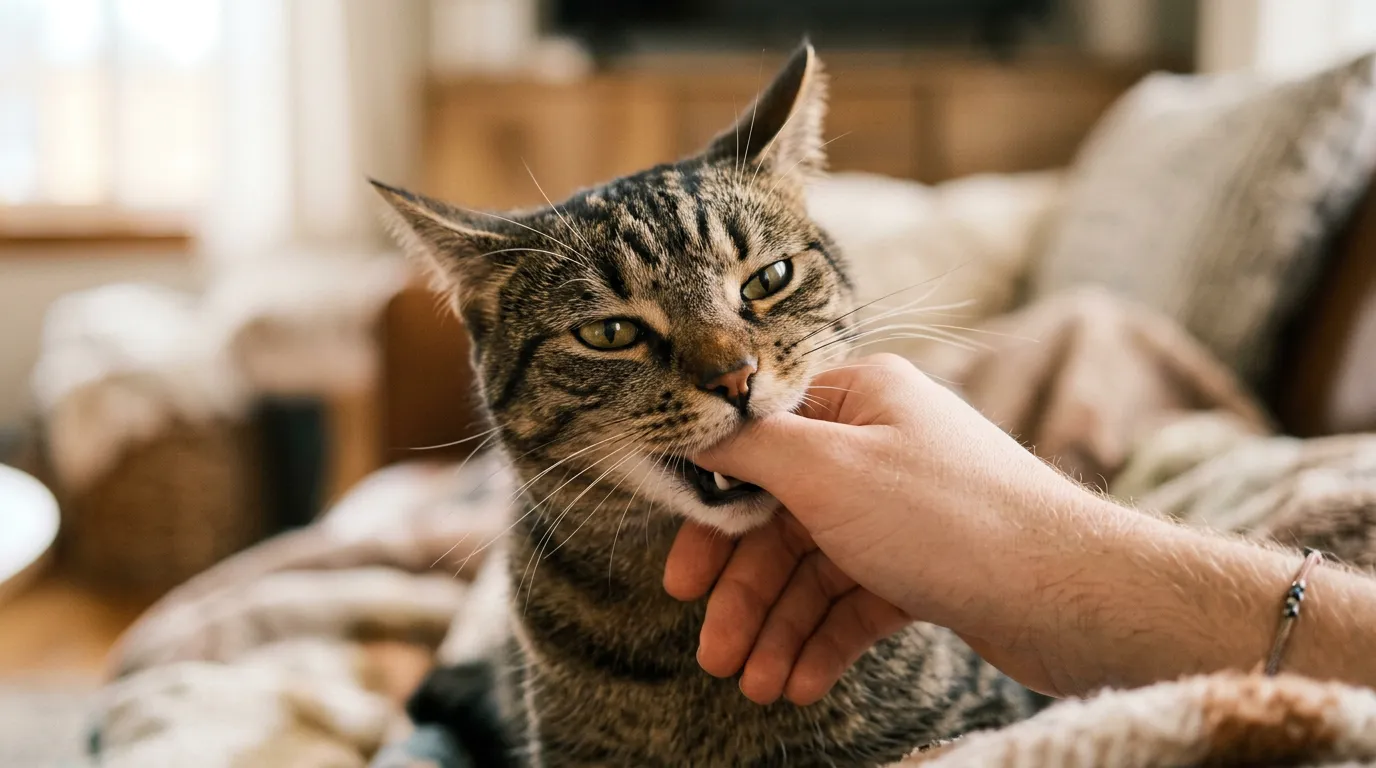
1. Overstimulation (Petting-Induced Aggression)
This is the most common reason cats bite during petting. The cat enjoys being petted, then suddenly reaches its threshold and bites. It is not being mean — its nervous system has had enough. Some cats have a very low threshold (30 seconds), others can be petted for minutes.
Warning Signs
- Tail starts twitching or swishing while being petted
- Ears flatten slightly or rotate back
- Skin ripples or twitches along the back
- The cat turns its head toward your hand
- Sudden bite after several seconds of calm petting
What to Do
Learn your cat's threshold and stop petting before it reaches it. Watch for the warning signs (tail twitch, ear rotation). When you see them, stop immediately. Short, frequent petting sessions work better than long ones. Let the cat come to you for more.
Breed Differences
Siamese and other Oriental breeds tend to have lower petting thresholds. Ragdolls and Persians are generally more tolerant. Mixed breeds vary widely — learn your individual cat's limit.
2. Play Aggression
Kittens and young cats bite during play because they are practicing hunting. This is normal kitten behavior, but if not redirected, it becomes a habit in adult cats. The cat is not being aggressive — it is playing the only way it knows how.
Warning Signs
- The cat stalks your hands or feet before biting
- Bites are accompanied by bunny kicks with hind legs
- The cat crouches low, wiggles its butt, then pounces
- Biting happens more in the evening (natural hunting time)
- The cat's pupils are dilated during the attack
What to Do
Never use your hands as toys. Always use a toy between your hand and the cat. When the cat bites during play, stop all play immediately and walk away. Redirect the energy to interactive toys (wand toys, laser pointers). Play with the cat for 15-20 minutes before bed to tire it out.
Breed Differences
Bengals, Abyssinians, and Siamese are the most play-aggressive breeds. They need more interactive play time than average. British Shorthairs and Persians are less likely to play-bite.
3. Fear Biting
A scared cat bites as a last resort. It has already tried to warn you with body language (flattened ears, hissing, crouching) and you (or the situation) did not back off. Fear biting is defensive — the cat wants the threat to go away.
Warning Signs
- Ears flattened against the head
- Hissing or growling before the bite
- Body crouched low, tail tucked
- The cat is cornered or has no escape route
- Bite is quick, followed by the cat trying to flee
What to Do
Give the cat space. Never corner a scared cat. Let it come to you on its own terms. If the cat is scared of specific things (loud noises, strangers), gradual desensitization can help. Provide hiding spots (boxes, cat trees) so the cat always has an escape route.
Breed Differences
Siamese and other high-strung breeds are more prone to fear biting. Ragdolls and Maine Coons are generally more confident and less fear-reactive. Socialization as a kitten is the biggest factor.
4. Love Bites (Affectionate Biting)
Some cats give gentle, nibbling bites as a sign of affection. These are usually soft and do not break the skin. The cat is showing you it likes you — in cat language, gentle biting is a social bonding behavior.
Warning Signs
- Bites are gentle and do not break the skin
- The cat is purring or relaxed while biting
- Bites happen during petting or cuddling
- The cat may also lick you before or after the bite
- Body language is relaxed (no tension, no flattened ears)
What to Do
You do not need to stop love bites — they are a sign of affection. If they bother you, gently redirect the cat's attention to a toy. Do not punish the cat for love bites — it will not understand why you are upset.
Breed Differences
Siamese and Burmese are known for love bites. Maine Coons are gentle giants who rarely bite hard. Bengals may bite more intensely during play but are not typically love-biters.
5. Pain-Induced Biting
A cat in pain may bite when you touch the sore area. This is not aggression — the cat is protecting itself from further pain. If a normally gentle cat suddenly starts biting, pain is the first thing to rule out.
Warning Signs
- Biting started suddenly (was not a biter before)
- Bite happens when you touch a specific area
- The cat flinches or pulls away before biting
- Changes in appetite, grooming, or litter box habits
- The cat is less active or hides more than usual
What to Do
Take the cat to the vet immediately. Sudden behavioral changes, especially biting, often indicate pain or illness. Do not try to diagnose the problem yourself — cats hide pain very well, and by the time they show signs, the problem may be serious.
Breed Differences
All breeds can bite from pain. Scottish Folds are prone to joint problems that can cause pain-induced biting. Maine Coons are susceptible to hip dysplasia. Regular vet checkups catch problems early.
6. Territorial Biting
Cats are territorial animals. They may bite when they feel their territory is being invaded — by another cat, a new person, or even new furniture. Territorial biting is usually directed at the perceived intruder.
Warning Signs
- Biting happens when a new person or animal enters the home
- The cat guards specific areas (bed, couch, food bowl)
- Urine marking may accompany the biting
- The cat stares, hisses, or growls before biting
- Aggression is directed at a specific person or animal
What to Do
Introduce new people and animals slowly. Give the cat its own space that no one else invades. Use Feliway (synthetic pheromone) to reduce territorial stress. If introducing a new cat, follow the slow introduction protocol (separate rooms, scent swapping, supervised meetings).
Breed Differences
Siamese and Bengals are more territorial than average. Ragdolls and Maine Coons are generally more accepting of new people and animals. Neutering reduces territorial behavior in all breeds.
Quick Reference: Why Is My Cat Biting?
| Type | When | Force | Fix |
|---|---|---|---|
| Overstimulation | Tail starts twitching or swishing... | Varies | Learn your cat's threshold and stop petting before it reaches it. |
| Play Aggression | The cat stalks your hands... | Medium | Never use your hands as toys. |
| Fear Biting | Ears flattened against the head... | Hard | Give the cat space. |
| Love Bites | Bites are gentle and do... | Gentle | You do not need to stop love bites — they are a sign of affection. |
| Pain-Induced Biting | Biting started suddenly (was not... | Varies | Take the cat to the vet immediately. |
| Territorial Biting | Biting happens when a new... | Varies | Introduce new people and animals slowly. |
Related: Why Does My Cat Knead Me?
Kneading (pushing paws in and out on you) is related to biting but means something completely different. Kittens knead their mother's belly to stimulate milk flow. Adult cats knead when they feel safe, comfortable, and content. If your cat kneads you, it means "I feel like I did when I was a kitten with my mother." Some cats knead and bite at the same time — this is usually a love bite combined with kneading, which is peak affection.
If your cat's kneading is painful (claws!), keep its nails trimmed and place a thick blanket between the cat and your lap. Do not punish kneading — it is one of the highest compliments a cat can give you.
Does Breed Affect Biting Behavior?
Yes, but individual personality matters more. Some breeds are known for specific tendencies:
- Siamese: More vocal, more prone to overstimulation biting, but also more affectionate. They have a low petting threshold but give more love bites.
- Bengal: High energy, more play-aggressive. Needs more interactive play than average. Bites during play are common if not redirected.
- Ragdoll: Goes limp when held, very tolerant of handling. One of the least likely breeds to bite.
- Maine Coon: Gentle giant. Rarely bites hard. More likely to chirp or trill than bite.
- British Shorthair: Calm and independent. Less likely to bite during play or petting.
Knowing your cat's breed can help you understand its biting tendencies and adjust your behavior accordingly.
Frequently Asked Questions
Why does my cat bite me when I pet it?
This is called petting-induced aggression or overstimulation. The cat enjoys being petted but has a threshold — when it is reached, the cat bites to say "enough." Watch for warning signs: tail twitching, ear rotation, skin rippling. Stop petting when you see these signs. Some cats have a threshold of 30 seconds, others can be petted for minutes.
Why does my cat bite me and then lick me?
This is a common cat behavior called "love biting." The cat is showing affection — the bite is gentle and the lick is a grooming gesture. It means "I like you." Some cats also bite then lick when they are overstimulated and trying to calm themselves down.
Why does my cat bite my feet?
Cats bite feet because feet moving under a blanket look like prey. This is play aggression — the cat is hunting your feet. Redirect the behavior with interactive toys. Play with the cat for 15-20 minutes before bed to tire it out. Never use your feet as toys.
Is it normal for kittens to bite?
Yes. Kittens bite during play because they are practicing hunting. This is normal behavior, but you should redirect it early. Never use your hands as toys — always use a toy between your hand and the kitten. If the kitten bites, stop play immediately and walk away. The kitten will learn that biting ends the fun.
Why does my cat bite me when I stop petting it?
Some cats bite to demand more petting. This is a demand behavior — the cat has learned that biting gets a reaction. To fix this, stop petting before the cat demands more, and do not resume petting after a bite. Reward calm behavior with petting; ignore demanding behavior.
Should I punish my cat for biting?
No. Punishment (spraying water, yelling, hitting) does not work on cats and will make the problem worse. The cat will not understand why it is being punished — it will just become afraid of you. Instead, redirect the behavior, remove yourself from the situation, and reward good behavior.
Why does my cat bite me when I touch its belly?
The belly is a vulnerable area with vital organs. When a cat exposes its belly, it is showing trust — not inviting you to touch. Touching the belly triggers a defensive reflex (the cat grabs your hand with paws and bites). This is normal cat behavior, not aggression.
How do I stop my cat from biting?
First, identify why the cat is biting (overstimulation, play, fear, pain). Then address the root cause: learn the cat's petting threshold, provide more play time, give the cat space, or see the vet. Never punish biting — redirect it. If the biting is sudden and new, see the vet first to rule out pain.
Do some cat breeds bite more than others?
Yes. Siamese, Bengals, and Abyssinians are more prone to play biting and overstimulation. Ragdolls, Persians, and British Shorthairs are generally more tolerant. But individual personality matters more than breed — a well-socialized Siamese may bite less than a poorly socialized Ragdoll.
When should I see a vet about my cat biting?
See the vet if: the biting started suddenly (was not a biter before), the cat bites when you touch a specific area, the cat has other behavioral changes (appetite, grooming, activity level), or the bite broke the skin and shows signs of infection. Sudden behavioral changes often indicate pain or illness.