

Three details identify a Birman before the cat even moves. White gloves on all four paws. Deep sapphire blue eyes. A pointed coat, pale gold on the body with darker ears, face, legs, and tail. Few breeds are this easy to spot, and no other breed puts all three together.
There is a story behind every part of that look. The Birman is the Sacred Cat of Burma, and the legend says the breed was born inside a temple. Understand that story and you understand why these cats behave the way they do: calm, quiet, and devoted to their people.
1. The Legend of the Sacred Cat
According to the legend, the temple of Lao Tsun in ancient Burma sheltered a high priest named Mun-Ha. His companion was a white cat named Ki-Tsane, and the temple cats were watched over by a golden goddess with sapphire blue eyes. When invaders attacked, Mun-Ha fell and died at the foot of the goddess. Ki-Tsane pressed against the body, and the goddess worked through the cat. The white fur turned golden. The eyes turned the same deep blue as hers. The paws stayed white where they touched the priest's hair.
The other temple cats gathered, and each one took on the same markings. The goddess declared that every cat carrying those colors would be honored in the temple forever. That is the story behind the golden body, the blue eyes, and the four white gloves.
The history is thinner but real. The breed's ancestors lived in Burma, present day Myanmar, where temples kept them as sacred cats. In 1919 a pair was brought to France, and European breeders rebuilt the breed after the Second World War nearly erased it. The name Sacred Cat of Burma stuck.
2. Personality and Temperament
The Birman personality is the softest part of the breed. These cats are gentle, quiet, and remarkably easy to live with. They do not shout for attention like a Siamese and they do not demand nonstop play like a Bengal. A Birman wants to be near you, in the same room, on the same couch, often in the same lap, but it asks quietly.
Social in a calm way is the best summary. Birmans greet visitors, follow their people room to room, and settle next to a stranger without a hiss. They do well with gentle children and usually accept dogs and other cats after a proper introduction. Energy sits at moderate: a good play session, then back to the couch.
3. Coat and Color-Point
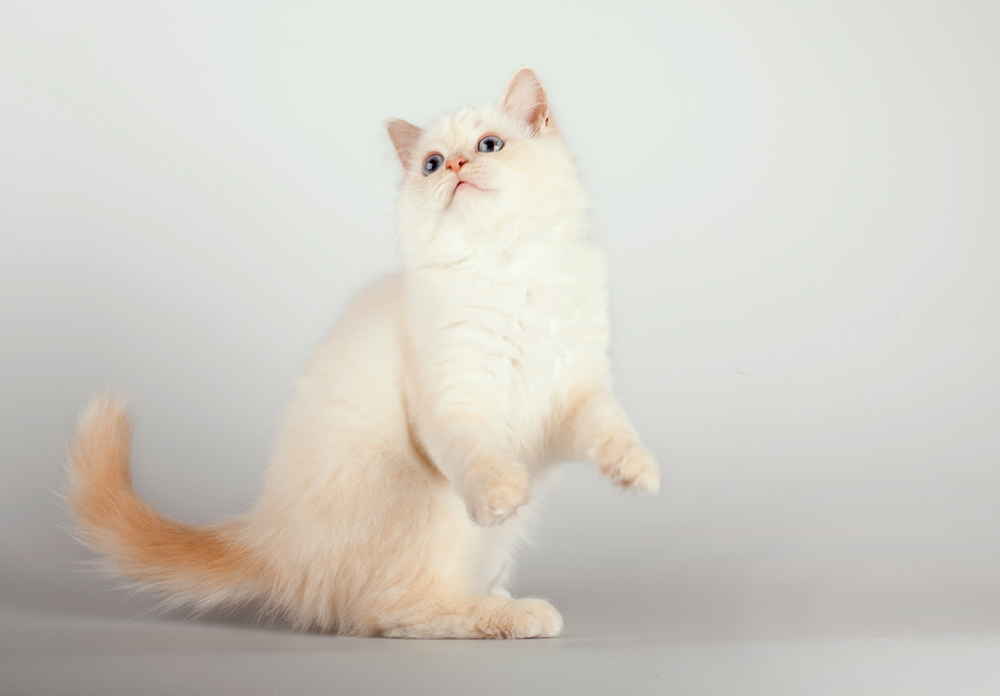
The coat is a single layer of medium to long silky hair with almost no undercoat. That matters more than it sounds. A single coat sheds less, mats less, and stays soft without constant work. The color-point pattern follows the Siamese family: a pale body with darker points on the ears, face, paws, and tail. Birmans come in seal, blue, chocolate, lilac, and a few rarer shades.
The signature is the white gloves. Every Birman has white feet, front and back, with the white stopping at the ankle or running up the back of the hind legs. No other pointed breed carries those gloves as a requirement. A pointed cat with white mitts is a Birman or a Birman cross. That one detail separates the breed from the Ragdoll and the Himalayan, which can share the pointed pattern and the blue eyes but never the gloves.
4. Care and Grooming
Birman care is straightforward. Brush the coat twice a week to remove loose hair and keep the silk from tangling. Trim nails every couple of weeks, clean the ears when they look dirty, and brush the teeth regularly. The single coat means no baths on a schedule, the way a Persian needs them. Most owners bathe only when the cat gets into something.
Plan for an indoor life. Birmans are trusting cats with no street sense, and the safest home keeps them inside. A scratching post, a window perch, and a few toys are enough; the breed handles apartment living better than most. Expect a warm weight on the bed by evening.
5. Health Notes
The Birman is a generally healthy breed with a typical lifespan of 12 to 16 years. Two conditions deserve attention. Hypertrophic cardiomyopathy, a thickening of the heart muscle, appears in the breed, so responsible breeders screen for it. Feline infectious peritonitis shows up more often in Birman lines than in the general cat population, which is one more reason to buy from a breeder who tests.
Standard care covers the rest. Keep the weight down, because pointed cats put on pounds easily, stay current on vaccines, and see the vet once a year, twice after age ten. The Birman is not high-maintenance, but it is long-lived, and routine care protects those years.
6. Birman vs Ragdoll vs Himalayan
Put a Birman next to the two breeds it is most often confused with and the table does the talking.
Birman vs. Ragdoll vs. Himalayan
| Trait | Birman | Ragdoll | Himalayan |
|---|---|---|---|
| Size | Medium, 7 to 12 lb | Large, 10 to 20 lb | Medium, 7 to 12 lb |
| Coat | Medium-long, silky, single layer | Long, plush, dense | Long, dense, Persian style |
| Face | Moderate and gentle | Moderate and sweet | Flat, Persian type |
| White gloves | Required, all four paws | Not required | Not required |
| Eye color | Deep blue | Blue | Blue |
| Energy | Moderate, calm | Low, very relaxed | Low, calm |
| Best home | Quiet families, apartments | Laid-back homes | Lap cats, calm homes |
Size is the quickest tell. Ragdolls are bigger, often ten pounds heavier, with a denser plush coat and no requirement for white feet. Himalayans are Persian cats with color points: flat face, round head, heavy coat, and a sleepier routine. The Birman sits between them, smaller than the Ragdoll, softer in the face than the Himalayan, and always wearing the gloves.
7. Is a Birman Right for You?
A Birman suits a home that wants affection without drama. Families with children, singles, seniors, and apartment dwellers all work, as long as someone is usually around. These cats bond to their people and do not love long days alone. If you are out twelve hours a day, a Birman will cope, but it will not be happy. A second cat can help, or a pet sitter on long days.
Buy from a breeder who health-tests and socializes kittens, or check Birman rescues, because the breed appears in shelters more often than people expect. The Birman is not a lap cat on loan. It is a companion, and the legend says it was bred to stay close to its people.
For the full rundown on standards, history, and the complete care list, read the Birman breed profile. If you are still sorting out which pointed cat you live with, compare the Ragdoll and Himalayan profiles, or run a photo through our cat breed identifier and work through the cat breed identification guide for the pointed-pattern shortlist.
Related breeds
All breedsKeep reading
All articlesBreed Guides
Maine Coon Personality & Characteristics
Maine Coon traits go beyond size: calm, friendly temperament, soft chirps instead of meows, and a slow climb to maturity. Life with a gentle giant.
7 min read
Breed Guides
Siamese Cat Personality & Behavior: What to Expect
Siamese cats are loud, clingy, and brilliant. The Siamese personality means constant meowing, intense attachment, and daily play. Is that your cat?
7 min read
Breed Guides
Sphynx Personality & Temperament: What to Expect
The Sphynx temperament is more dog than cat: clingy, playful, smart, and prone to separation anxiety. What to expect before you adopt one.
7 min read
Still not sure what your cat is?
Stop guessing from photos and text. Upload one clear photo and the AI checks 40+ visual markers in seconds. Free, no sign-up, and your photo is never stored.
Free cat breed scan