

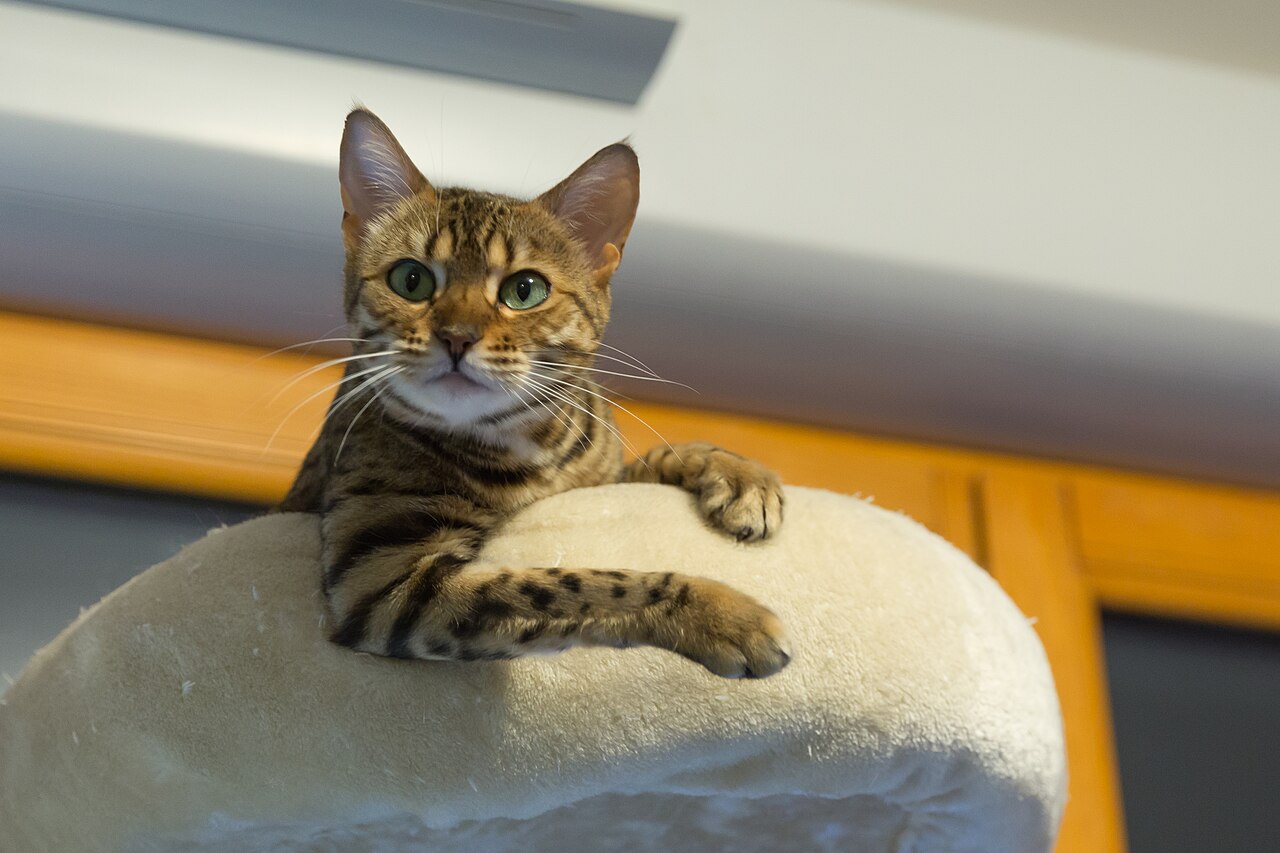
Picture a leopard in miniature: glittered golden coat, dark rosettes, an athletic stride. That is the Bengal, the house cat bred to carry the look and some of the spirit of a wild Asian leopard cat. Most cats watch you with polite curiosity. A Bengal watches you like it is deciding whether you are prey, playmate, or pack.
Here is the short version. Bengals are high energy, smart, and deeply bonded to their people, but they are demanding. They need daily play, climbing space, and a human who is home enough to engage them. This is not a cat for a first-time owner or a small apartment with no entertainment.
That heritage shapes everything below. This guide covers the history, energy, intelligence, quirks, and whether a Bengal fits your life. For the physical side, see the Bengal breed profile.
Where the Wild Comes From
The Bengal is not a spotted domestic cat named after a wild one. The breed descends from a real cross between the Asian leopard cat, a small wild feline of South and Southeast Asia, and domestic cats. Breeders, Jean Mill most famous among them, worked through the 1960s and 1980s to keep the striking coat while taming the temperament.
That project took generations. The first crosses, F1 and F2, are still half wild: shy, defensive, hard to live with. By the fourth generation, F4, the cats are domestic in temperament while keeping the wild look. Every pet Bengal today sits far enough from the original cross to be a house cat, but the instincts stayed in the gene pool.
Energy Level and Exercise Needs
Are Bengal cats high energy? Yes, emphatically. Most cats sleep sixteen hours and treat play as a hobby. A Bengal treats play as a job. Expect zoomies, vertical leaps, and a cat that wants interactive sessions twice a day or more.
This is the make-or-break part of Bengal ownership. A Bengal with outlets is a joy. Without them it climbs curtains, opens cabinets, and finds the one shelf you thought was unreachable. Cat trees and puzzle feeders are not optional extras; they are the difference between a happy cat and a destructive one.
Intelligence and Trainability
Bengals rank among the smartest cat breeds. Many learn to fetch, sit, high-five, and walk on a harness. Some open cabinet doors, turn on faucets, and work lever-style handles. Intelligence like this is wonderful until the cat uses it against you.
Training is not optional for a Bengal. Teach the cat what you want, reinforce it, and the cleverness works in your favor. Puzzle feeders and trick sessions burn the same mental energy that play burns physically. A bored Bengal is a Bengal that invents problems. The Abyssinian comes closest in mental energy among common breeds, yet even an Aby slides into downtime faster.
Social and Affectionate
With their own people, Bengals are affectionate to the point of being needy. They follow you from room to room, sit on your keyboard, and greet you at the door. The bond is intense, which is why Bengals do poorly when left alone all day.
Strangers are a different story. The territorial instinct runs strong, so Bengals often tolerate guests rather than charm them, and some stake out one human as theirs.
With Kids and Other Pets
Bengals suit active households better than quiet ones. Older children who play rough and tumble find a willing partner; a Bengal will chase, wrestle, and retrieve for hours. Very young children are better off with a calmer breed, since a Bengal plays hard and misses social cues.
Other cats are usually fine with gradual introductions and enough space. Small animals are another story. The prey drive is real, so hamsters, birds, and fish need secure enclosures. A Bengal will watch a cage the way it watches a bird outside the window. The Egyptian Mau shares that hunter focus, and the Toyger carries the striped look with a softer energy. True hybrids like the Savannah and the Chausie need even more space and prey-proofing, while the Serengeti borrows the serval look without the wild blood.
Water Obsession and Quirks
Most cats avoid water like a bath appointment. Bengals often do the opposite. Owners report cats that paw at running faucets, splash in bathtubs, drink from the toilet, and occasionally join the shower. Nobody is sure whether it comes from the Asian leopard cat lineage or generations of curious cats, but it is one of the breed's most reliable quirks.
The water habit pairs with other oddities. Many Bengals carry toys in their mouths and announce the catch with a loud, chirpy call. A Bengal that has decided the sink is its territory will stand in it, nudge the tap with a paw, and look at you as if to say the plumbing is doing its job.
Bengal vs Egyptian Mau vs Toyger: wild looks, three different energy levels
| Trait | Bengal | Egyptian Mau | Toyger |
|---|---|---|---|
| Energy | Very high, needs daily play | High, fast and athletic | Moderate, calm for its size |
| Personality | Bold, territorial, devoted | Loyal, one-person, vocal | Friendly, relaxed, easygoing |
| Wild look | Rosettes, glittered coat | Spotted, naturally ticked | Striped tiger pattern |
| Owner experience | Experienced owners only | Moderate, active home | First-time owner friendly |
All three wear patterns that echo wild cats, so the table matters more than the looks. The Bengal is the most demanding of the trio. The Egyptian Mau is a fast, loyal hunter with a softer edge. The Toyger delivers the tiger look with much gentler energy, making it the natural first stop if the wild look is the draw. More detail lives in the Toyger breed profile and the Egyptian Mau breed profile.
Is a Bengal Right for You?
Here is the honest checklist. Choose a Bengal if you have owned cats before, are home often, and can commit to daily interactive play, vertical space, and training. The rewards are real: one of the most athletic, engaged, and loyal cats you will ever live with.
Skip the breed if you are gone twelve hours a day, live in a studio with no climbing room, or want a calm lap cat. Plenty of wonderful breeds fit those lives; the Bengal is not one of them. Health is worth planning for too. Hypertrophic cardiomyopathy, a thickening of the heart muscle, and progressive retinal atrophy, which leads to blindness, both appear in the breed, so buy from a breeder who screens for them.
If you already share a home with a spotted, athletic cat, the label matters less than the care. Compare your cat against the Bengal breed profile, work through the cat breed identification guide, or run a photo through our cat breed identifier. Whatever the result, a high-energy cat is a commitment worth making.
Related breeds
All breedsKeep reading
All articlesBreed Guides
Maine Coon Personality & Characteristics
Maine Coon traits go beyond size: calm, friendly temperament, soft chirps instead of meows, and a slow climb to maturity. Life with a gentle giant.
7 min read
Breed Guides
Siamese Cat Personality & Behavior: What to Expect
Siamese cats are loud, clingy, and brilliant. The Siamese personality means constant meowing, intense attachment, and daily play. Is that your cat?
7 min read
Breed Guides
Sphynx Personality & Temperament: What to Expect
The Sphynx temperament is more dog than cat: clingy, playful, smart, and prone to separation anxiety. What to expect before you adopt one.
7 min read
Still not sure what your cat is?
Stop guessing from photos and text. Upload one clear photo and the AI checks 40+ visual markers in seconds. Free, no sign-up, and your photo is never stored.
Free cat breed scan