

Cat Breed Glossary
What Is Domestic Shorthair (DSH)?

Quick Answer
A DSH cat (Domestic Shorthair) is any short-coated cat with no documented breed ancestry. About 95% of cats worldwide are DSH or DLH. DSH is not a breed, it is a label.
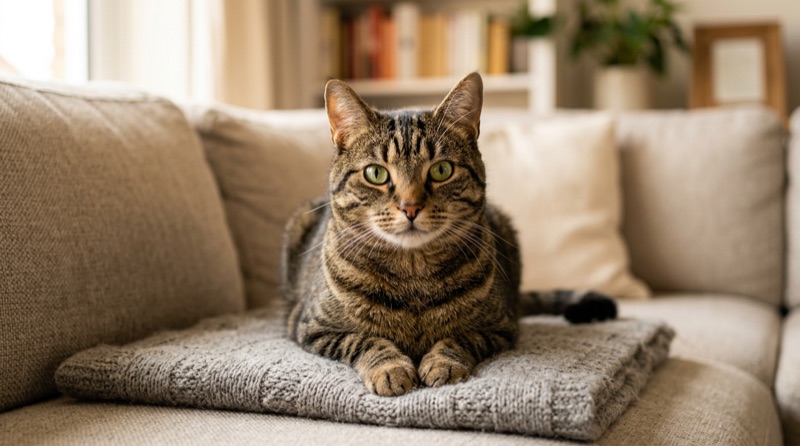
A Domestic Shorthair (DSH) is not a breed. It is a catch-all label for any short-coated cat with no documented breed ancestry. The term covers the vast majority of cats worldwide, from shelter rescues to neighborhood strays. A Domestic Longhair (DLH) is the long-coated equivalent.

Did You Know?
- 1The orange tabby DSH is one of the most recognized cats on the internet, yet "orange tabby" describes a color pattern, not a breed.
- 2DSH cats can live 15 to 20 years, often outliving many purebred cats thanks to their diverse gene pool.
- 3Shelters label cats as DSH or DLH based solely on coat length. No DNA test required.

How It Works
Visual trait analysis
DSH identification starts with what you can see: coat length, pattern, color, body shape, ear set, and eye color. Because DSH cats carry genes from many breeds, they show a wide range of appearances. A tabby DSH and a solid black DSH look nothing alike, but both fall under the same label.
Breed exclusion
The process works by exclusion. If a cat does not show strong markers for any specific breed, like the flat face of a Persian or the curled ears of an American Curl, it defaults to domestic shorthair. This is not a failure of identification, it is the honest answer.
Statistical reality
Around 95 percent of cats in shelters and homes are domestic shorthairs or longhairs. Only about 5 percent have any documented breed ancestry. When someone asks "what breed is my cat?", the most likely answer is "probably a domestic mix."

Why DSH Cats Are Healthy
- Genetic diversity
DSH cats benefit from a broad gene pool. They tend to have fewer breed-specific health problems than purebred cats, which are often prone to conditions linked to their lineage.
- Hardiness
Mixed ancestry often produces cats that are robust, adaptable, and long-lived. Many DSH cats live well into their late teens or early twenties.
- Availability
DSH cats make up the overwhelming majority of shelter cats. Adopting one is straightforward, affordable, and gives a home to a cat that needs one.

What You Cannot Predict
- Unpredictable traits
Because there is no breed standard, you cannot predict adult size, coat texture, or temperament from kittenhood. A DSH kitten might grow into a lean six-pound cat or a stocky fourteen-pound one.
- No pedigree or registration
DSH cats cannot be registered with breed organizations like CFA or TICA. If you want a cat for showing or breeding, a DSH is not the path.

Who This Guide Is For
Ideal for
❌ Not ideal for

Try It with Furriq
- 1
Take a clear photo
Good lighting, full body visible, and capture any distinctive markings. A photo from above hides ear shape. A dark room hides coat pattern. Natural daylight works best.
- 2
Upload to Furriq
Visit furriq.com and upload your photo. The tool runs a quality check in your browser first, then sends the image for analysis.
- 3
Review the breed clues
Furriq compares your cat against 61 breed profiles and returns visible trait clues with confidence ranges. If the cat is a typical DSH, the report will say so honestly rather than forcing a breed guess.
Ready to identify your cat?
Upload a photo and get breed clues in seconds, free.
Upload a Photo to Furriq
Frequently Asked Questions
Q.Is Domestic Shorthair a real breed?
No. Domestic Shorthair is a label, not a breed. It describes any short-coated cat with no documented breed ancestry. There is no breed standard, no registry, and no pedigree for DSH cats.
Q.What is the difference between DSH and DLH?
DSH stands for Domestic Shorthair (short fur). DLH stands for Domestic Longhair (long fur). Both are mixed-breed cats with no documented ancestry. The only difference is coat length.
Q.Can a DSH cat have purebred ancestry?
Possibly, but without documentation there is no way to prove it. A DSH cat might carry genes from a Siamese or Maine Coon ancestor, but without a pedigree it remains a domestic shorthair.
Q.How can I tell if my cat is a DSH or a specific breed?
Look for strong breed markers: flat face (Persian), folded ears (Scottish Fold), curly coat (Rex), or blue eyes with pointed coloring (Siamese). If none of these stand out, your cat is most likely a domestic shorthair or mix.
Q.What does DSH cat mean?
DSH stands for Domestic Shorthair. A DSH cat is any cat with short fur and no documented breed pedigree. It is the most common label shelters and vets use for mixed-breed short-haired cats. DSH is not a breed, it is a description of coat length and ancestry status.
Q.Is a DSH cat the same as a tabby?
No. DSH describes coat length and breed status (short fur, no pedigree). Tabby describes a coat pattern (stripes, spots, swirls). A DSH cat can be tabby, calico, solid, tortoiseshell, or any other pattern. The two terms describe different things and are often used together (e.g., "tabby DSH").

Sources

More Glossary Terms