

Verify your cat's breed from a photo
One clear photo runs a free quality check, then unlocks the full AI report for a one-time €5.99: breed verdict, why-likely reasoning, 40+ visual markers, health notes, and follow-up questions. No subscription, and your photo is never stored.
Quick answer: a Russian Blue kitten from a named TICA cattery costs $2,500 to $4,000 in 2026. Flat pricing rules the breed: one cattery charges $2,500 for every kitten, another $3,450, another $4,000. Archangel Cat, the most transparent seller in the market, itemizes a $4,700 total with an optional $925 pick-of-the-litter add-on. Adoption runs $75 to $200. No cattery prices by color, because the breed only comes in one.
This is the breed where the price guides are most wrong. The most-quoted pages still say $500 to $1,500, a range that no named cattery we could find has charged since at least 2023. If you budget from those numbers you will spend six months being told no, or you will buy a gray cat with no papers and find out at the vet.
First, the identification problem, because this breed has the worst of it. Any gray cat with green eyes gets called a Russian Blue. The Russian Blue breed profile lists the real markers, and cats similar to the Russian Blue separates it from the Chartreux, the Korat, and the British Blue.
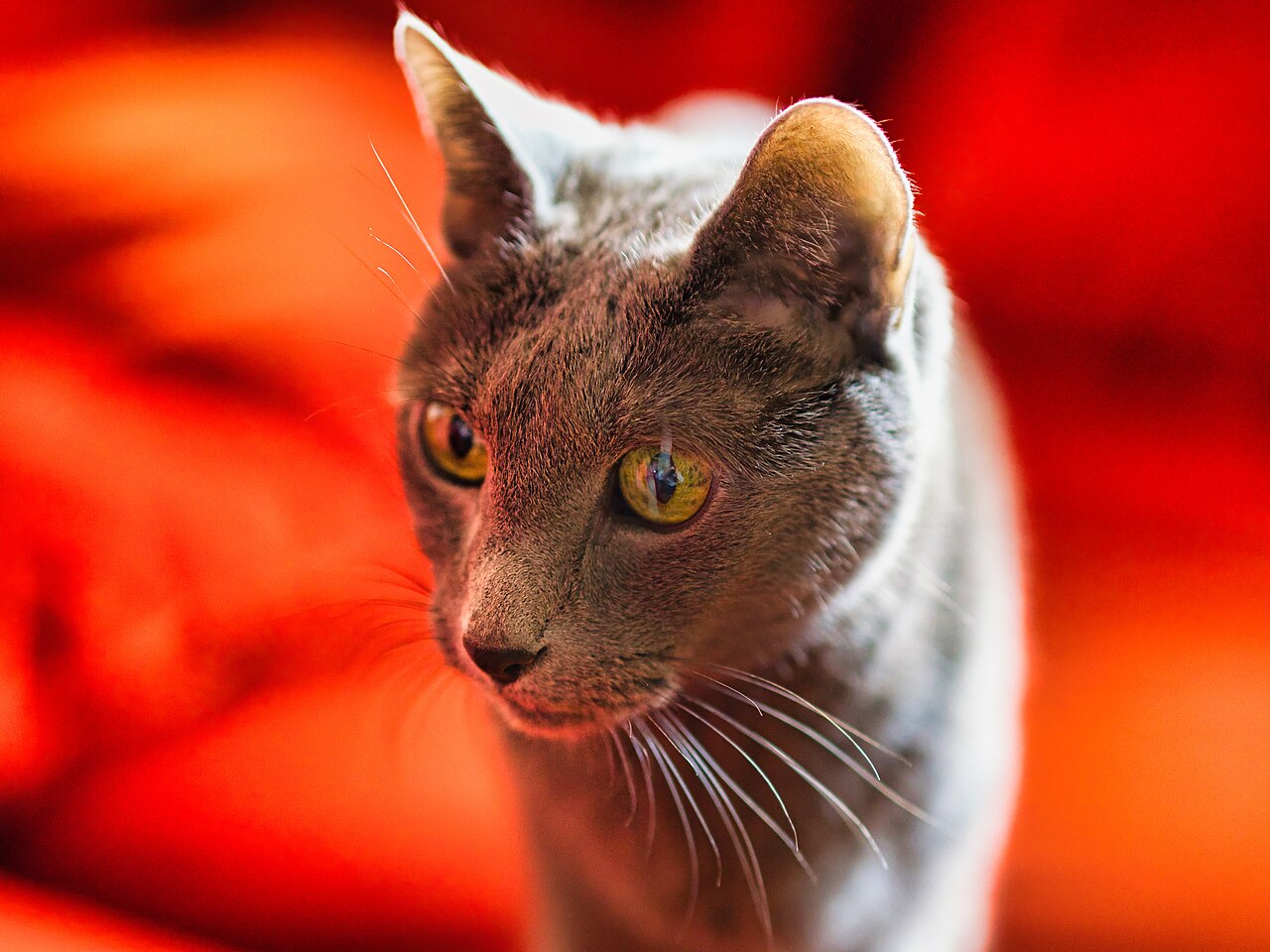
Russian Blue Kitten Price in 2026
Three named TICA catteries publish flat, untiered prices. Russian Blue Pomskies in Missouri charges $2,500. Royal Blues in Dayton charges $3,450, a figure that had to be screenshot-confirmed because the page's styling split the number in two. UBetCat charges $4,000. Then there is Archangel Cat, a nationwide breeder with the most transparent page in the breed: a $250 reservation, a $4,450 balance at six weeks, and a $925 optional pick-of-the-litter add-on that pushes the ceiling to $5,625.
Two other named catteries publish guidance rather than fixed prices, at $3,000 to $3,500 and $1,200 to $2,500. The lower one is the cheapest figure we found anywhere from a named seller, and it is the only one that does not name a registry.
The tiers, such as they are:
- $1,200 to $2,500: the floor at named breeders, usually a smaller program or a kitten that is a few months older.
- $2,500 to $3,500: the real market. Three of the six named US catteries sit here, and this is where most buyers land.
- $3,500 to $4,700: premium programs, itemized contracts, and pick-of-the-litter privileges.
- $5,000-plus: reserved for add-ons and show prospects. Rare enough that it is not a tier, it is a negotiation.
My read: $2,500 to $3,500 is the honest band for a pet Russian Blue in 2026, and $4,700 is a fair price only if the breakdown is on paper and includes the things you would otherwise pay for separately. Below $1,500 from a seller who claims a registry, assume the registry is in the seller's imagination.
What $2,500 Buys vs What $4,700 Buys
Same breed, same coat, same green eyes. This is not a case where the cheaper cat is visibly worse. It is a case where the price reflects the cattery's size, its show record, and how much hand-holding comes with the purchase.
$2,500 to $3,500 · PET PRICE
- ✓Same silver-tipped plush coat
- ✓Same flat, untiered price for every kitten in the litter
- ✓Same reserved, devoted temperament
- △What is bundled varies; ask for the list
- △Deposit terms and health window may be shorter
$4,400 to $4,700 · ITEMIZED
- ✓Ten numbered inclusions, from the TICA slip to 30 days of insurance
- ✓Written deposit and balance schedule
- ✓Optional pick-of-the-litter for $925
- ✓Parents with named show titles you can verify
Here is the part that matters for a pet buyer. The pick-of-the-litter add-on is $925, which is 20 percent of the base price for the right to choose first from a litter of a breed that only comes in one color and one pattern. You are choosing a personality you have not met yet. I would skip it. Spend that $925 on insurance and an echo instead.
Coat sheen, eye color, and head shape are checkable in one photo. Upload the kitten's picture and Furriq reads 40+ markers like these: the quality check is free, the full report is €5.99. Or check the markers yourself →
Adult and Retired Breeder Prices
Russian Blue catteries retire queens at four to six years and place them for $400 to $1,200. The breed is sensitive to change, so the first month is genuinely hard, harder than with a British Shorthair. Give it quiet, routine, and no visitors, and it settles. Skip that and you get a cat that hides under a bed for six weeks.
An adult is also the only realistic way to get a Russian Blue at a price under $2,000. Adults from private owners run $300 to $900, and they are the segment where mislabeled cats are most common. A Nebelung, a Chartreux, or a plain gray domestic shorthair sold as a Russian Blue at $600 is a bad trade, and it is the single most common bad trade in this breed.
Ask for the pedigree, not the story. A rehoming owner with a TICA slip will produce it. A rehoming owner with a gray cat and a confident description will not, and that tells you what you need to know.
Adoption vs Breeder
Adoption is cheap and real here, but the cat you get is rarely a purebred. Russian Blues and gray mixes arrive in shelters steadily, at $75 to $200 including neuter and vaccines. Breed-specific rescue is thin in the US, and most gray cats labeled Russian Blue at a shelter are domestic shorthairs with the right coat color.
That is not a reason to avoid it. A gray shelter cat is a lovely animal at one-twentieth the price. It is a reason to stop expecting registered lineage at a rescue fee, and to stop paying $1,500 to a stranger for a cat with no papers when $150 gets you a healthier one with a neuter included.
| Source | Typical cost | What you get | Main risk |
|---|---|---|---|
| Pet kitten, named TICA cattery | $2,500-$4,000 | Registered parents, flat price, contract, health guarantee | Waiting lists; deposits usually non-refundable |
| Itemized program | $4,400-$4,700 | Bundled registration, insurance, and support in writing | Add-ons push the ceiling past $5,600 |
| Retired breeder | $400-$1,200 | Adult, often spayed, papers usually available | Slow adjustment; sensitive to a new routine |
| Shelter adoption | $75-$200 | Neuter, vaccines, microchip included | Almost always a mix or a mislabeled cat |
| Listing site, no papers | $300-$900 | A gray cat, sometimes a Nebelung or a Korat | No testing, no registry, no recourse |
| Kijiji or classifieds, cheap tier | $150-$500 | Whatever the photo shows | One listing we read priced a different breed entirely |
That last row is not a hypothetical either. In a live UK sample of 24 listings, the bottom of the range was dominated by seller-labeled crosses, and one £500 "Russian Blue" was a mislabeled Nebelung by the seller's own description. Long silver-blue coat, no wedge head, wrong breed.
Why Every Russian Blue Price Guide Quotes a Different Number
This is the widest gap in the four breeds we priced. The top guide range and the top cattery price differ by nearly a factor of ten, and the guides have not caught up. Five sources, read in October 2026:
Pet-quality kitten, as each source states it
| Source | Pet-quality range | Show or breeding |
|---|---|---|
| Petful | $500 - $1,500 | $1,500 - $3,000 |
| Cats.com | $1,000 - $1,700 | not stated |
| Kittens Up 4 Sale | $2,100 - $3,400 (live listings) | not stated |
| Royal Blues, UBetCat | $3,450 and $4,000 flat | $4,700 itemized |
Petful's ceiling of $1,500 is below the price at every named cattery we read. Cats.com's ceiling of $1,700 is below the cheapest listing on a live marketplace. Both pages rank for the search people actually type, which means the most visible numbers are the least accurate ones, and the buyers who trust them are the ones who end up with a gray cat and a story.
Our range, $2,500 to $4,000 for a pet kitten, comes from named TICA catteries with published prices: Russian Blue Pomskies $2,500 flat, Royal Blues $3,450, UBetCat $4,000, Archangel Cat $4,700 itemized. Collected 17 August 2026 and compiled by feedmehooman, which links every seller. When a source publishes its numbers, we link it. When it does not, we say so.
What Drives the Price Up or Down
Registry and litter size. A Russian Blue litter is four to six kittens and catteries breed rarely. There is no volume to spread costs across, which is why flat prices of $2,500 to $4,000 are normal rather than an upsell.
Health screening. Catteries screen for HCM, though at lower incidence than in Maine Coons or Ragdolls, and manage the breed's urinary predisposition through pedigree rather than testing. The bigger screening cost is time: a cat not bred until it is two, echoed, and proven is a cat that has eaten for two years without producing a kitten.
Show record. US registries publish no prices, and two of the catteries we read publish none at all. Where numbers exist, the ones with titled lines sit at the top. A grand champion behind the parents is the most common reason one cattery charges $4,000 and another $2,500.
Country. UK registered listings run £900 to £1,750, and six named UK catteries from the breed club's own list publish no price at all. Canadian catteries in Toronto run CA$3,200 to CA$3,800. Australia's two priced catteries sit at A$2,500 and A$3,000. Importing adds $1,000 to $2,000.
Timing and deposits. Expect a $250 to $500 deposit, usually non-refundable, and a balance due at six weeks. Kittens leave at 12 to 16 weeks. Waiting lists run three to nine months at the catteries that publish prices, which is itself a signal: a cattery with kittens available today and no list is either new or not doing the screening.
Price and the Gray Cat Problem
Color is not a price axis in this breed, because there is only one recognized color: a clear, even blue-gray with silver-tipped guard hairs. One cattery we read prices Russian White kittens lower, and white is only a recognized Russian color in the UK and Australia. That is the entire color story.
What does move the effective price is whether the cat is actually a Russian Blue, and the market punishes buyers who cannot tell.
| What the listing says | Typical ask 2026 | What it usually is |
|---|---|---|
| Registered Russian Blue kitten | $2,500-$4,000 | The real thing, with a TICA or CFA slip and screened parents |
| "Russian Blue, no papers" | $300-$900 | A gray domestic shorthair or a mix. Fine cat, wrong price |
| Nebelung sold as Russian Blue | $400-$800 | A long-haired silver-blue cat. Different breed entirely |
| British Blue sold as Russian Blue | $600-$1,200 | Round face, copper eyes, cobby body. Check the eyes first |
| Korat sold as Russian Blue | $500-$1,000 | Heart-shaped face, single coat, more silver halo |
The eye test is the fastest filter. Adult Russian Blues have vivid green eyes. Kittens are born with yellow eyes that turn green by about four months, which is the one legitimate reason a breeder's kitten photo has the wrong eye color. Copper or gold eyes on an adult gray cat means you are looking at a British Blue or a Chartreux, and the price should reflect that.
British Shorthair vs Russian Blue walks through the comparison marker by marker. If you already have the cat and just want a name for it, the breed identifier scores a photo in seconds.
Ongoing Costs: What You Pay Every Year
Russian Blues are cheap to groom and moderate to feed. The expensive part is urinary health, because this breed is predisposed to bladder stones and stress-triggered cystitis, and stress is something a sensitive cat generates plenty of.
| Expense | Monthly | Yearly | Notes for Russian Blues specifically |
|---|---|---|---|
| Food | $35-$65 | $420-$780 | Wet food matters here. High moisture supports urinary health and offsets the breed's FLUTD risk |
| Litter | $18-$32 | $216-$384 | Keep the box clean; stress and a dirty box are both cystitis triggers |
| Vet and preventive care | $25-$50 | $300-$600 | Exam, vaccines, dental. Ask for a urinalysis at the annual visit once the cat is over five |
| Pet insurance | $25-$50 | $300-$600 | A blocked bladder is a $1,500 to $3,000 emergency. This is the reason to carry cover |
| Grooming | $0-$10 | $0-$120 | The cheapest coat on this list. Weekly brushing, no matting, no groomer |
| Toys and perches | $10-$25 | $120-$300 | They want height and quiet. A tall perch in a corner beats a busy play area |
First year runs $2,000 to $3,800 including starter gear and the neuter. Steady-state years land between $1,350 and $2,800. Over a 12 to 17 year life, that is $18,000 to $38,000 on top of the purchase price.
One behavior worth budgeting for: Russian Blues are among the least adaptable breeds in multi-cat households. Adding a second cat to a Russian Blue's home is a known stress event, and stress in this breed shows up as cystitis within weeks. If you already have cats, plan a slow introduction and expect it to take months. The lookalike guide explains the temperament differences between the gray breeds, which matter more than the coat.
Red Flags: When a Cheap Russian Blue Is Not a Deal
A Russian Blue under $1,500 with no registry name is a gray cat. That is the whole test. Here is how the bad listings present.
- No registry named, only "purebred." TICA and CFA both maintain breeder directories. A cattery that will not name its registry has no registry.
- Kittens available immediately, any number. This breed produces small litters and catteries keep waiting lists. A page with twelve available kittens is a reseller or a mill.
- A coat that does not shimmer. The silver tipping is the breed's signature. A flat gray coat with no sheen is a domestic shorthair or a mix, however green the eyes look in a filtered photo.
- Copper or gold eyes on an adult. Wrong breed. Every gray cat with warm eyes sold as a Russian Blue is a British Blue, a Chartreux, or a mix.
- Long hair. Nebelungs are lovely and they are not Russian Blues. One UK listing in our sample was exactly this.
- No health guarantee, no return clause. With a breed that carries a urinary predisposition and lower body fat, the anesthesia conversation matters too. A breeder who has never discussed either is not screening.
- A deposit requested before you see the cat live. These listings are the most common scam in the gray-cat market, because the photos are easy to source and the buyer cannot tell the breed anyway.
The expensive version of the mistake is paying $2,800 to a "cattery" with a nice website and no registry listing, then discovering at the first vet visit that the kitten is a cross. Papers you can look up are the only protection, and they take five minutes to check.
Is a Russian Blue Worth the Money?
Yes, if you want a quiet, devoted cat that prefers one person and hates disruption. No, if you want a cat that greets your guests. Russian Blues hide from strangers, follow their own human around the house, and take change badly. That is not a flaw. It is the breed, and it is priced at $2,500 to $4,000 because catteries produce few of them.
The price I would pay: $2,500 to $3,500 from a named TICA cattery with a written health guarantee, or $400 to $1,200 for a retired adult if I had a calm house and no other cats. I would not pay $5,600 with the pick-of-the-litter add-on, and I would not pay $800 for a gray cat with a story.
If $2,500 is out of reach, the honest alternative is a shelter cat at $150. A gray domestic shorthair will not have the silver tipping or the emerald eyes, and it will be just as good a companion. What you cannot do is split the difference with a stranger on a classifieds site, because that transaction is where the money gets lost.
Is that gray kitten really a Russian Blue?
Upload a photo to our cat breed identifier: 40+ visual markers, side-by-side breed scores, a plain-English breakdown. No sign-up, photo never stored. Cheaper than a $2,800 mistake.
🐱 Scan the listing photosBefore you pay: verify the cat, not just the breeder
- ✓A TICA or CFA cattery name you looked up yourself
- ✓Vivid green eyes in the adult parents, in an unfiltered photo
- ✓A written deposit and balance schedule, plus a health window
- ✕"Purebred, no papers" at $600. That is a gray shelter cat at four times the fee
Papers can be faked. The cat itself cannot. Upload a photo of the kitten or its parents and Furriq checks 40+ visual markers: the silver-tipped plush coat, the wedge head with the smiling whisker pads, the large wide-set ears, and the almond green eyes that separate a real Russian Blue from a Nebelung or a British Blue. The photo quality check is free; the full breed report costs €5.99, well under 1% of what you are about to pay. No sign-up needed.
Check the breed before you pay →Frequently Asked Questions
How much does a Russian Blue kitten cost in 2026?
From $2,500 to $4,000 at named TICA catteries, flat priced. One fully itemized program totals $4,700 with an optional $925 add-on. Adoption runs $75 to $200. Guides quoting $500 to $1,500 are describing a market that no longer exists at registered breeders.
Why are Russian Blues more expensive than Siamese?
Supply. Russian Blue litters are four to six kittens and catteries breed rarely, so there is no volume to spread the cost of screening and two years of raising a breeding cat. Siamese are far more widely bred, in the US and everywhere else. The price difference is arithmetic, not quality.
Does color change the price of a Russian Blue?
No. The breed comes in one recognized color in the US, so catteries charge one price for every kitten. The single exception we found prices Russian White kittens lower, and white is only recognized in the UK and Australia. Anyone charging a color premium in this breed is inventing a category.
How much does a Russian Blue cost per month?
About $110 to $230 in steady state for food, litter, insurance, vet care, grooming, and toys. The first year runs $2,000 to $3,800 with starter gear and the neuter. Wet food and insurance are the two line items specific to this breed's urinary risk.
Can you adopt a Russian Blue?
Yes, at $75 to $200 through a shelter. What you adopt is almost always a gray mix rather than a registered Russian Blue, because purebreds rarely reach general shelters and breed rescue is thin in the US. If papers matter, that route is closed to you.
How do I tell a Russian Blue from a British Blue?
Eyes and build. Russian Blues have vivid green almond eyes, a wedge head, and a long, fine-boned body. British Blues have copper or gold eyes, a round head with full cheeks, and a stocky body that can weigh 18 pounds. The Russian Blue coat has visible silver tipping; the British Blue is uniform.
What is the total lifetime cost of a Russian Blue?
Plan on $18,000 to $38,000 over a 12 to 17 year life, purchase included, with most owners near $24,000. Urinary emergencies are the variable that decides where you land, and a blocked bladder can cost $1,500 to $3,000 in one night.
How do I avoid Russian Blue scams online?
Check the cattery against the TICA or CFA directory, ask for a live video call with the mother, and refuse any fee requested after the deposit. Then look at the eyes and the coat in the photos: green eyes and a silver sheen, or it is a different cat. Reverse image search the kitten photo, because stolen pictures are the standard tool in this market.
More Breed Price Guides
Every breed prices differently. If you are weighing a Russian Blue against another cat, these guides break down kitten prices, adoption fees, and yearly costs for each one.
- Sphynx cat price: flat cattery rates and the eye-color premium
- Siamese cat price: why the floor is low and where it is not
- British Shorthair price: blue vs golden and what each tier costs
- Maine Coon price: $1,800 to $3,500 kitten cost breakdown
- Persian cat price: doll-face vs peke-face costs
Before You Pay: Verify the Kitten Is the Real Breed
Every gray cat with green eyes gets sold as a Russian Blue, and Nebelungs and British Blues fill the gap. Before you send a deposit, run the listing photos through Furriq's free identifier: it checks 40+ visual markers (coat tipping, head shape, ear set, eye color) against the Russian Blue standard in seconds. No sign-up, no storage.
Want the full picture? Read the Russian Blue breed profile for size, coat, and temperament, the lookalike guide if you are sorting out a gray cat at home, or British Shorthair vs Russian Blue for the side-by-side. And if the cat is already on your windowsill and you suspect the seller stretched the truth, the free cat breed identifier settles it in about ten seconds.
Related breeds
All breedsKeep reading
All articlesCat Breeds
Sphynx Cat Price 2026: $2,000-$5,000 Kitten Cost Guide
Sphynx kittens cost $2,000-$5,000 from a named US cattery in 2026. Flat prices, eye-color premiums, adoption vs breeder, yearly costs, and scam checks.
10 min read
Cat Breeds
Siamese Cat Price 2026: $1,000-$3,500 Kitten Cost Guide
Siamese kittens cost $1,000-$3,500 at named US catteries in 2026, flat priced. Point colors do not change the price. Rescue fees, yearly costs, red flags.
10 min read
Cat Breeds
British Shorthair Price 2026: $1,100-$4,000 Kitten Cost
British Shorthair kittens cost $1,100-$4,000 from named US catteries in 2026. Why blue is cheapest, what golden adds, adoption fees, and yearly costs.
11 min read
Still not sure what your cat is?
Stop guessing from photos and text. Upload one clear photo and the AI checks 40+ visual markers in seconds. The quality check is free; the full AI report is €5.99, one-time. Your photo is never stored.
Scan your cat's photo