
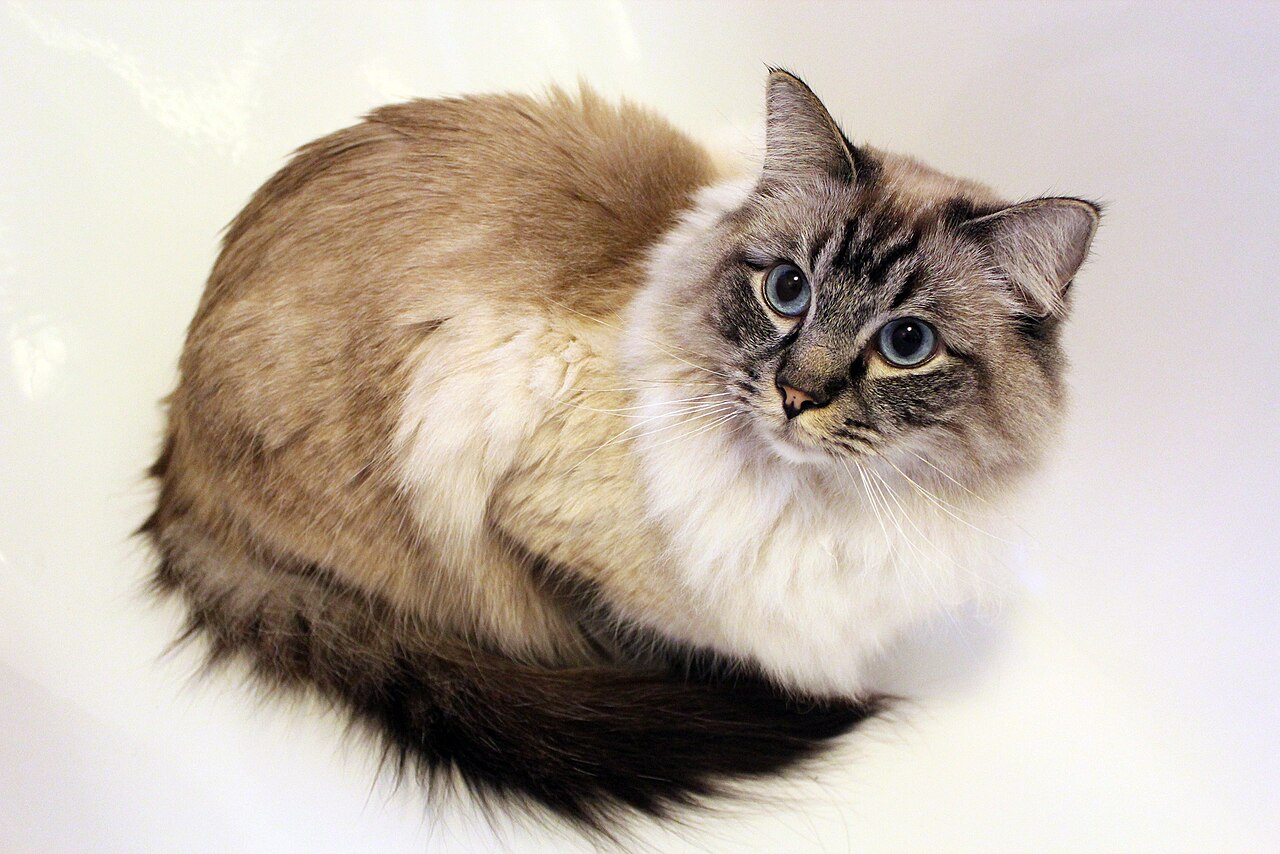

People fall for the Ragdoll in one glance: huge, blue-eyed, color-pointed, and draped over someone's arms like a fur stole. The breed got its name because most of them go completely limp when picked up, the ragdoll flop, and that trust is the whole personality in one gesture. But a 10 to 20 lb cat with a silky semi-long coat is not a low-maintenance cat, and the docility that makes them wonderful also makes them dangerous outdoors.
Here is what living with a Ragdoll actually involves, from the brushing schedule to the cardiac screening, so you know what you are signing up for.
What a Ragdoll Looks Like
Start with the eyes, because they are the whole game. Ragdolls always have vivid blue, oval-shaped eyes. Green, gold, or copper eyes mean the cat is not a purebred Ragdoll, full stop. Add the color-point pattern, a pale body with darker ears, face mask, legs, and tail, plus white mitts on the front paws and white boots on the back. Three patterns exist: colorpoint with no white, mitted with white mitts and a white chin, and bicolor with a white inverted V on the face.
Body: large and muscular, with a broad chest and substantial bone. Males run 15 to 20 lbs, females 10 to 15. The coat is semi-long, silky, and lies flat, with minimal undercoat, which is why they tangle less than Persians and shed less than double-coated breeds. The ruff around the neck and the britches on the hind legs are the parts that need the most attention. Ragdolls mature slowly, not reaching full size until 3 to 4 years old.
Grooming: Silky, Not Effortless
Brush two to three times a week. Start with a wide-toothed metal comb to work out knots, then a soft bristle brush to smooth the coat and spread natural oils. Pay special attention to the ruff, the belly, and the britches, where tangles form first. Shedding is moderate, with a bump during spring and fall coat changes. It is not the grooming load of a Persian, but it is not zero either, and a matted Ragdoll belly is a painful, expensive problem.
Diet: Big Cat, Slow Metabolism
Ragdolls gain weight easily because their laid-back nature burns few calories. Feed high-quality, protein-rich wet food in measured portions twice a day. Avoid free-feeding dry kibble, which is an open invitation to overeat. Formulas with moderate fat plus glucosamine and omega-3s support the joints on a heavy frame. Treats stay under 10% of daily calories. A 20 lb Ragdoll that is all muscle is one thing; a 20 lb Ragdoll that is mostly cushion is a heart and joint problem in the making.
Exercise: Play That Works With Their Nature
They are not hyperactive, but they enjoy and need daily interactive play. Two 10 to 15 minute sessions a day with feather wands, fetch, or puzzle feeders keeps the weight off and the brain busy. Cat trees and climbing shelves give them vertical space, and a Ragdoll will happily supervise you from the top perch for hours.
Indoor Only, No Exceptions
This is the part breeders hammer hardest. Ragdolls were bred for docility, not street smarts. They lack the wariness that keeps outdoor cats alive, they greet strangers with trust, and they freeze or go limp instead of fighting. That combination makes them targets for theft, dogs, and traffic. Indoor life with window perches, cat trees, and daily play suits them perfectly. Fresh air means a harness and leash or an enclosed catio, never free roaming.
Health: Heart, Bladder, and Blood
Hypertrophic cardiomyopathy is the big one. Ragdolls carry a breed-specific HCM mutation, MYBPC3-R820W, and annual cardiac auscultation plus screening is the standard recommendation. Feline lower urinary tract disease is the second concern, so watch for straining, frequent litter box trips, or blood in the urine. A mild bleeding disorder called thrombopathia affects some lines, worth mentioning to your vet before any surgery. Annual exams catch all of it early, and well-cared-for Ragdolls regularly live into their late teens.
Is Your Cat Actually a Ragdoll?
The blue eyes are the strongest single marker. If the eyes are not blue, it is not a purebred Ragdoll. Then check the pattern, the size, and the flop. The breed people confuse it with most is the Birman, which is smaller, 6 to 15 lbs, and always has four symmetrical white paws. The Maine Coon shares the size but not the blue eyes or the silky coat.
If your cat has the look, start with the Ragdoll breed profile and work through the markers. Then upload a photo to the Furriq cat breed scanner for a second opinion on face shape, ear set, and body type. It reads visible traits, not DNA, so treat the result as a strong clue rather than a certificate. The cats similar to Ragdolls guide covers the look-alikes in detail, and the Ragdoll health deep dive goes further on the medical side.
Ragdoll households tend to orbit the same few fluffy breeds, which is why the Siberian care guide and the British Shorthair care guide sit right next to this one.
FAQ
Do all Ragdolls go limp when picked up?
Most do, but individuals vary. Some only relax partially, and a few prefer not to be carried at all. The flop is a strong breed indicator, not a guarantee, and relaxed mixed-breed cats can do it too.
Are Ragdolls hypoallergenic?
No. They produce the Fel d 1 allergen like any cat. Some allergy sufferers report milder reactions because the minimal undercoat traps less dander, but that varies by person and by cat. Spend time with the actual cat before adopting.
Are Ragdolls good for first-time owners?
Yes, with two conditions. They are gentle and forgiving of handling mistakes, which makes them beginner-friendly. But the coat needs brushing two to three times a week, and they crave company badly enough that a Ragdoll left alone all day every day will get lonely. If you can offer daily interaction and a brush, they are a superb first cat.
Keep reading
All articlesBreed Care
British Shorthair Care Guide: Grooming & Diet
British Shorthair care routine: brushing the plush double coat, measuring meals to stop obesity, play for a low-energy cat, and heart and kidney screening.
5 min read
Breed Care
Siberian Cat Care Guide: Grooming & Diet
Siberian cat care: taming the triple coat through spring shed, high-protein meals for a heavy frame, climbing enrichment, and the hypoallergenic question.
6 min read
Cat Health
Cat Breed DNA Test: Accuracy, Cost & What It Shows
What a cat breed DNA test can and cannot show, how accurate the results are, what kits cost, and when a free photo check tells you enough.
8 min read
Still not sure what your cat is?
Stop guessing from photos and text. Upload one clear photo and the AI checks 40+ visual markers in seconds. Free, no sign-up, and your photo is never stored.
Free cat breed scan