
Cat ear guide
Cats With Small Ears
Small ears are the signature of the round-headed pedigree families. Five breeds anchor the list: the Persian and its two derivatives, the Exotic Shorthair and Himalayan, the British Shorthair, and the Scottish Fold. Below is each breed's ear shape with the second clue to confirm it, plus the big-eared breeds that help you rule small ears in or out.
The small-eared breeds
Ear details come from the CFA breed pages and standards plus our own breed profiles, cross-checked against each other. Read the ears first, then confirm with the second clue, because ear size alone never closes the case. One row is the nuance case: the British Shorthair makes many short-ears lists, but its standard says medium-sized ears, and we say so in the table.
| Breed | Ears | Confirm with |
|---|---|---|
| Persian | Small, round-tipped, set low and far apart on a flat face | Long flowing coat, heavy cobby body |
| Exotic Shorthair | Small, round-tipped, tilted forward into the round head contour | The Persian look on a short plush coat |
| Himalayan | Small, as on the Persian head type it shares; our profile calls that flat-faced head "identical to the Persian" | Pointed coat with deep blue eyes, always |
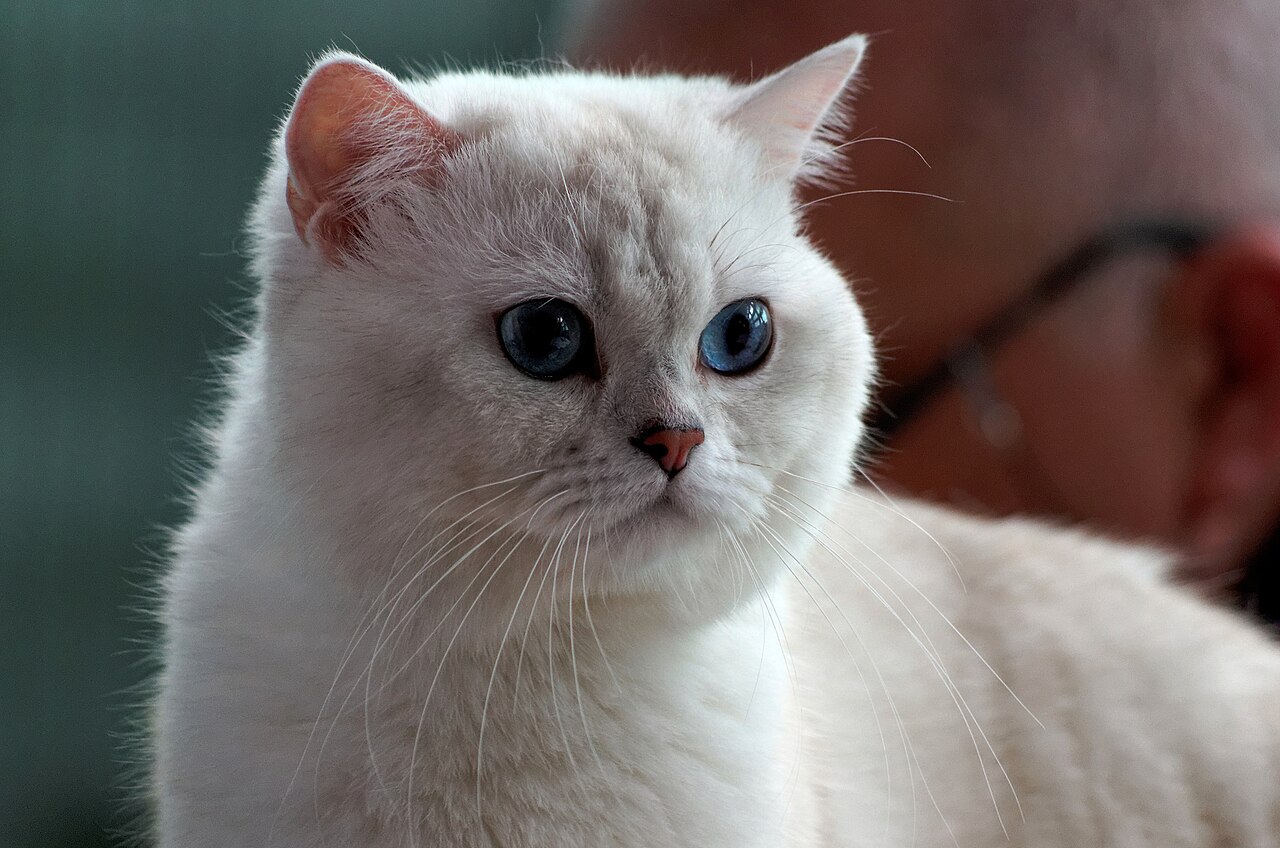
| British Shorthair | Medium in size by the CFA standard, but set far apart so they fit into the round head contour, which reads small on that wide round face | Dense plush coat, copper to gold eyes |
| Scottish Fold | Folded forward and down, an owl-like silhouette | Round head, teddy-bear soft coat |
Sources: cfa.org breed pages and standards (Persian, Exotic, British Shorthair, retrieved October 2026) and Furriq breed profiles for the Himalayan and Scottish Fold rows.
The Scottish Fold trade-off: read this before you envy the look
The fold is not a cosmetic trait. It is a cartilage mutation, and every folded-ear Scottish Fold carries osteochondrodysplasia, a painful joint condition, to some degree. Symptoms can show as early as seven weeks: stiffness, short stiff tails, a reluctance to jump. No treatment reverses the cartilage defect, so management is pain control, and responsible breeders never mate two folded cats together.
Two timing facts follow, and they matter if you are identifying a kitten. Fold kittens are born straight-eared and the fold usually develops by three to four weeks, so a young straight-eared kitten can still be a Fold. And if an adult shelter cat has folded ears without papers, it is most likely a Fold mix, which turns the fun guessing game into something practical: mention the folded ears at the vet and ask for a joint check. The Scottish Fold profile has the full health picture.
Small ears prove nothing on their own
A random-bred cat can have small ears, and plenty do. Ears become a real signal only in combination: small ears plus a round head and a dense or long coat point at the cobby pedigree families above; small ears plus a siamese-style wedge point the other way entirely. If the ears sit between categories, weigh coat pattern and body shape instead. The breed chart lines up all the markers side by side, and the mixed breed guide explains how to count clues when the traits conflict.
Big ears help too: ruling breeds out
Negative evidence is still evidence. If your cat has clearly large ears, these breeds are out of the running: the Siamese and Oriental Shorthair with their huge wedges, the Devon Rex with its bat ears, the Sphynx with cupped ears wider than its face, and the tiny Singapura, whose ears look oversized for its head. None of them has small ears, ever.
Read your cat's ears against 61 breeds
Furriq scores 40+ visible markers, ear shape and set among them, against the breeds we profile. Upload a photo and get a ranked list of likely matches framed as clues, not proof. Guests get one free scan, no sign-up required.
No cat photo handy?
Scan a sample, one tap:
Only cat photos are recognized — non-cat images will return meaningless results
Example results
Maine Coon
~92%
Large frame, ear tufts, rectangular body
Siamese
~87%
Blue eyes, pointed coat, triangular face
British Shorthair
~85%
Dense coat, round face, copper eyes
Frequently asked questions
Which cat breeds have small ears?
The round-headed pedigree families: Persian, Exotic Shorthair, Himalayan, British Shorthair, and Scottish Fold, whose ears fold forward into an owl-like silhouette. In all five, the small ears come with a round head and a dense or long coat.
Do small ears mean a cat is purebred?
No. Random-bred cats can have small ears. Ear size becomes a useful identification signal only when it combines with other markers such as head shape, coat density, and eye color. A cat with small ears and no other pedigree markers is most likely a random-bred domestic cat.
Why do some cats have such small ears?
Selective breeding. Breeders chasing round, cobby silhouettes in the Persian and British families kept cats whose small ears sit low and far apart, which completes the circle of the head. The opposite extreme, the giant ears of the Oriental family, came from breeding for a long wedge.
Are folded ears bad for a cat's health?
The fold gene causes osteochondrodysplasia, a cartilage and joint condition that every folded-ear Scottish Fold carries to some degree. It cannot be reversed, only managed for pain, which is why responsible breeders never pair two folded cats. Small but upright ears, like a Persian's, are head type and carry no such condition.