
Start here
The 5-Second Rule: How to Read Any Cat
When you meet a new cat, spend 5 seconds reading its body language before you approach. Here is the checklist:
- 01Tail position. Up = friendly. Low = scared. Swishing = agitated.
- 02Ear direction. Forward = interested. Back = anxious.
- 03Eye contact. Slow blink = trust. Stare = challenge. Look away to defuse.
- 04Body tension. Loose = relaxed. Tense = stressed.
- 05Vocalization. Meow = greeting. Hiss = back off. Purr = usually happy.
If the signals are mostly positive (tail up, ears forward, relaxed body), you can slowly extend your hand and let the cat sniff. If the signals are negative (tail low, ears back, tense body), give the cat space and let it come to you.
Tail Signals
A cat's tail is the most expressive part of its body. Tail position and movement tell you more about a cat's mood than any other single signal. Watch the tail first.
What Each Position Means
Breed Differences
Some breeds like Manx and Japanese Bobtail have naturally short or absent tails, making tail signals harder to read. Bobbed-tail breeds use body posture and ear position more than tail movement.
Ears Signals
Cat ears are mobile radar dishes that rotate independently. Ear position is one of the fastest-changing signals — cats move their ears in real-time to reflect their mood.
What Each Position Means
Breed Differences
Scottish Folds have naturally folded ears that cannot move as freely as other breeds. Their ear signals are subtler — watch for the angle of the fold rather than rotation. Sphinx cats have very large, mobile ears that exaggerate every signal.
Eyes Signals
Cat eyes are windows to their mood. Pupil size, blink speed, and eye contact all communicate different things. Cats use eye contact very differently from humans.
What Each Position Means
Breed Differences
Siamese and other blue-eyed breeds have eyes that are naturally more expressive due to their larger size and lighter iris color. Persian cats have rounder eyes that make dilated pupils more noticeable.
Body Posture Signals
Overall body posture tells you the big picture. Is the cat tense or loose? Arched or flat? Forward or back? Body posture combines with tail, ears, and eyes for the full read.
What Each Position Means
Breed Differences
Ragdolls go limp when picked up (hence the name), making their body language different from most cats. Maine Coons are more dog-like in their body posture — they tend to follow you around and sit upright. Sphynx cats seek warmth and often curl into tight balls.
Vocalizations Signals
Cats have over 100 distinct vocalizations. Meows, purrs, hisses, chirps, and trills all mean different things. Adult cats mainly meow at humans — they rarely meow at other cats.
What Each Position Means
Breed Differences
Siamese cats are the most vocal breed — they have a loud, low-pitched meow that sounds almost human. They will "talk" to you constantly. Russian Blues are quiet and rarely meow. Maine Coons chirp and trill more than they meow.
Whiskers Signals
Whiskers (vibrissae) are sensory organs, not just hair. They detect air currents, help with spatial awareness, and communicate mood through position.
What Each Position Means
Breed Differences
All cats have roughly 24 whiskers (12 on each side), but longer-haired breeds like Maine Coons and Persians have more prominent whiskers that are easier to read. Hairless breeds like Sphynx have fewer and shorter whiskers.
Different breeds express themselves differently.
Siamese cats are the most vocal. Ragdolls go limp when held. Maine Coons chirp and trill. Knowing your cat's breed helps you read its body language more accurately.
Find out your cat's breed — free photo scanCat Body Language Quick Reference
| Signal | Happy | Anxious | Angry |
|---|---|---|---|
| Tail | Up, hook tip | Low, tucked | Thrashing fast |
| Ears | Forward, upright | Airplane ears | Flattened back |
| Eyes | Slow blink | Dilated pupils | Unblinking stare |
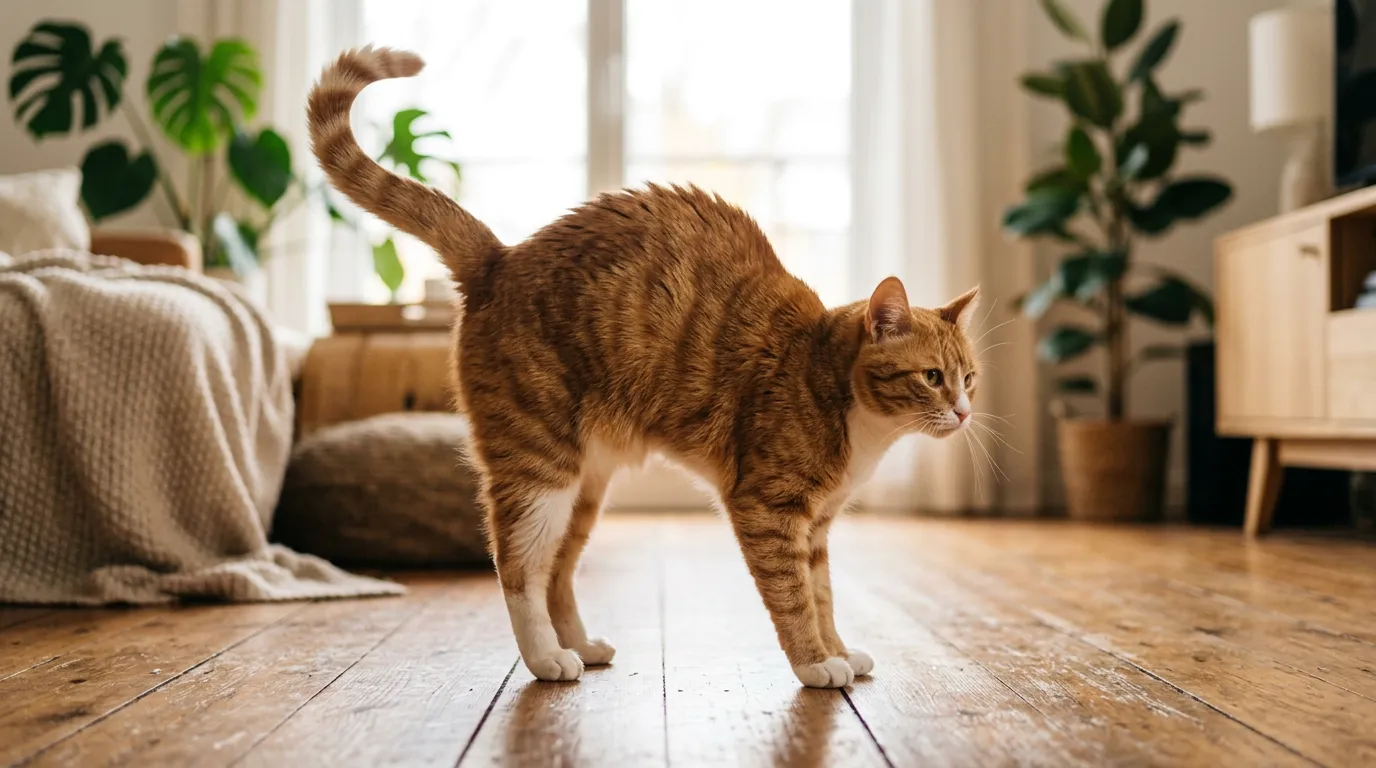
| Body | Loaf, relaxed | Crouched low | Arched, fur up |
| Vocal | Purr, trill | Low meow, yowl | Hiss, growl |
| Whiskers | Neutral | Flattened back | Flattened back |
Why Understanding Body Language Matters for Breed Identification
Different breeds have different body language tendencies. Siamese cats are extremely vocal — they meow, chirp, and trill constantly. Ragdolls go limp when picked up, which is unique to the breed. Maine Coons chirp and trill more than they meow. Russian Blues are quiet and reserved. Understanding your cat's body language can give you clues about its breed heritage.
If your cat is unusually vocal, it may have Siamese ancestry. If it goes limp when held, it may have Ragdoll genes. If it chirps at birds instead of meowing, it may be part Maine Coon. These are clues, not proof — but combined with physical markers, they help narrow down the possibilities.
Frequently Asked Questions
How do I read my cat's body language?+
Start with the tail — it is the most expressive part. Tail up = happy. Tail low = scared. Tail swishing = agitated. Then check ears (forward = alert, back = anxious), eyes (slow blink = trust, stare = challenge), and overall posture (relaxed = comfortable, tense = stressed). Combine all signals for the full picture.
What does it mean when a cat slowly blinks at you?+
A slow blink is the "cat kiss." It means "I trust you enough to close my eyes near you." Cats only slow-blink at people and animals they feel safe around. You can slow-blink back to communicate trust — many cats will blink back at you.
Why does my cat show its belly then attack me when I touch it?+
Exposing the belly is a sign of trust, but it is not an invitation to rub. The belly is a vulnerable area with vital organs. Touching it triggers a defensive reflex — the cat grabs your hand with its paws and bites. This is normal cat behavior, not aggression.
What does a puffed-up tail mean?+
A puffed-up tail (bottle brush) means the cat is frightened or aggressively aroused. The fur stands on end to make the cat look bigger — this is a fear response. The cat may also arch its back and flatten its ears. Give the cat space and remove whatever is scaring it.
Why does my cat knead me with its paws?+
Kneading is a behavior from kittenhood — kittens knead their mother's belly to stimulate milk flow. Adult cats knead when they feel safe, comfortable, and content. It is a sign of deep trust and affection. Some cats drool while kneading, which is also normal.
What does it mean when a cat chirps or trills?+
Chirping and trilling are excited, friendly sounds. Cats chirp when watching birds or squirrels (prey excitement). Mother cats trill to call their kittens. Adult cats trill when greeting people they like. It is one of the most positive vocalizations.
Why does my cat stare at me without blinking?+
In cat language, prolonged unblinking staring is a challenge or threat. If your cat stares at you, try looking away first or slow-blinking — this defuses the tension. If the cat is staring with relaxed body language, it may just be watching you with interest.
Do different cat breeds have different body language?+
Yes. Siamese cats are extremely vocal and use meowing as their primary communication. Ragdolls go limp when picked up, which is unique to the breed. Maine Coons chirp and trill more than other breeds. Scottish Folds have limited ear movement due to their folded ears. Breed affects how a cat communicates, but the basic signals are universal.
What does it mean when a cat wraps its tail around you?+
A cat wrapping its tail around your leg or arm is the cat equivalent of holding hands. It is a sign of affection and bonding. Cats also wrap their tails around other cats they are friendly with. It means "you are part of my group."
How can I tell if my cat is happy?+
Happy cats have: tail straight up or with a hook at the tip, ears forward, slow blinks, relaxed body posture, purring, kneading, and rubbing against you. A cat that greets you with a raised tail and a meow is genuinely happy to see you.