

Black cats carry more cultural baggage than any other cat. In Western superstition they are unlucky. In Britain, Japan, and Scotland they are the opposite, a sign of good fortune walking through the door. Almost none of that has anything to do with the animal, which is why the question "what is a black cat personality?" tends to get answered with folklore instead of evidence.
Here is the short version. Black cats are consistently rated among the calmest, most tolerant coat colors in owner surveys. They are described as affectionate, adaptable, and quietly playful rather than intense. Color does not cause personality, and a black cat can be as timid as any other cat, but the stereotype of the spooky, hostile black cat is the opposite of what owners report.
1. The Stereotype vs the Real Cat
The hostile black cat is a medieval European invention. During the witch-trial centuries, dark cats were tied to witchcraft, and the association stuck in English-speaking countries long after the trials ended. Japan and Britain went the other way. A black cat crossing your path is good luck in both, and in Scotland a black cat arriving at a house is supposed to bring prosperity.
None of that reflects cat temperament, but it has real consequences. Black cats sit in shelters longer than cats of other colors, partly because they photograph poorly in kennel lighting and partly because the superstition still nudges some adopters away. The cat in the cage is not the cat the folklore describes. For the identification side, including six breeds where solid black is a recognized color, see our guide to what breed your black cat might be.
2. Black Cat Personality Traits Owners Report
The most repeated finding in owner surveys is that black cats are calm under handling. A 2012 study at the University of California, Davis, surveyed more than 1,200 cat owners and compared aggression ratings across coat colors. Black cats came out on the low end for aggression during veterinary visits and routine handling. That is the reverse of the folklore, and it is also the reverse of what the same study found for calico and tortoiseshell cats, which owners rated as more reactive.
Calm does not mean boring. Owners describe black cats as playful in a measured way. Picture a laser pointer: the orange cat launches, the black cat watches for a beat and then decides. That pause is the trait people are pointing at when they call black cats thoughtful. Loyalty and adaptability show up in the same surveys. Black cats settle into new homes, new furniture arrangements, and new routines with less fuss than the average cat.
3. Black Cat Behavior at Home
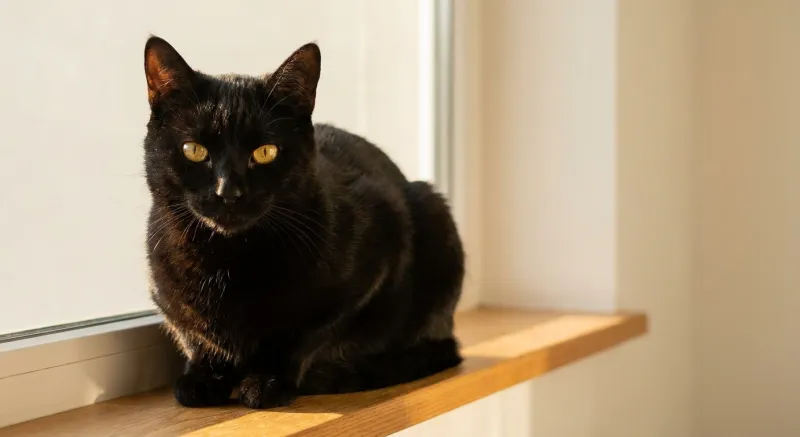
Three behaviors come up again and again in black cat households. The first is the lap habit. Owners report black cats settling onto laps, chests, and keyboards for long sessions rather than short visits. The second is sunbathing, and the reason is physics. A black coat absorbs more heat than any other color, so the warmest patch of floor in the house is worth claiming.
The third is the odd one. If your black cat spends time in direct sun, brown or reddish streaks may appear in the coat. This is called rusting. Ultraviolet light breaks down melanin in the coat and lets the hidden tabby banding show through. It looks like a color change, it is entirely cosmetic, and indoor cats rust far less because they get less UV.
Black cats also talk less than the vocal breeds, but not nothing. Many owners describe short, chirpy comments and a quiet trill instead of the sustained demands of a Siamese. If your cat is loud, that trait came from the breed mix, not the color.
4. What "Black Cat Meaning" Refers To
Searches for black cat meaning and black cat personality mix two different questions. Personality is about the animal. Meaning is about the symbol, and the symbol changes with the country. In the United States and much of Western Europe, the black cat is tied to Halloween and bad luck. In the United Kingdom, a black cat crossing your path is lucky. In Japan, black cats are considered protective, and the maneki-neko beckoning cat is sometimes produced in black specifically to ward off illness. In Scotland, a black cat on the porch means prosperity is on the way.
The practical takeaway is that black cat meaning is a mirror of the culture asking the question. None of it predicts whether the cat on your couch will sit on your lap or hide under it.
5. Black Cat Temperament Next to Other Colors
Coat color comparisons are the most popular form of cat astrology, and most of them come from owner surveys rather than controlled studies. That caveat matters, but the patterns are consistent enough to be worth reading. Black cats land at the calm end, and the loudest reputation in the group belongs to the tortoiseshell.
Black cat temperament compared to other coat colors
| Coat | Owner description | Handling response | Most likely to |
|---|---|---|---|
| Black | Calm, loyal, adaptable | Rated least aggressive | Follow you and settle on your lap |
| Orange | Bold, social, outgoing | Generally tolerant | Greet strangers at the door |
| Calico | Independent, strong willed | Rated more reactive | Set terms and defend them |
| Tortoiseshell | Vocal, opinionated, intense | Rated most reactive | Announce every opinion loudly |
One exception is worth flagging so the table is not read as absolute. The same 2012 survey found that black and white cats, the tuxedo pattern, were rated as more aggressive at the vet than cats of other colors. Solid black and black with white patches are different patterns, and the results went in opposite directions. That is a useful reminder of how small the color effect really is.
6. Why Color Does Not Decide Personality
Solid black comes from the non-agouti gene. When both copies of agouti are inactive, the tabby banding never shows and the hair is uniformly dark. That gene controls pigment, not temperament. There is no known mechanism that connects dark pigment to behavior in cats.
Sex-linked color is the one place where coat and behavior genuinely overlap, and it works through hormones rather than pigment. Orange is carried on the X chromosome, so roughly four out of five orange cats are male, and male cats are more likely to be territorial. Calico and tortoiseshell patterns require two X chromosomes, so they are almost always female. That is why calico and tortie personality stereotypes sound different from orange ones: the coat is a side effect of sex, and sex shapes behavior.
Black cats have no such link. Both sexes are black in the same proportions, so the personality owners describe is more likely a mix of breed ancestry, early socialization, and confirmation bias than biology. Kittens handled gently in the first weeks tend to become tolerant adults no matter what color they are. Coat color is a weak signal, socialization is a strong one, and the cat in front of you outranks the chart every time.
7. Is Your Black Cat a Bombay or a Domestic Shorthair?
Personality questions usually follow a breed question, and with black cats that question is genuinely hard. Solid black hides every pattern clue, so breed has to be read from structure instead of coat. Copper or gold eyes on a glossy, muscular, medium-sized cat points to the Bombay, the only breed created specifically to be all black. A sturdy, unremarkable build in the same color is far more likely to be a solid black American Shorthair or a domestic shorthair. Most black cats are domestic shorthairs, and that is the honest answer for the majority of them.
For the full trait list, our guide to black cat breed identification walks through six breeds in order. For the coat genetics behind the color, the black coat profile covers the agouti gene and the rusting effect. And if you want a first pass before reading anything else, upload a clear side profile photo to our cat breed identifier. Black cats are the hardest case for any visual model, so use daylight, a light background, and no flash.
Frequently Asked Questions
What is a black cat personality?
Owner surveys describe black cats as calm, tolerant of handling, affectionate, and adaptable. A 2012 UC Davis survey of over 1,200 owners rated them as less aggressive during handling than most other coat colors. The belief that black cats are hostile comes from superstition, not from cat behavior research.
Are black cats more aggressive than other cats?
No. Solid black cats scored low on aggression in owner surveys. One nuance: black and white tuxedo cats were rated as more reactive at the vet than other colors. Solid black and black with white patches behave differently in the data, which shows how small the color effect really is.
Do black cats have different personalities from other cats?
Only slightly, and mostly in the statistics rather than in the individual cat. Coat color genes control pigment, and there is no known link between dark pigment and temperament in cats. Breed and early socialization shape personality far more than color does.
What does a black cat mean in different cultures?
It depends entirely on the culture. In the United States and parts of Western Europe, black cats are tied to Halloween and bad luck. In the United Kingdom and Japan they are considered lucky, and in Scotland a black cat arriving at your home is a sign of prosperity.
Why does my black cat have brown stripes in the sun?
This is called rusting. Ultraviolet light breaks down melanin in the coat and lets hidden tabby banding show through. Almost all black cats carry tabby genetics, and the non-agouti gene only suppresses the pattern rather than removing it. Rusting is cosmetic and reverses once sun exposure drops.
Keep reading
All articlesCat Behavior
Cat Kneading: Why Cats Knead and What It Means
Cat kneading is when a cat pushes its paws alternately against a soft surface. Learn why cats knead, what it means, and when kneading signals a health problem.
8 min read
Breeds
Cats That Look Like Norwegian Forest Cats: 3 Look-Alikes Compared
Maine Coon, Siberian, or Ragdoll? Compare the 3 large longhaired breeds most often confused with the Norwegian Forest Cat: coat layers, head shape, and size side by side.
9 min read
Breeds
Cats That Look Like Abyssinians: 3 Look-Alikes Compared
Somali, Bengal, or Siamese? Compare the 3 breeds most often confused with the Abyssinian: ticked coats, wild markings, and athletic builds side by side.
8 min read
Still not sure what your cat is?
Stop guessing from photos and text. Upload one clear photo and the AI checks 40+ visual markers in seconds. Free, no sign-up, and your photo is never stored.
🐱 Free cat breed scan