
Colorpoint Shorthair vs Siamese: Key Differences
Colorpoint Shorthair and Siamese are often confused. Compare their size, weight, lifespan, origin, temperament, and health, and learn how to tell them apart at a glance.
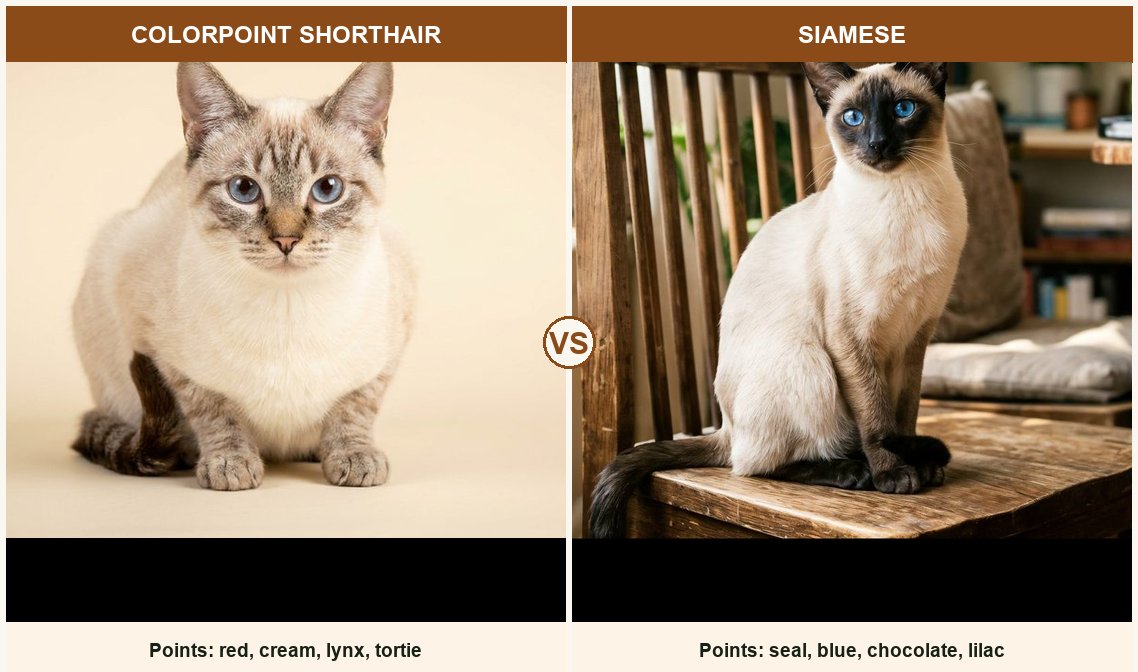
The short answer: Siamese are restricted to seal, blue, chocolate, and lilac points. Colorpoint Shorthairs are the same cat in red, cream, lynx, or tortie points. A tabby-striped face mask or a red or cream-colored point means Colorpoint Shorthair, never Siamese.
Quick Comparison
| Trait | Colorpoint Shorthair | Siamese |
|---|---|---|
| Size | Medium | Medium |
| Weight | 6–10 lbs (2.7–4.5 kg) | 6–10 lbs (2.7–4.5 kg) |
| Lifespan | 12–20 years | 12–20 years |
| Origin | United States (1940s–60s) | Thailand (formerly Siam) |
| Temperament | Extremely vocal, Intensely people-oriented | Extremely vocal and communicative, Highly affectionate and people-oriented; hates being left alone |
| Known Health Risks | Hepatic amyloidosis · Progressive retinal atrophy (PRA) | Progressive retinal atrophy (PRA) · Asthma and bronchial disease |
Visual Differences
Telling a Colorpoint Shorthair from a Siamese
Siamese are restricted to seal, blue, chocolate, and lilac points. Colorpoint Shorthairs are the same cat in red, cream, lynx, or tortie points. A tabby-striped face mask or a red or cream-colored point means Colorpoint Shorthair, never Siamese.
Colorpoint Shorthair Key Markers
- Color-point pattern in non-traditional colors — seal, blue, chocolate, and lilac points are Siamese territory; Colorpoint Shorthairs add red, cream, lynx (tabby), and tortie points in the same four base colors, 16 accepted combinations total
- Vivid blue, almond-shaped eyes — the same sharp, consistent blue as the Siamese, required in all point colors
- Long, tapering wedge head with a straight profile and large, wide-set ears that continue the wedge lines
Siamese Key Markers
- Color-point pattern: pale body with darker ears, face, paws, and tail
- Vivid blue, almond-shaped eyes
- Short, fine coat that lies close to the body
Is a Colorpoint Domestic Shorthair the Same as a Siamese?
No. Colorpoint domestic shorthair is a shelter description of a coat pattern, and Siamese is a breed with a written standard. A cat can wear the pointed pattern and still be a mixed-breed cat. In most cases, that is exactly what it is.
The colorpoint allele is common in the general cat population. It pales the body and darkens the ears, face, paws, and tail. Siamese breeders built a breed around that gene. They did not invent it, and pointed kittens keep turning up in ordinary litters.
Four checks do most of the work.
- Head shape. A Siamese head is a long tapering wedge, with a straight line from forehead to nose tip. A pointed domestic shorthair usually has a rounder, wider head and a visible stop where the forehead meets the nose.
- Body. Siamese are svelte and tubular, on long legs, with a long tapering tail. A mixed-breed cat tends to run shorter in the body and heavier in the leg.
- Coat. The Siamese coat is short, fine, and glossy. It lies flat and carries almost no undercoat. Most domestic shorthairs feel denser in the hand.
- Papers. The Colorpoint Shorthair has been its own CFA breed since 1964. A shelter tag reading colorpoint domestic shorthair describes what the cat looks like, not what it descends from.
Point color will not settle it. Siamese are limited to seal, blue, chocolate, and lilac. A pointed cat from a mixed litter can also show red, cream, lynx, or tortie points, and those colors appear in cats with no Siamese pedigree at all.
For the breed standard itself, the Siamese profile covers the wedge, the ear line, and the blue almond eyes. For lookalikes on real cats, how to tell a Siamese mix walks the same markers.
Not Sure Which Breed Your Cat Is?
Upload a photo to Furriq's breed identifier and let AI check 40+ visual markers in seconds, no sign-up, no storage.
Temperament & Personality
Colorpoint Shorthair
- Extremely vocal — talks constantly in the loud Siamese voice and answers when spoken to
- Intensely people-oriented — follows owners, greets at the door, and hates being left alone
- Highly intelligent — opens doors, learns tricks, and solves puzzle feeders
- Active and playful — jumps, climbs, and stays kittenish into its teens
- Social with other pets but demands human attention above all
- Sensitive to cold — the short single coat offers little insulation
Siamese
- Extremely vocal and communicative — will "talk" to owners constantly
- Highly affectionate and people-oriented; hates being left alone
- Intelligent, curious, and known for opening cabinets and doors
- Social with other pets but demands human attention above all
- Active and playful throughout life
Health Notes
Colorpoint Shorthair
- Hepatic amyloidosis — a hereditary condition causing amyloid protein deposits in the liver, shared with Siamese lines; unexplained weight loss with a normal appetite is the early sign
- Progressive retinal atrophy (PRA) — a genetic retinal degeneration that starts with night blindness and progresses over years; DNA testing available and recommended before breeding
- Asthma and bronchial disease — a higher incidence of airway sensitivity than most cats, inherited from Siamese ancestry; coughing or wheezing warrants a vet visit
- Dental disease — the long narrow muzzle crowds the teeth and raises gingivitis and tooth resorption risk; regular dental care recommended
- Anesthesia sensitivity — svelte breeds with low body fat need a careful anesthetic protocol; pre-anesthetic bloodwork is essential before any surgery
Siamese
- Progressive retinal atrophy (PRA) — an inherited eye disorder
- Asthma and bronchial disease — more common in Siamese than other breeds
- Amyloidosis — a liver disease with genetic predisposition
- Dental issues — prone to gingivitis and tooth resorption
- Sensitivity to anesthesia — discuss with your veterinarian
This information is for educational purposes only. Always consult a veterinarian for health advice specific to your cat.
Frequently Asked Questions
How can I tell a Colorpoint Shorthair apart from a Siamese?
Are Colorpoint Shorthair cats hypoallergenic?
Are Siamese cats hypoallergenic?
Breed Profiles & More Comparisons
Colorpoint Shorthair
A Siamese in colors the Siamese standard does not allow. Same wedge head, same vivid blue eyes, same talkative personality, but the points come in red, cream, lynx, and tortie shades. The CFA recognized the Colorpoint Shorthair as its own breed in 1964 to give the non-traditional point colors a ring of their own.
Siamese
One of the oldest and most recognizable cat breeds, the Siamese is famous for its striking color-point pattern, vivid blue almond-shaped eyes, and vocal, people-oriented personality.
Have a photo of your cat handy?
One clear photo runs a free quality check in your browser. The full AI report adds breed clues, 40+ visual markers, health notes, and follow-up questions for a one-time $5.99. No account needed, and your photo is never stored.
Scan my cat's photo