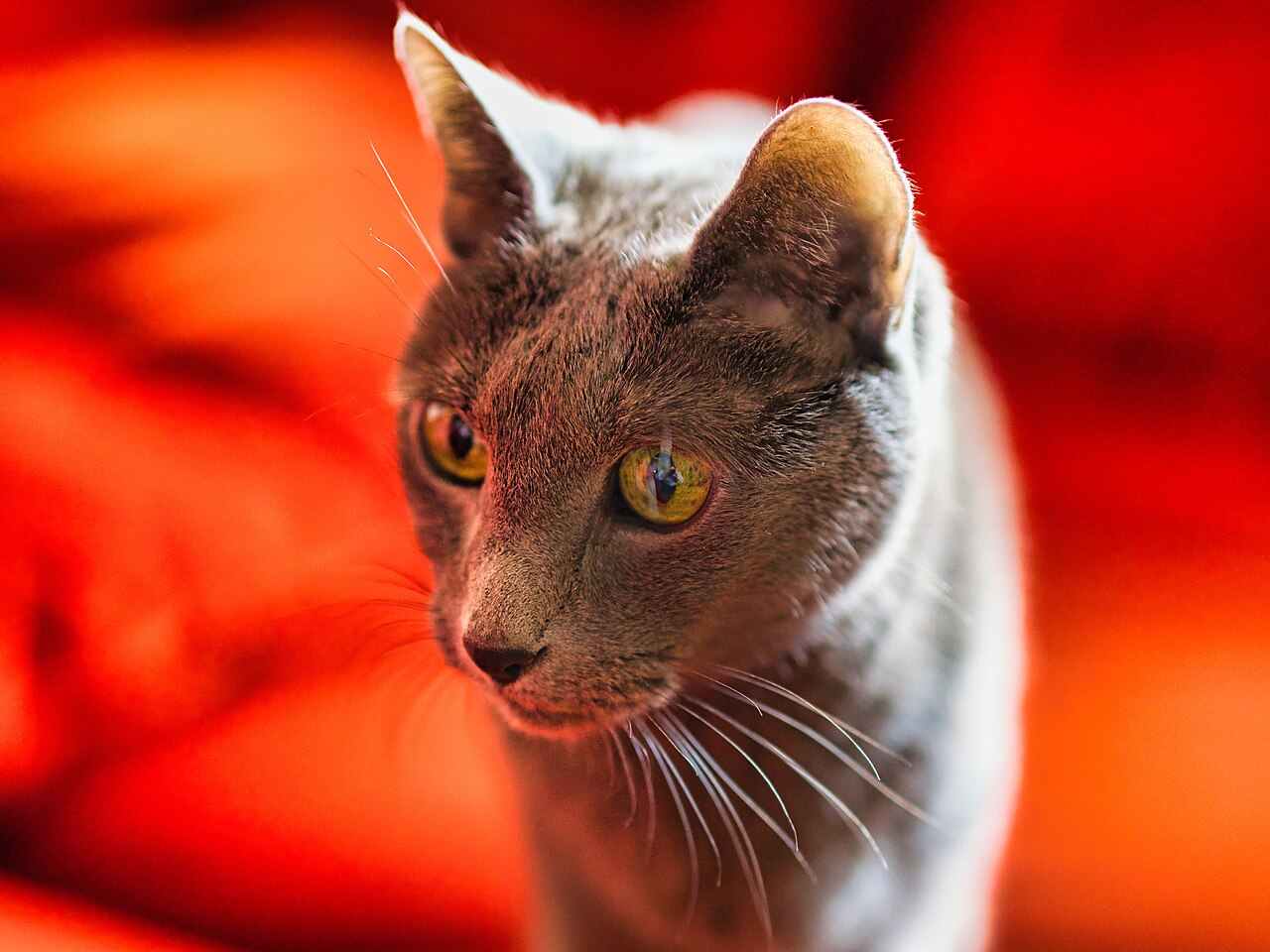

Four breeds wear a blue-gray coat, and that single shared color causes a decade of misidentification. Ask for "cats similar to Chartreux" and the same trio appears: Russian Blue, British Shorthair, and Korat. All four are blue-gray. All four carry silver-tipped hairs that make the coat glow. The fastest separation is not color at all, it is eye color and coat texture. Two of these breeds have green eyes. The Chartreux does not.
The Chartreux Baseline
Before comparing, pin down the Chartreux itself. A robust, muscular French breed running 7 to 17 lbs, with males dramatically heavier-boned than females. The coat is medium-short and slightly woolly, a resilient double layer that breaks like sheepskin at the neck and flanks, the texture people describe as lamb-like. The head is rounded and broad but, per the CFA standard, not a sphere: a high contoured forehead, a straight nose with only a slight stop, and a comparatively small, narrow, tapered muzzle that produces the breed's famous smiling expression. The eyes are rounded and open, in rich copper to deep brilliant orange, and that eye color is fixed: a green-eyed blue cat is not a Chartreux. Ears are medium, set high, and carried erect. Personality is quiet to the point of near-silence, some Chartreux are effectively mute, combined with a dog-like streak: they learn to fetch, walk on a leash, and come when called. A blue-gray cat with orange eyes, a woolly coat, and a smiling face is the target.
Russian Blue: The Green-Eyed Elegant One
The Russian Blue shares the blue-gray color and the silver-tipped shimmer, then the bodies diverge. The Russian Blue is svelte and elongated, a foreign-type frame on long legs at 7 to 12 lbs, with a wedge-shaped head, a flat skull, and a long straight nose. The Chartreux is stockier and rounder-headed, with males substantially heavier. Coat texture differs the same way: the Russian Blue's plush double coat is silky and fine, standing slightly away from the body, while the Chartreux coat is woolly and breaks like sheepskin. And the eyes settle it on sight. Russian Blues have vivid, emerald green almond eyes, a color the Chartreux never carries. Temperament splits too: the Russian Blue is reserved and gentle with a soft voice, while the Chartreux is the near-silent one with dog-like fetch games. A slim, green-eyed, blue-gray cat is a Russian Blue. See our Chartreux vs Russian Blue comparison.
British Shorthair: The Plush Heavyweight
The British Shorthair in its blue form, the British Blue, is the most frequent Chartreux stand-in because both breeds are big, round, and blue-gray. The head shape separates them. British Shorthairs have a spherical head with full cheeks, a visible stop between forehead and nose, and a defined whisker break; Chartreux heads are more trapezoid than sphere, with a straight nose and a narrow tapered muzzle. The coats differ in hand: the British coat is dense plush that stands away from the body like thick velvet, while the Chartreux coat is woollier and breaks in sheepskin-like ridges. Size overlaps at 9 to 18 lbs for the British versus 7 to 17 lbs for the Chartreux, but the British is cobby and short-legged where the Chartreux is robust yet surprisingly supple. Eye color gives a second confirmation: British Blues run copper or gold, not the deep orange the Chartreux standard prefers. A round-cheeked, plush, short-legged blue cat is a British Shorthair. See our British Shorthair vs Chartreux comparison.
Korat: The Heart-Shaped Small One
The Korat is the least known of the four blue breeds and the easiest to rule out on size. Korats run 6 to 10 lbs, compact and fine, against the Chartreux's sturdy 7 to 17 lbs. The head is the signature: the Korat forms a heart shape when viewed from the front, with the width across the eyebrows as the top curves and the muzzle tapering to the point, and it holds large, luminous peridot-green eyes that look oversized for the face. The Chartreux head is rounded with a narrow muzzle, never heart-shaped, under copper to orange eyes. Coat texture differs too: the Korat's is a short, fine single coat lying flat with silver tipping, where the Chartreux wears a woolly double coat that breaks like sheepskin. And the Korat lacks the Chartreux's smiling expression entirely. A small, heart-headed, green-eyed blue cat is a Korat. See our Chartreux vs Korat comparison.
Side-by-Side Comparison
| Breed | Size | Coat | Head Shape | Eyes | Personality |
|---|---|---|---|---|---|
| Chartreux | 7-17 lbs | Woolly double coat, sheepskin break | Rounded, tapered muzzle, smiling look | Copper to deep orange | Near-silent, dog-like, plays fetch |
| Russian Blue | 7-12 lbs | Silky plush double coat, silver-tipped | Wedge, flat skull, long straight nose | Vivid emerald green | Reserved, gentle, quiet |
| British Shorthair | 9-18 lbs | Dense plush, stands away from body | Spherical, full cheeks, visible stop | Copper or gold | Calm, easygoing, undemanding |
| Korat | 6-10 lbs | Fine single coat, flat-lying, silver-blue | Heart-shaped from the front | Luminous peridot green, oversized | Alert, people-bonded, playful |
Still Not Sure?
Green eyes on a slim foreign-type body point to the Russian Blue. Full cheeks, a plush coat, and short legs point to the British Shorthair. A heart-shaped head and a 6 to 10 lbs frame point to the Korat.
Still not sure after reading all that?
You just spent several minutes learning what makes each breed different. A photo scan does the same check in 10 seconds, 40+ visual markers, side-by-side breed scores, and a plain-English breakdown. No sign-up, photo never stored.
🐱 Scan a photo nowFAQ
What cat breed looks most like a Chartreux?
The British Shorthair, especially in its blue form. Both are large, round-headed, blue-gray breeds with dense coats, and casual observers mix them up constantly. The best tells: the British Shorthair has a spherical head with full cheeks and a visible stop, a plush coat like thick velvet, and copper or gold eyes, while the Chartreux has a narrower tapered muzzle, a woolly sheepskin-like coat, and deep orange eyes.
Can a Chartreux have green eyes?
No. The Chartreux standard is explicit: the eyes range from copper to deep, brilliant orange, and green disqualifies. Every green-eyed blue-gray cat belongs to a different breed, most often the Russian Blue with its emerald green almond eyes or the Korat with its luminous peridot green. If eye color is hard to judge, check the coat instead: the Chartreux is the only one of the four with a woolly double coat that breaks like sheepskin.
Why is the Chartreux called the smiling cat?
The head structure creates it. The Chartreux combines a rounded, broad skull with a comparatively small, narrow, tapered muzzle and a straight nose, and that contrast curves the mouth line upward into what breeders call the smile. The other blue breeds lack it: the Russian Blue's flat skull and wedge shape, the British Shorthair's full spherical cheeks, and the Korat's heart-shaped head all produce different expressions.
How do I tell a blue-gray domestic shorthair from a real Chartreux?
Weight and texture first. A true Chartreux is a robust, heavy-boned 7 to 17 lbs cat, with males dramatically larger, wearing a woolly double coat that breaks into sheepskin-like ridges at the neck. Random-bred blue cats usually have a flat-lying sleeker coat and a lighter frame. Then confirm the fixed points: copper to orange eyes, a tapered muzzle with the smiling expression, and the near-silent personality, since many Chartreux communicate through body language and chirps instead of meows.
Related breeds
All breedsChartreux
A sturdy blue-gray cat from France with a woolly double coat, copper-gold eyes, and a quiet, dog-like personality. Chartreux are known for their "smiling" expression, lightning-fast reflexes, and rare voice — one of the oldest natural breeds, prized since medieval times for their hunting ability.
Russian Blue
A blue-gray short-hair with a shimmering silver sheen and vivid green eyes. Russian Blues are reserved with strangers but deeply affectionate with their own people — quiet, gentle, and sensitive. The breed’s double coat stands up from the body, giving the cat a plush, velvety feel that cat breeders call "the smile under the hand."
British Shorthair
A sturdy, round-faced cat with a dense plush coat and a calm, undemanding personality. The British Blue — a solid blue-gray coat with copper eyes — is the breed’s most recognized look, but British Shorthairs come in many colors and patterns.
Korat
A blue-gray cat from Thailand with a heart-shaped face, luminous green eyes, and a silver-tipped coat that shimmers like rain clouds. The Korat is one of the oldest naturally occurring cat breeds, cherished in Thailand as a "good luck cat" for centuries. Intelligent, loyal, and sensitive, Korats form deep bonds with their families and dislike living in homes where people are gone for long hours.
Keep reading
All articlesBreeds
Cats That Look Like Norwegian Forest Cats: 3 Look-Alikes Compared
Maine Coon, Siberian, or Ragdoll? Compare the 3 large longhaired breeds most often confused with the Norwegian Forest Cat: coat layers, head shape, and size side by side.
9 min read
Breeds
Cats That Look Like Abyssinians: 3 Look-Alikes Compared
Somali, Bengal, or Siamese? Compare the 3 breeds most often confused with the Abyssinian: ticked coats, wild markings, and athletic builds side by side.
8 min read
Breeds
Cats That Look Like Scottish Folds: 3 Look-Alikes Compared
American Curl, Highland Fold, or British Shorthair? Compare the 3 breeds most often confused with the Scottish Fold: ear shape, head shape, and coat side by side.
8 min read
Still not sure what your cat is?
Stop guessing from photos and text. Upload one clear photo and the AI checks 40+ visual markers in seconds. Free, no sign-up, and your photo is never stored.
🐱 Free cat breed scan